What Is the Rainiest Month in Slovenia?
September and October tie as the rainiest months in Ljubljana at 147 mm each, ahead of July. The full monthly breakdown, why the measuring period matters, and what to do when it rains.
What Is the Rainiest Month in Slovenia?
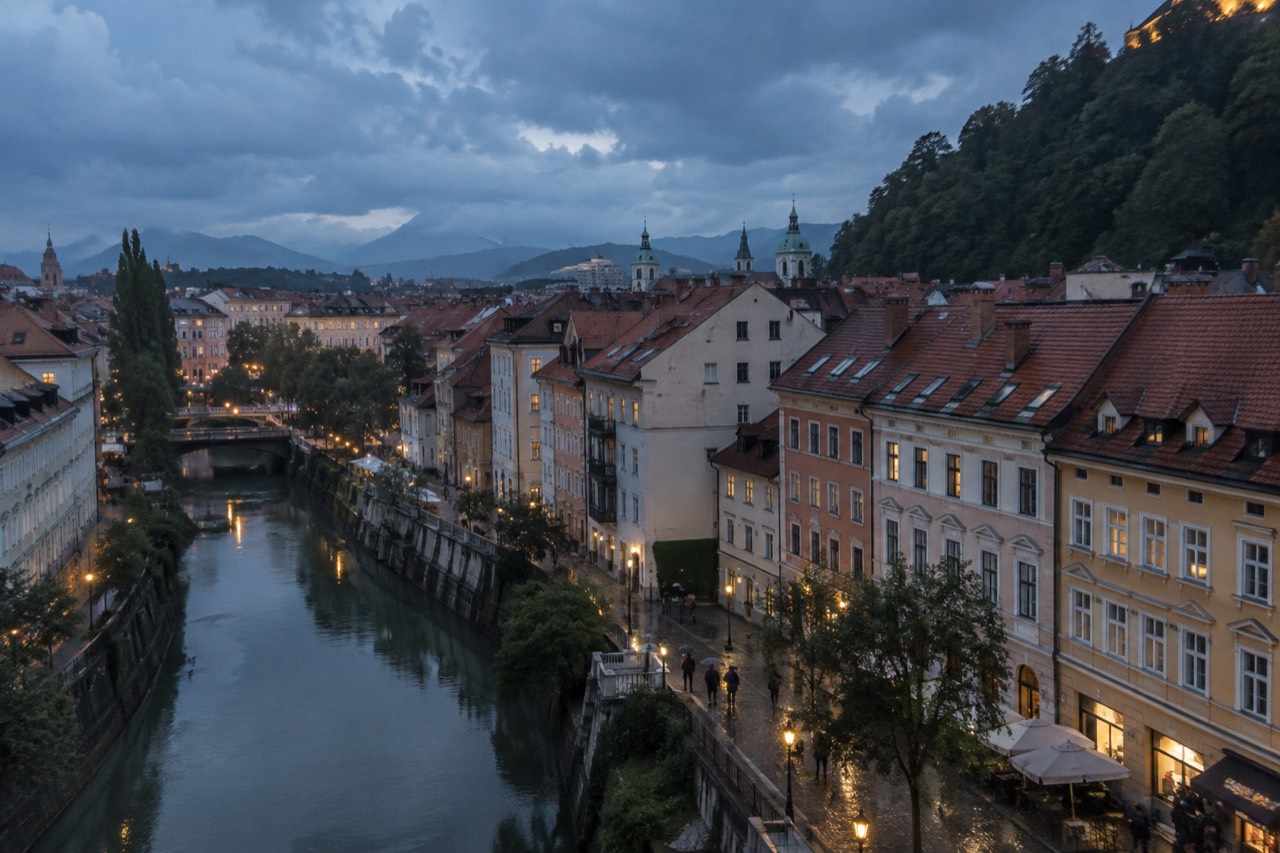
September and October tie as the rainiest months in the country's published capital-city series: Ljubljana records 147 mm of precipitation in each, ahead of July's 115 mm, according to ARSO's 1981-2010 climate normals. Most people assume the peak falls in summer or midwinter, but the early-autumn shoulder is the wettest stretch of the Slovenian year.
The figure comes from Slovenia's national weather and climate service, ARSO, measured at the Bežigrad station in central Ljubljana at 299 metres. It is the country's longest and most complete precipitation record, which is why the question "rainiest month in Slovenia" is really answered with the Ljubljana series. The two autumn months sit level at 147 mm, and the annual total across the year is 1362 mm, spread over 153 days with at least a little measurable rain.
That last number is the one worth sitting with. It rains somewhere in the capital, at least a little, on roughly every second or third day of the year. Slovenia is not a dry country. The Julian Alps to the north-west are wetter still, and the Mediterranean coast around Piran is drier, so the capital's series is a middle path through a country with genuinely varied climates for somewhere so small.
The surprise for most visitors is that the wettest months are not the grey ones. Nobody plans a trip around September rain. The summer crowds have gone, the lake water is still warm, and the prices have dropped, which is exactly why the rainfall catches people out. The tables below show the full picture.
How Much Rain Does Ljubljana Actually Get Each Month?
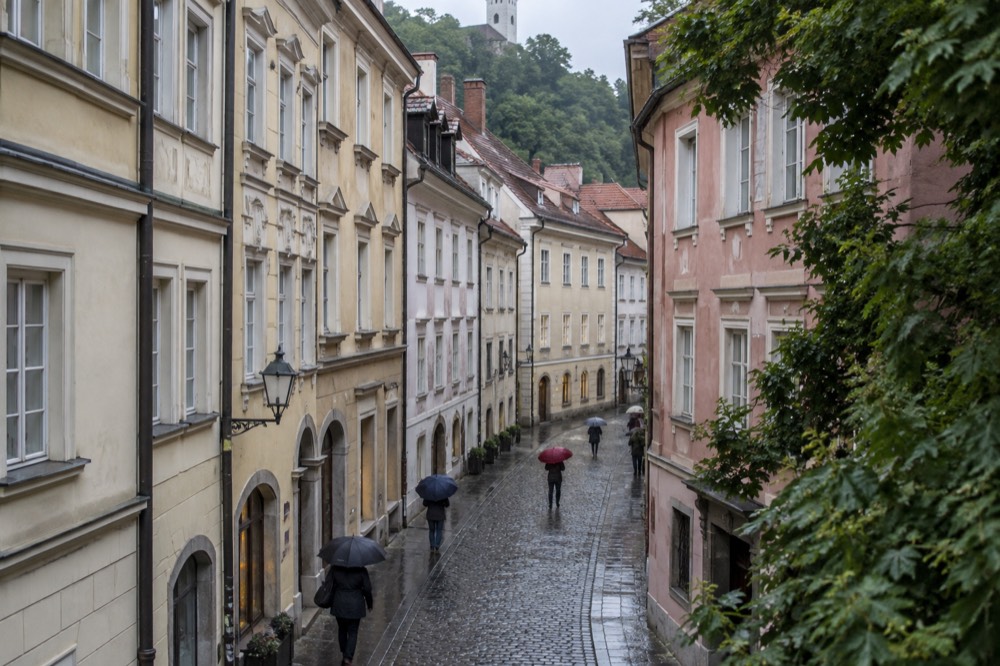
Ljubljana averages 1362 mm of rain a year, and the monthly curve peaks twice: a long climb through spring to a June plateau, a July dip, then the true maximum in September and October at 147 mm each. November stays wet at 129 mm before the winter months fall back to between 69 and 107 mm.
ARSO's 1981-2010 normals for the Bežigrad station give the full monthly series. The count of rain days matters as much as the totals, because 147 mm falling across 12 or 13 days is a different experience from the same water arriving in two storms.
| Month | Precipitation (mm) | Days with rain |
|---|---|---|
| January | 69 | 11 |
| February | 70 | 9 |
| March | 88 | 11 |
| April | 99 | 14 |
| May | 109 | 14 |
| June | 144 | 15 |
| July | 115 | 12 |
| August | 137 | 12 |
| September | 147 | 12 |
| October | 147 | 13 |
| November | 129 | 14 |
| December | 107 | 14 |
The pattern is not what most of Europe follows. Ljubljana sits in a basin at the meeting point of Alpine, continental and Mediterranean influences, and the autumn maximum comes from that mix. Warm, moist air from the Adriatic keeps pushing north-east into Slovenia while the first cold air starts pooling in the basin, and the collision shows up as the September and October totals. June's 144 mm, only 3 mm behind the peak, is the thunderstorm contribution.
If you are weighing this against a trip plan, the practical reading is that June through November is reliably wet, with 115 mm or more every month. February is the driest month on the table at 70 mm, though it buys that with grey skies rather than sunshine. The full seasonal picture, including sunshine and temperatures, is covered in the best time to visit Ljubljana, and the month-by-month comparison lives in the best month to visit guide.
The rain also changes what is worth booking. A wet day in the capital is a poor day for the castle viewing tower but a perfect day for the caves, which is why the wet-weather roster matters here.
Does the Answer Change Depending on the Measuring Period?
Yes, and this is the detail most summaries get wrong. ARSO's older 1971-2000 normals put June as the wettest month at 154 mm, while the newer 1981-2010 series puts September and October first at 147 mm each. The two reference periods are both official, both correct for their own 30-year window, and must never be mixed in one sentence.
Climate normals are 30-year averages, and when the window shifts, the ranking shifts with it. The 1981-2010 series is the more recent and the one this site uses throughout, but the 1971-2000 tables are still published and still circulate online, which is why you will find June quoted as the rainiest month in some places and September or October in others. Both statements were true for the period they describe. The annual totals differ too: 1362 mm in the newer series against 1368 mm in the older one, and annual sunshine differs by more, 1974 hours against 1798.
| Series | Wettest month | Wettest total | Annual total |
|---|---|---|---|
| 1981-2010 (this site's standard) | September and October, level | 147 mm | 1362 mm |
| 1971-2000 | June | 154 mm | 1368 mm |
The honest answer to the title question is therefore: September and October on the current published series, with June as the record holder if you measure over the older window. What does not change between the two is the underlying character of the country. Slovenia is wet at the shoulder of autumn on any measure, and the basin geography that traps the rain also traps something else, which is the fog that arrives with it.
Because a rainy day is also a foggy day in this city, the practical fallback matters. The Postojna Cave and Predjama Castle tour is the standard answer: the cave holds roughly the same temperature year round, about 10 degrees Celsius, so the weather above ground is irrelevant to the experience. The trip runs about 6 hours from Ljubljana and the operator's live listing carries the current departure details.
Is the Rainiest Month Also the Foggiest?
It very nearly is. ARSO's 1971-2000 series, the only period for which fog is published, gives September and October 12.4 fog days each, level with December's 12.6 and above January's 11.3. The wettest two months of the year are also among the foggiest, at 91.2 fog days annually.
This is the fact that most guides to Slovenia miss, because everyone writes that Ljubljana is a winter fog city. The numbers say the early-autumn shoulder is just as bad. September is also the most humid morning of the year at 94 percent relative humidity at 07:00, ahead of October at 93 and January at 90. The rain, the fog and the grey are all one phenomenon: the basin inversion, where cold air pools on the valley floor under warmer air above and the city sits under its own cloud while the hills a few hundred metres up are in sunshine. The full index of guides sits on Ljubljana Travel Guide.
The consequence for a visitor is concrete. On a September or October morning the forecast may say 16 degrees and partly cloudy while the city centre sits in grey murk at 11. The viewing points above the basin, Šmarna gora, the castle hill, Rožnik, can be in clear sun at the same moment. The rainy day guide to Ljubljana covers the indoor fallbacks, and the inversion itself is explained in the Ljubljana in December guide, where the effect is at its strongest.
The sunshine table makes the same point from the other direction. Ljubljana records 183 sunshine hours in September and 120 in October, against 293 in July. October averages a single clear day for the whole month, and November matches it. A wet-weather plan is not pessimism here, it is the base case for a third of the year.
What Should You Actually Do When the Rain Arrives?
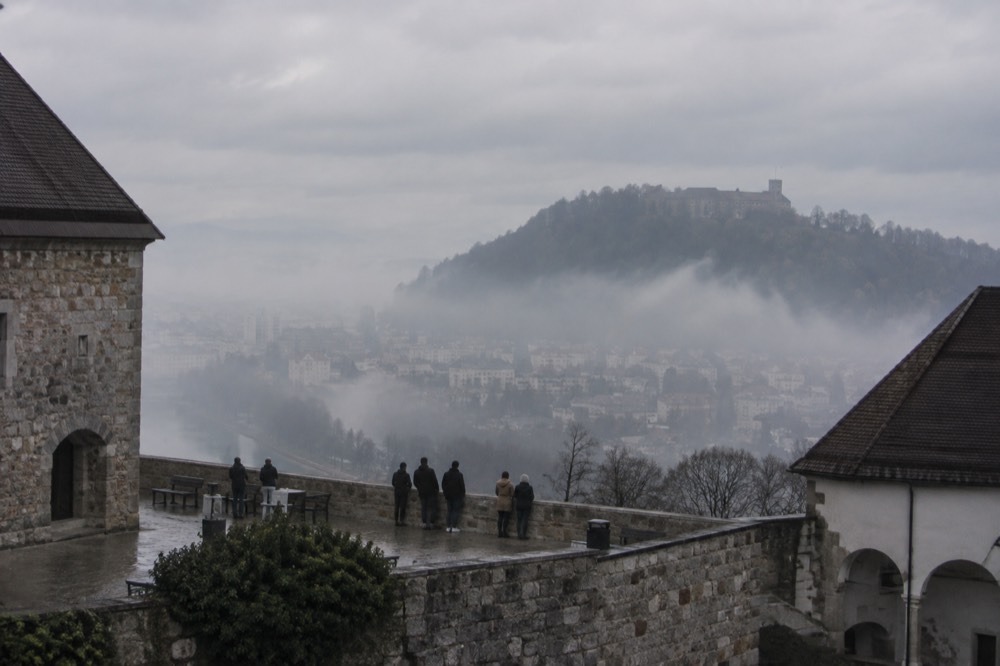
The reliable answers are the caves, the covered market halls, the museums and the river boats, in roughly that order. Postojna Cave holds about 10 degrees Celsius all year regardless of the weather above, the national museums are free on the first Sunday of every month, and the Ljubljanica boats run all year from sheltered piers.
The cave answer deserves its emphasis because it is the only major attraction in the country that is genuinely weather-proof. Postojna's published visitor route is 3.7 km, partly by the underground train, with tours of about an hour and a half. The temperature never moves, which makes it as good an answer to a July heatwave as to an October downpour. Škocjan Caves, the UNESCO-listed alternative, holds about 12 degrees and is a walking route of roughly 400 stairs rather than a train ride, so it suits the more energetic.
Inside the city, the practical list is short and solid. The Central Market's covered halls run Monday to Friday, so a wet Saturday sends you to the outdoor stalls' neighbours indoors or to a café. The national institutions close on Mondays almost without exception, which is the planning fact people forget. The Ljubljana Card guide runs the value comparison if museums are the backbone of your wet day, since the card covers the castle funicular, the river cruise and more than thirty museums on one pass.
One seasonal trap deserves its own warning. The Open Kitchen food market on Pogačarjev trg runs on Fridays, roughly March to November, and the official wording is "every sunny Friday". That is literal: the market is cancelled in bad weather, and September and October are its wettest Fridays of the season. Do not build the one rainy-day plan around it without a forecast check. The tourist board's Open Kitchen page states the cancellation policy plainly.
The Postojna Cave and Predjama Castle tour remains the strongest single booking for a wet day, combining the weather-proof cave with the cliff castle that is dramatic in exactly the moody conditions an autumn front brings.
Does the Rest of the Country Match Ljubljana?
No. Slovenia packs Alpine, continental and Mediterranean rainfall regimes into a small area, so the capital's September and October peak is not a national constant. The north-west around the Soča Valley and Triglav is the wettest corner of the country, while the coast around Piran and Koper is markedly drier, and the north-east is the driest of all.
The published, verified series this site can stand behind is the Ljubljana one, and the honest position is that the capital's numbers are the best proxy for the country's most-visited region. What the visitor needs to know is the direction of the differences. A rainy week in Ljubljana is usually a rainy week in Lake Bled and the Julian Alps, and usually wetter there, because the mountains force the same air upward. The same week can be dry on the coast, two hours south-west.
That geography is why the question in the title has a slightly slippery answer. If you are staying in Ljubljana or Bled, plan around September and October. If your trip is Piran and the coast, the peak risk shifts later and lighter. The day trips guide shows how close these different climates sit to each other, which is the real point: on a wet morning in the basin you can be in a drier sky within an hour's drive.
Common Questions About Rain in Slovenia
What Is The Rainiest Month In Slovenia?
September and October, which tie at 147 mm of precipitation each in Ljubljana on ARSO's 1981-2010 climate normals, ahead of July's 115 mm. On the older 1971-2000 series, June was the wettest month at 154 mm.
Does it rain more in Slovenia than in the rest of Europe?
Ljubljana's annual total is 1362 mm across 153 rain days, which is high for an inland capital. No verified primary source compares it directly with another European capital, so the comparison should not be stated as fact.
Which is the driest month?
February, at 70 mm in the 1981-2010 series, narrowly ahead of January's 69 mm. The two midwinter months are the driest, though they are also among the greyest.
Is the rainiest month also the foggiest?
Nearly. ARSO's 1971-2000 series gives September and October 12.4 fog days each, level with December's 12.6 and above January's 11.3. The city averages 91.2 fog days a year.
What is the best thing to do in Ljubljana on a rainy day?
Postojna Cave, which holds about 10 degrees Celsius all year, is the weather-proof answer and runs as a day trip from Ljubljana. In the city, the covered market halls, the museums and the Ljubljanica boats are the standard fallbacks.
Does the whole country share Ljubljana's rainfall pattern?
No. The Julian Alps in the north-west are wetter, the coast around Piran is drier, and the north-east is the driest region. The capital's series is the best published proxy for the most-visited part of the country.