What Is the Best Way to Get to Ljubljana?
How to reach Ljubljana by plane, train, car or coach, with the airport transfer explained and the seasonal fog fact most guides miss.
What Is the Best Way to Get to Ljubljana?
The best way to get to Ljubljana is to fly into Ljubljana Airport, about 26 km from the city, if you are coming from beyond central Europe. If you are already in Vienna, Graz, Zagreb, Budapest or the Italian cities, the train is often the better choice, and the car only makes sense when the Alps are the point of the trip.
Ljubljana is a small capital with unusually good positioning. It sits between Vienna, Venice, Zagreb and Budapest, and Slovenia has been inside the Schengen area since land and sea border checks were lifted on 21 December 2007, with air checks following on 30 March 2008. There are no routine border checks arriving from Austria, Italy, Hungary or Croatia, and no currency to change anywhere in the country, because Slovenia adopted the euro on 1 January 2007.
That geography is why the honest answer to this question is a comparison rather than a verdict. A traveller landing from London faces a different calculation to a family driving down from Salzburg. This page walks through each option with the real numbers, then covers the [airport transfer](https://tpk.ro/o5VLPVUy), which is the part of the journey people most often get wrong.
The city you arrive into matters too. The historic centre is pedestrianised, a car-free zone of roughly 20 hectares, so a car is a liability for the final kilometre even when it wins the long drive. More detail on that in the Ljubljana city centre area guide.
Is Flying the Fastest Way to Reach Ljubljana?
Flying is the fastest option from Britain, Ireland, the Low Countries and most of western Europe, with Ljubljana Airport sitting about 26 km north of the city. The airport is small, which cuts both ways: transfers are quick, but the route network is thinner than Vienna's or Zagreb's, so some journeys route through a hub.
The airport, formally Jože Pučnik Airport at Brnik, handles a modest number of carriers. Its size is a genuine advantage on arrival: baggage appears quickly and the walk from gate to kerb is short. The trade-off is frequency. Some travellers fly to Zagreb, Venice or Trieste and cross the border by land, which is seamless inside Schengen but adds hours of ground time.
The airport bus into the city exists, but its timetable and fare are not published in any readable form, so check the airport's own site before travelling rather than trusting a secondhand number. A taxi or pre-booked transfer covers the 26 km quickly. The full transfer comparison, including what the bus does and does not promise, is in the Ljubljana Airport to city centre guide.
If you are still choosing airports, the flights to Ljubljana guide compares the routes season by season.
Can You Reach Ljubljana by Train?
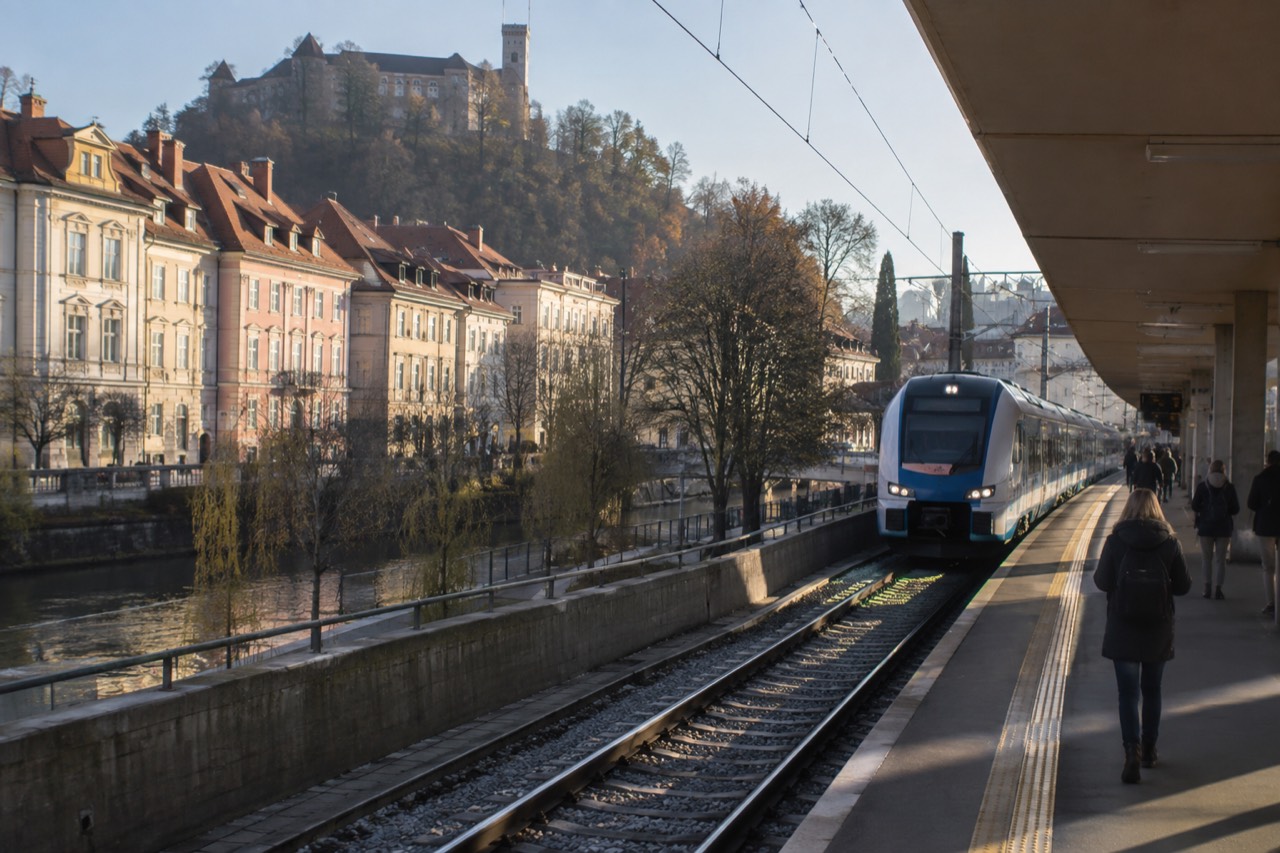
Yes, and for many travellers the train is the best way to get to Ljubljana. Direct services connect the city with Vienna, Graz, Zagreb, Budapest and the Italian border at Gorizia, and the station sits at the northern edge of the centre, a flat 15 minute walk from Prešeren Square.
The rail option rewards anyone starting inside central Europe. The Vienna train in particular is a proper long-distance service, and the Zagreb run is short now that Croatia joined Schengen and the euro on 1 January 2023, making it an internal journey with no border formalities at all. From Trieste the crossing is similarly invisible.
What the train cannot do is serve the coasts of Europe quickly. There is no high-speed line into Slovenia, so journeys from Germany or France involve a night or a chain of regional trains. For those origins, flying wins.
The station itself is functional rather than beautiful, but its position is excellent. Arrival logistics, left luggage and the walk into town are covered in the Ljubljana train station guide, and onward routes are listed in trains from Ljubljana.
Is Driving to Ljubljana a Good Option?
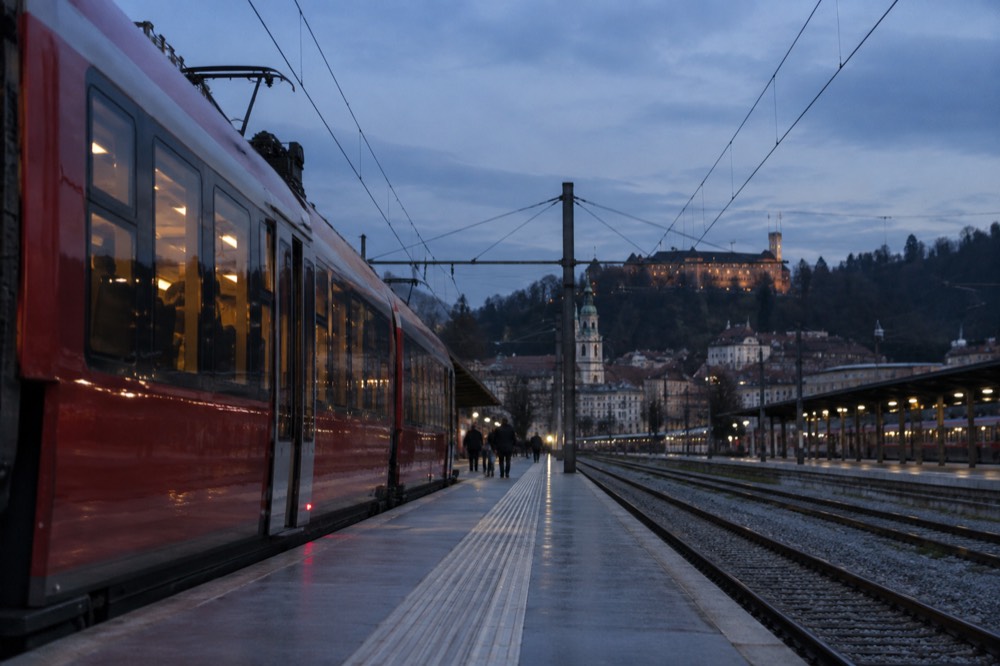
Driving is the best way to get to Ljubljana only when the journey itself is the destination. If the route runs through the Alps, the Karst or the Adriatic coast, the car earns its cost. If the plan is city only, the car becomes a burden, because the centre is pedestrianised and parking sits outside it.
Slovenia's motorways are fast and tolled, and vignettes are bought before joining them. The border crossings from Austria, Italy, Hungary and Croatia are open internal Schengen crossings, so there are no checks to plan around, only traffic.
The catch is the last mile. The historic centre has been closed to general motor traffic in stages since 2007, so drivers park in the garages at the edge of the pedestrian zone and walk in. That is a small friction, not a dealbreaker, but it means a hire car sitting unused for three days is pure cost. Anyone planning day trips to Bled, the Soča Valley or the coast should read the where to stay in Ljubljana guide with parking in mind.
How Do You Get from Ljubljana Airport to the City Centre?
Ljubljana Airport is about 26 km from the city centre, and the transfer takes under half an hour by taxi or pre-booked transfer. An airport bus runs into the city, but the fare and timetable are not published in a form this site could verify, so confirm times on the airport's own site before relying on it.
This is the one leg where printed guidebooks go wrong most often, because airport transfer details change and thirdhand numbers circulate for years. The distance and the general shape of the transfer are solid facts. The fare is not, and this site does not print numbers it could not source.
A pre-booked private transfer is the low-stress option after a late flight, and the coach stand outside the terminal handles the budget end. The full comparison, including how the transfer fits an arrival day plan, is in the Ljubljana Airport to city centre guide.
| Option | Best for | Watch out for |
|---|---|---|
| Fly to LJU, transfer by taxi | Speed from western Europe | Thinner route network than Vienna or Zagreb |
| Train from Vienna, Graz, Budapest, Zagreb | Comfort from central Europe | No high-speed lines into Slovenia |
| Car via the Alpine routes | Journeys where the drive is the point | Pedestrianised centre, parking outside it |
| Fly to Zagreb, Venice or Trieste, cross by land | Cheaper fares from some origins | Adds several hours of ground travel |
Do You Need a Visa or a Currency Change for Ljubljana?
Most European travellers need neither. Slovenia is in the European Union, the eurozone and the Schengen area, so there are no routine border checks from Austria, Italy, Hungary or Croatia, and the currency is the euro everywhere. Non-EU visitors need a Schengen visa, which is the same document that covers the rest of the zone.
The euro arrived on 1 January 2007, and Schengen membership followed on 21 December 2007 for land and sea borders, with airports joining on 30 March 2008. The Slovenian government states the two-date structure plainly, and it is the detail most often garbled: air borders did not open on the same day as land borders. Croatia's accession on 1 January 2023 closed the last gap on the western Balkan side.
Practically, this means an arrival from anywhere in the zone is domestic in feel. No currency exchange, no border queue, no [roaming](https://airalo.tpk.ro/YlHC3OOn) charges. The only planning left is the transfer from the airport or the walk from the station, which is why the sections above spend more words on those than on formalities.
When Is the Best Time of Year to Arrive in Ljubljana?
The best arrival window is April to June, when the city averages 178 to 246 sunshine hours a month and the crowds have not peaked. September and October look like a pleasant shoulder season on paper but are actually the joint wettest months at 147 mm of rain each, and the foggiest months of the entire year.
That last fact is the one almost every guide gets wrong. ARSO's 1971-2000 climate normals give Ljubljana 12.4 days of fog in September and 12.4 again in October, level with December's 12.6 and ahead of January's 11.3. The same city averages 91.2 fog days a year, because it sits on the floor of a basin where cold air gets trapped under warmer air above.
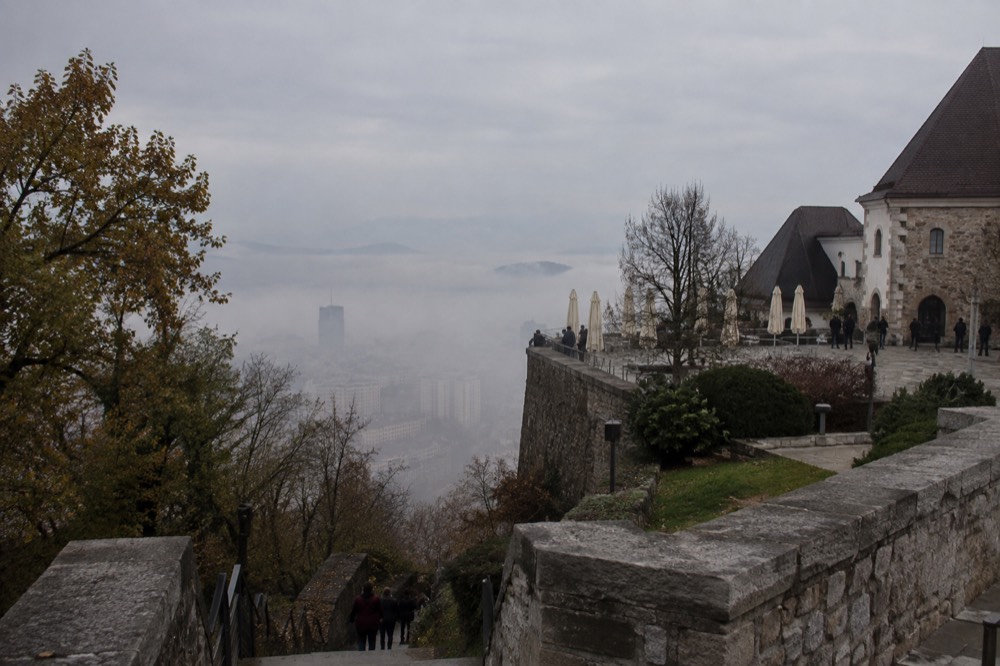
The inversion has a practical upside. On a foggy December day, when the city gets an average of just 56 hours of sunshine across the whole month, the hills above it can be in full sun. Kredarica, at 2514 m on Triglav, records 120 sunshine hours in the same December against the city's 56. The correct move on a grey arrival day is to go up, not to write the day off.
| Month | Rain (mm) | Fog days | Sunshine (h) |
|---|---|---|---|
| April | 99 | 3.0 | 178 |
| June | 144 | 3.0 | 246 |
| July | 115 | 3.7 | 293 |
| September | 147 | 12.4 | 183 |
| October | 147 | 12.4 | 120 |
| December | 107 | 12.6 | 56 |
The month-by-month detail, including the Christmas market season, is in the best time to visit Ljubljana guide.
What Should You Do on Your First Day in the City?
Walk the centre, then decide the shape of the rest of the trip. A free GuruWalk tips-based tour, the Ljubljana Unveiled walk, covers the Old Town from Roman roots to the dragon bridge in about two hours, and it is rated 4.91 from 1,496 reviews. It costs nothing up front; you pay what you think the walk was worth.
Orientation first is genuinely the right order in a city this compact. Once the layout is clear, the day trips pick themselves. The Cave and Castle Tickets tour to Postojna Cave and Predjama Castle runs six hours from the city, is rated 4.8 across 2,802 reviews, and works in any weather because caves hold roughly 10 C year round. Lake Bled is the other obvious first excursion, and the Lake Bled and Castle trip covers it in six hours from Ljubljana with a 4.7 rating from 1,641 reviews.
Both are easy to bolt onto an arrival day, and neither needs a car. The full comparison of the two is in the Lake Bled guide and the Postojna Cave guide, with booking notes on the Cave and Castle tour page.
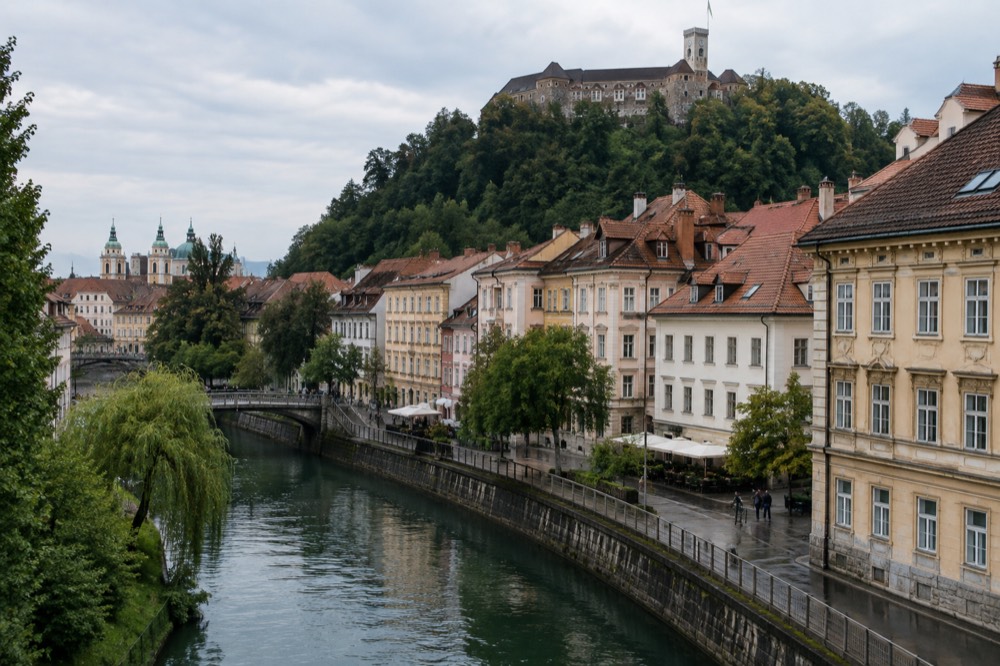
Arriving well is only half the job. The rest of the plan, from two-day itineraries to where to eat, is what Ljubljana Travel Guide exists for, and the two-night average stay the visitor numbers suggest is enough to cover the centre properly and add one day trip.
Common Questions About Getting to Ljubljana
What Is The Best Way To Get To Ljubljana?
Fly into Ljubljana Airport, about 26 km from the city, if you are coming from beyond central Europe. Take the train from Vienna, Graz, Zagreb or Budapest if you are already inside the region, and drive only when the Alps or the coast are part of the plan.
Is there a direct train to Ljubljana?
Yes, from Vienna, Graz, Zagreb, Budapest and the Italian border at Gorizia. There is no high-speed line into Slovenia, so journeys from Germany or France involve changes and are usually slower than flying.
How far is Ljubljana Airport from the city centre?
About 26 km. A taxi or pre-booked transfer covers it in under half an hour. An airport bus exists, but its fare and timetable are not published in a verifiable form, so confirm on the airport's own site.
Do I need to change money in Ljubljana?
No. Slovenia adopted the euro on 1 January 2007, and it is the only currency you will need. If you are arriving from another eurozone country there is nothing to change at all.
Are there border checks entering Slovenia?
Not from Austria, Italy, Hungary or Croatia. Slovenia has been in the Schengen area since 21 December 2007 for land and sea borders, with air borders following on 30 March 2008, and Croatia joined Schengen on 1 January 2023.
Can I drive into central Ljubljana?
No. The historic centre is a pedestrianised zone of roughly 20 hectares, closed to general motor traffic in stages since 2007. Drivers park in garages at the edge of the centre and walk in.