How Long Does It Take to Walk Around Lake Bled, Slovenia?
A practical answer to how long the Lake Bled loop walk takes, what the path is like, and how to combine it with the castle, the island and Vintgar Gorge.
How Long Does It Take to Walk Around Lake Bled, Slovenia?
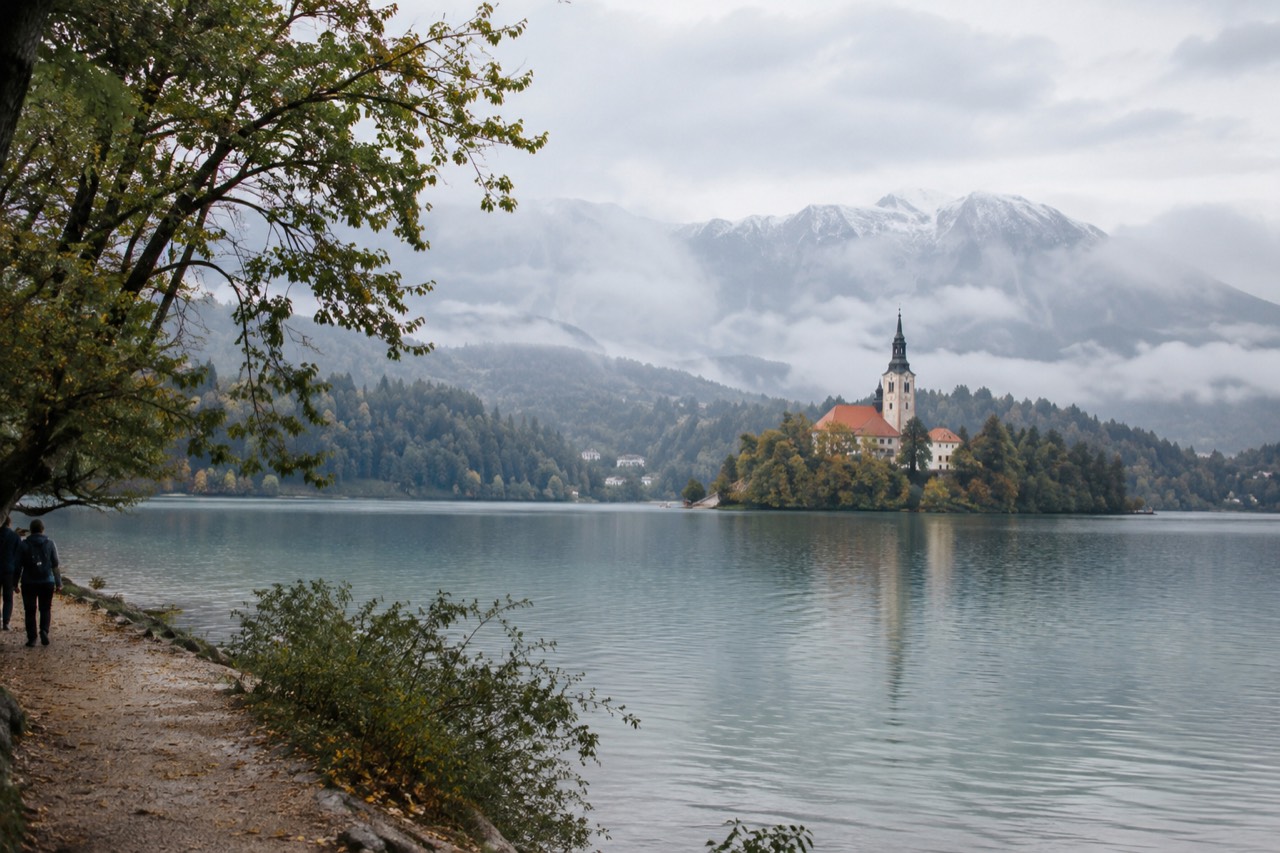
Most visitors walk the full Lake Bled loop in about one and a half to two hours at a relaxed pace, with the path measuring roughly six kilometres end to end. Add photo stops, a castle detour and a pletna boat to the island and the same circuit quietly becomes a half-day or more. The path itself is level, paved or gravel for nearly its whole length, and it never leaves the lakeshore.
That headline figure deserves unpacking, because the honest answer depends on what kind of walker you are. The loop around the lake is not a hike in any meaningful sense: it is a lakeside promenade that happens to close into a circle. Families with small children complete it in two to two and a half hours with stops. A couple walking for exercise, pausing only at the classic viewpoints, can finish in well under ninety minutes. Photographers chasing the light across the water should budget a whole morning, because the east bank in the early hours and the west bank in the late afternoon are where the postcard shots live, and the light does not wait.
The direction you walk barely matters, but the starting point does. Most people begin at the rowing centre or near the town beach on the western shore, where parking and the bulk of the cafés sit. Walking clockwise puts the island church in view almost immediately, which is the orientation most visitors want on their first hour. Walking anticlockwise delays the payoff but delivers the castle cliffs from below, a view many people never see because they take the funicular up and never look back down at the water.
One planning note that saves people real money: the walk itself costs nothing. The expenses at Bled are the optional layers on top of it. Bled Castle charges 19.00 EUR for an adult, the pletna traditional boat to the island is 20 EUR per person, and the electric Bled Boat Line is 16 EUR per person. A visitor who walks the loop, swims in summer and photographs the island from the shore spends nothing but time. A visitor who adds the castle, the boat and lunch can spend 50 EUR per head before the afternoon is out.
Is the Lake Bled Walk Difficult, or Can Anyone Do It?
No, the loop is genuinely easy, and it is one of the few headline Slovenian sights that works for pushchairs, wheelchairs in dry conditions, small children and walkers with no fitness at all. The path is level for its entire length and involves no climbing unless you choose to detour up to the castle. The only real difficulty is distance, and even that is modest at around six kilometres.
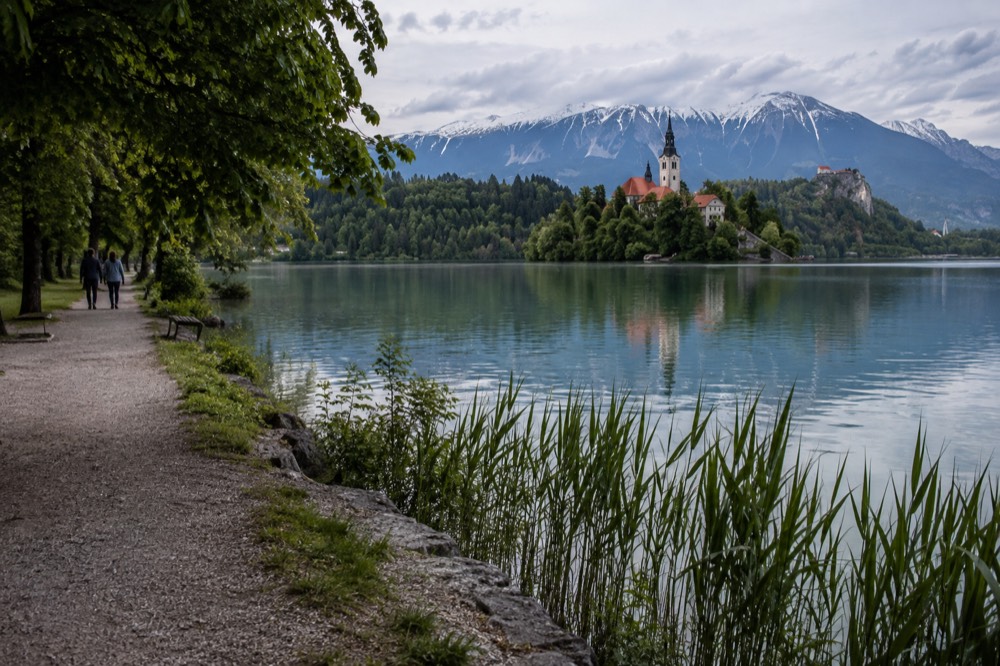
The surface alternates between paved promenade near the town, compacted gravel along the northern shore and a narrower earth-and-gravel stretch through the woods on the southern and eastern banks. That wooded section is the nicest part of the walk and the least visited: the path runs under mature trees with the water flickering through the trunks, and for long stretches you share it only with locals walking dogs. In wet weather the gravel sections hold puddles, so ordinary trainers are fine in summer and something with a bit of grip is kinder in October.
The gradient story changes completely the moment you leave the loop. The castle sits on a cliff high above the lake, and the walking path up from the town side is a stepped lane that takes most people ten to fifteen minutes of steady climbing. It is short but unrelenting, and in summer heat it humbles people who assumed Bled was flat. The full guide to the castle, its entry prices and the viewpoints is on our Bled Castle worth it page, which also covers how long to allow inside.
For anyone basing the day on public transport, the practical chain matters more than the path itself. The lake is a short hop from Ljubljana, and the details of coaches, trains and the two different Bled stations, including why Bled Jezero station is 1.5 km from the water while Lesce-Bled is 4 km, are laid out in getting from Ljubljana to Lake Bled. Get that leg right and the walk starts relaxed instead of rushed.
| Walker type | Realistic loop time | What adds time |
|---|---|---|
| Steady walker, few stops | 1h 15m to 1h 30m | Nothing but a coffee |
| Relaxed visitor with photos | 2h to 2h 30m | Viewpoint stops, swim |
| Family with children | 2h 30m to 3h | Playgrounds, ice cream, island boat |
| Loop plus castle visit | 3h 30m to 4h | Steps up, castle exhibits, views |
| Full day: loop, island, castle | 5h to 6h | Pletna queue, lunch, castle climb |
What Does the Walk Pass, and Where Are the Best Stops?
The loop passes the town beach, the rowing centre, the village of Mlino on the south shore, the wooded east bank and the castle cliffs, with the island church visible from almost every angle. The four stops that earn their time are the swimming area on the west bank, the viewpoint across to the island from the north-east, the Mlino churchyard on the south shore, and the base of the castle cliff on the north side.
The west bank is the social stretch: hotels, the lido, sunbeds in summer and the boat departure points for both the pletna and the electric Boat Line. This is where the loop feels like a resort promenade. The pletna boats, the traditional flat-bottomed gondolas rowed by standing oarsmen, leave from several points along this shore, and the 20 EUR per person fare covers the round trip to the island with time to climb the church steps. The electric Boat Line is the 16 EUR per person alternative, and it is worth knowing that the two are different products with different rhythms rather than competing prices for the same ride.
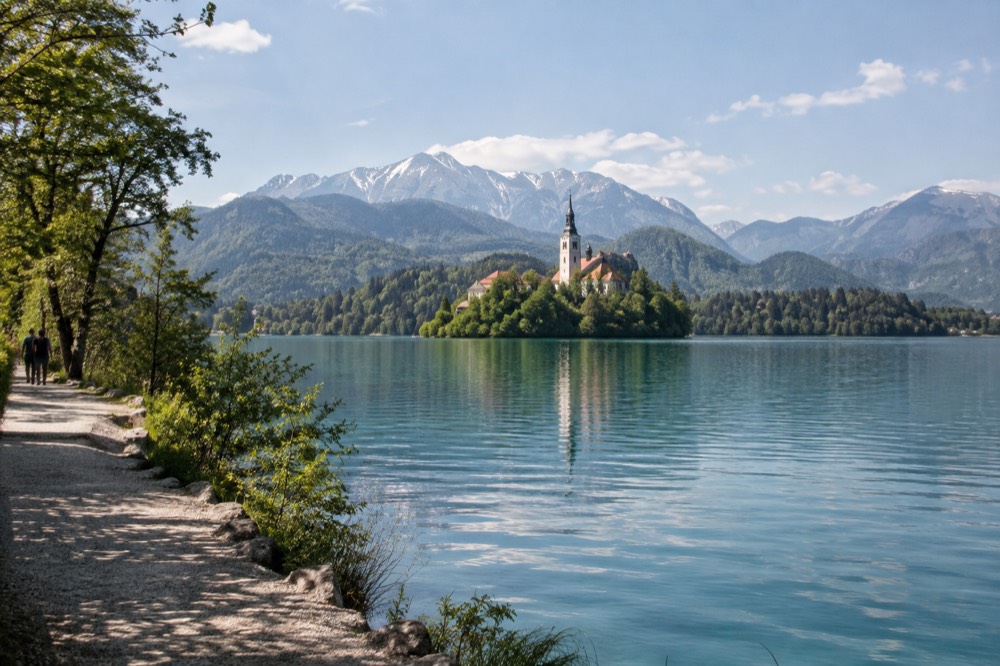
The south shore through Mlino is where the lake shows its everyday face: a small village church, private gardens running to the waterline and, in the distance, the karst wall of the Jelovica plateau. The east bank is the quiet third of the loop, a straight wooded stretch where the path runs close to the water and the island sits dead ahead. Photographers rate this section highest in the morning, when the sun comes over the hills behind you and lights the church front-on.
The north shore delivers the castle from below, which is the angle most visitors miss. The cliff face rises straight out of the trees, and the terrace of the castle café is visible far above. It is the best argument for walking the loop anticlockwise: you save the most dramatic composition for the final kilometre, when legs are tired and the reward needs to be visual rather than physical.
For visitors coming out from the capital for the day rather than staying overnight, the arithmetic of the lake loop has to fit around travel time. The Lake Bled and Castle day trip from Ljubljana covers the six-hour structure of that kind of outing, and the trio below shows the formats that suit different day-trippers: the full Bled-plus-cave combination, a free orientation walk for your first hours in the capital, and the standalone cave-and-castle ticket option.
The free walk in that trio is a GuruWalk tips-based tour, which means it costs nothing up front and you pay what you think it was worth at the end. It is a city orientation walk in Ljubljana rather than a Bled product, and it earns its place here because most Bled day trips start and end in the capital, and the first evening back in town is the natural slot for it.
Can You Combine the Lake Bled Walk with Vintgar Gorge?
Yes, and it is the single best upgrade to a Bled day, but the gorge is seasonal: it is open to visitors between April and October and closes for winter, with the exact closing date depending on conditions each year. Vintgar Gorge sits a few kilometres north of the lake, an adult ticket is 15.00 EUR, and the two walks together make a full and very varied day.
The pairing works because the two paths are opposites. The lake loop is open, sunny and level; the gorge is narrow, shaded and built on wooden galleries bolted above the Radovna river. The gorge's operator states that it is most crowded between 10:00 and 13:00, so the standard advice writes itself: do the gorge early, have lunch in Bled, then walk the lake loop in the afternoon and early evening when the day-trip coaches have started home. Timed-entry slots apply at the gorge, so booking ahead in July and August is not paranoia, it is the difference between walking straight in and standing in a car-park queue. More of these guides are collected on Ljubljana Travel Guide.
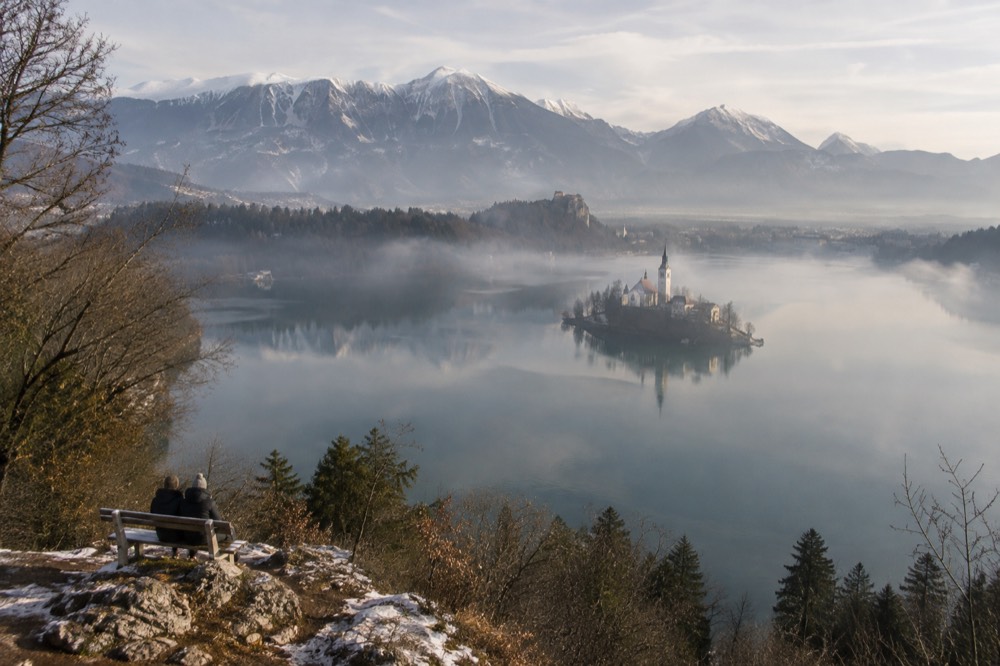
Seasonality is the trap. A visitor in November asking about the gorge gets a different answer from one in July, and the operator deliberately publishes no fixed closing date, only that the season runs April to October and depends on conditions. The full seasonal breakdown, hours and prices are in our Vintgar Gorge guide. The lake loop, by contrast, is walkable all year, and winter has its own case: fog and low cloud often sit in the Ljubljana basin while Bled, higher and west-facing, is in sunshine, so the lake can genuinely be the brighter choice on a grey capital morning.
| Layer on the Bled day | Cost per adult | Time needed | Season |
|---|---|---|---|
| Lake loop walk | Free | 1.5 to 3 hours | Year-round |
| Bled Castle entry | 19.00 EUR | 1 to 2 hours | Year-round |
| Pletna boat to the island | 20 EUR | About 1 hour with island time | Roughly April to October |
| Electric Bled Boat Line | 16 EUR | Under 1 hour | Warmer months |
| Vintgar Gorge | 15.00 EUR | 1.5 to 2 hours | April to October, conditions permitting |
Should You Walk the Lake or Take a Boat and the Funicular?
Walk the loop and take the boat, because they do different jobs: the loop gives you the lake's geography and quiet corners, while the pletna delivers the island itself, which the path never touches. The funicular is a separate question, since it serves the castle rather than the lake, and the honest split is that walkers with time should walk up to the castle and save the funicular fare, while visitors on a tight schedule get real value from it.
The island is the one part of the Bled picture the shore path cannot give you. From every angle on the loop, the church is a silhouette or a reflection; from the island, the lake becomes the view and the castle cliffs become the backdrop. That reversal is why the 20 EUR pletna fare survives year after year: it is not transport, it is a change of perspective. The electric Boat Line at 16 EUR is a cruise rather than an island landing, so the choice between them is really a choice between seeing the island and being on it.
The castle funicular is the other paid shortcut. The stepped lane up the cliff is free and takes most people ten to fifteen minutes; the funicular compresses that into a minute or two of cable-pulled glide with the lake opening underneath. Our Bled Castle guide covers the castle's own entry prices in full, including the combined ticket options, and the walking-up-first advice holds for anyone without knee trouble or a timetable to keep.
For a visitor who wants the whole Bled picture, caves included, without driving, the combined day tour is the efficient answer.
It runs ten hours from Ljubljana, rates 4.9 from 286 reviews and covers the lake, Postojna Cave and Predjama Castle in one outing, from $133. The trade-off is explicit: you trade the freedom to linger on the east bank for the certainty of seeing the cave on the same day, and the cave is the one element that is genuinely hard to self-drive efficiently because its tour slots are timed.
When Is the Best Time of Day to Walk Around Lake Bled?
Early morning is the best time to walk the loop, roughly from sunrise to 09:00, when the water is calm, the coaches have not arrived and the island church is lit from the east. Late afternoon, from about 17:00 in summer, is the strong second choice, with warmer light and thinner crowds. Midday is the worst window: the light flattens, the shared path is busiest and the summer heat sits squarely on the exposed west bank.
The morning argument is partly photographic and partly meteorological. Bled's summer mornings are disproportionately calm, and a still lake doubles the island and the castle in reflection, a state of affairs that wind and boat traffic erase by mid-morning. The practical version of the same advice is to walk the east and north banks first, while the light is behind you, then let the busy west-bank promenade absorb the late-morning crowds while you are already at the coffee stage of the morning.
The evening argument is the weather one. The Lake Bled weather patterns matter here because Bled sits just outside the Ljubljana basin, and the basin's famous fog thins as you go north-west. A grey, low-cloud morning in Ljubljana is regularly a bright morning at the lake, which is why so many locals drive out to Bled precisely when the capital looks unwalkable. In winter this reverses the obvious plan: the lake can be the sunnier day trip.
One last scheduling fact that changes itineraries: the tourist infrastructure at Bled runs on a seasonal clock. The pletna boats, the electric boat line and Vintgar Gorge all wind down or close outside the April-to-October window, while the lake loop and the castle keep going. A November or February visitor gets a quieter, cheaper, greyer Bled, and the walk itself loses nothing.
For a first visit built around the capital, the pairing most people end up happy with is a Bled day plus a proper introduction to Ljubljana itself, and what not to miss in Ljubljana covers the city side of that plan.
Common Questions About Walking Around Lake Bled
How Long Does It Take To Walk Around Lake Bled, Slovenia?
Plan on one and a half to two hours for the roughly six-kilometre loop at a relaxed pace, closer to two and a half or three hours with photo stops, a swim or children in tow. Adding the castle climb or the pletna boat to the island turns the walk into a half-day.
Is the path around Lake Bled suitable for pushchairs and wheelchairs?
Largely yes in dry conditions. The west and north shores are paved promenade, and the wooded east bank is compacted gravel. Only the short earthy sections after rain and the stepped lane up to the castle are genuine obstacles.
Can you walk around Lake Bled in winter?
Yes, the loop is open year-round and costs nothing. The pletna boats and Vintgar Gorge scale back or close outside the April-to-October season, but the path, the castle and the viewpoints keep going, and winter mornings often bring mist and reflections.
Which direction should you walk around the lake?
Clockwise from the west bank suits most first visits, because the island church comes into view early. Anticlockwise saves the castle cliffs seen from below for the final stretch, which many walkers prefer as a finish.
Do you need to book anything to walk the Lake Bled loop?
No, the loop itself is free and needs no booking. The optional layers, the pletna boat, the electric boat line, castle entry and Vintgar Gorge's timed slots, are worth booking ahead in July and August.