What Is Slovenia's Famous Food?
Slovenia's famous food explained: the dishes the country is known for, where to eat them in Ljubljana, and how to try cooking them yourself.
What Is Slovenia's Famous Food?
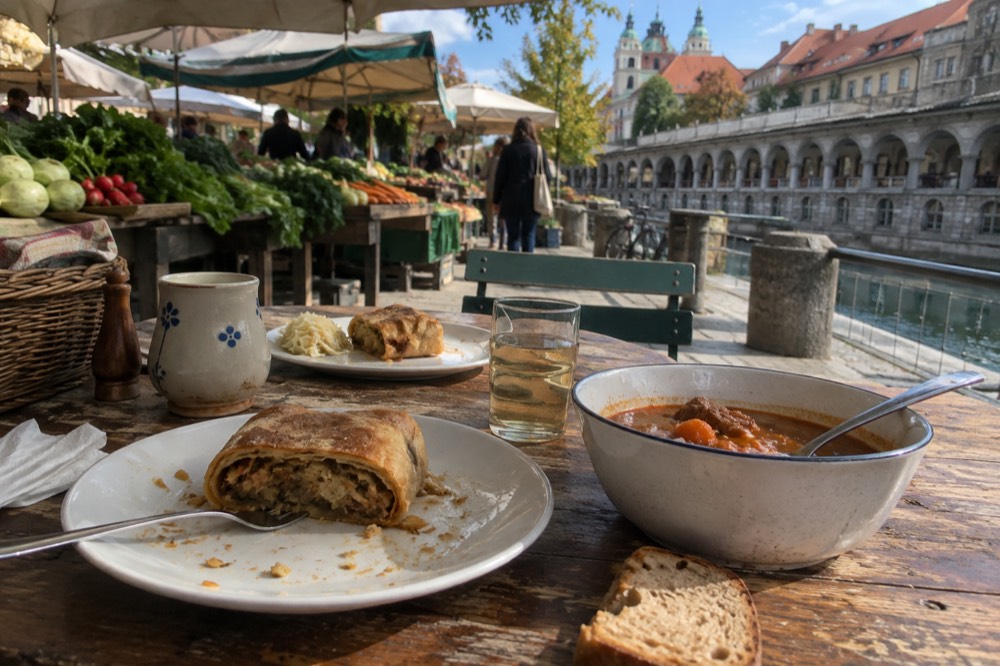
Slovenia's most famous food is štrukelj, a rolled pastry filled with cottage cheese, walnuts or apple, followed closely by potica, a yeast dough rolled around walnuts or tarragon, and kranjska klobasa, the protected Carniolan sausage. Around them sits a repertoire of hearty farmhouse dishes: dumplings, soups, buckwheat porridge and seasonal stews, all built on what the country's small farms and markets produce.
That sentence surprises people who expect a single signature dish. Slovenia does not really have one. What it has instead is a cooking tradition shaped by geography: Alpine dairying in the north-west, Mediterranean influence on the coast, Hungarian and Balkan flavours in the east, and Italian technique in the west. The result is a cuisine that changes every hundred kilometres, which is exactly why the country's food rewards a bit of planning.
Štrukelj is the best starting point because it appears everywhere, from Sunday family tables to restaurant dessert menus. It is a sheet of thin dough rolled around a filling, then either baked or boiled. Potica plays the same role at celebrations: a log of leavened dough sliced to reveal a spiral of walnut filling, served at Easter and Christmas and bought from bakeries year round. Kranjska klobasa, the Carniolan sausage, holds protected geographical status, which means the name legally describes a specific pork recipe from a specific region, seasoned with garlic and pepper and nothing much else.
Underneath the famous three sits a deeper layer worth knowing about. Štruklji, the plural, come in dozens of regional variants, some savoury, some sweet, some made from buckwheat dough. Idrija žlikrofi, small filled dumplings from the Idrija area, also carry protected status. Then there is bograč, a hunter's stew from the Prekmurje region in the far east, and kraški pršut, air-dried ham from the Karst, which is the local answer to prosciutto and pairs with the Karst's teran wine.
For a fuller sense of how the country's food culture works, our piece on what food Ljubljana is famous for narrows the question down to the capital, and the where to eat in Ljubljana guide turns the theory into a list of tables to book.
Which Slovenian Dishes Should You Try First?
Try potica, štrukelj and kranjska klobasa first, then move to the regional classics: Idrija žlikrofi dumplings, bograč stew, kraški pršut ham and buckwheat dishes from the Alpine regions. A tasting order that starts sweet, moves to cured and finishes with something slow-cooked will cover the whole tradition in a single trip.
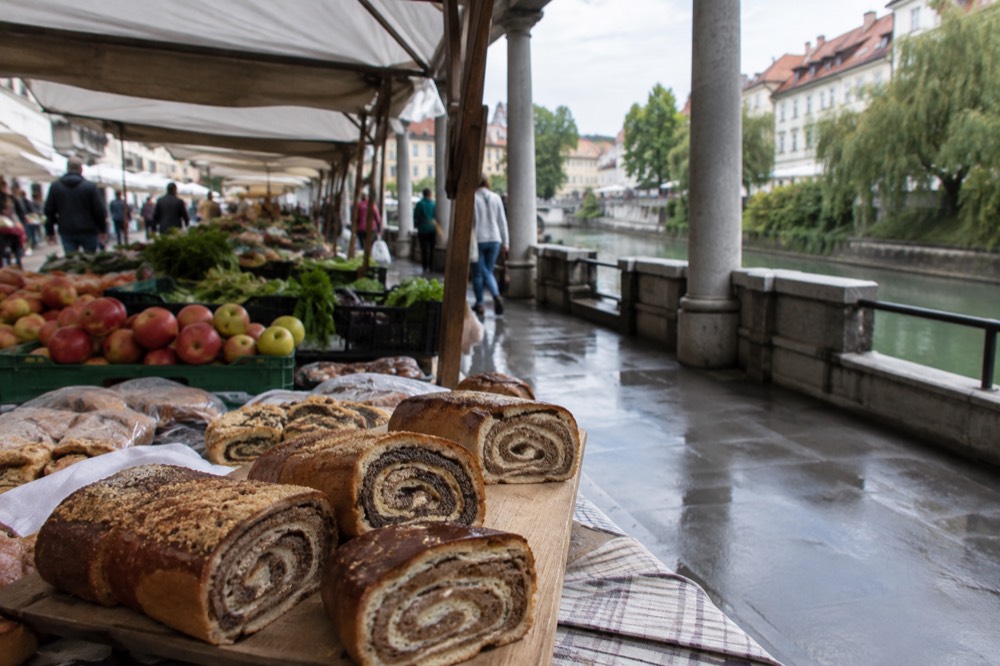
Potica is the dish Slovenians themselves will name if you ask them. Every family has a preferred filling, walnut being the standard but tarragon the passionately defended alternative, and the cake appears at every significant occasion. Bakeries across Ljubljana sell it by the slice, so it is the easiest famous food to try without planning.
Kranjska klobasa is the savoury counterpart. It is grilled, served with mustard and horseradish or with sauerkraut, and it appears on menus from street stalls to hotel restaurants. Because the recipe is protected, ordering it anywhere in the country gets you broadly the same sausage, which makes it a reliable benchmark rather than a gamble.
The regional dishes need slightly more effort. Idrija žlikrofi are worth the trip to Idrija itself, a mercury-mining town with UNESCO heritage status, though good versions exist in Ljubljana restaurants too. Bograč comes from Prekmurje, where it is cooked in a wide pot over open heat, and the coast contributes its own seafood traditions that have more in common with neighbouring Istria than with the rest of Slovenia. The Karst contributes pršut and teran, a dark red wine that grows only in that soil.
Here is how the famous foods stack up for a visitor deciding what to chase down first:
| Dish | What it is | Where it comes from | How easy is it to find in Ljubljana |
|---|---|---|---|
| Potica | Yeast dough rolled with walnut or tarragon filling | National, served at celebrations | Easy, bakeries sell it daily |
| Štrukelj | Rolled pastry with cottage cheese, walnut or apple filling | National farmhouse dish | Easy, on most dessert menus |
| Kranjska klobasa | Protected Carniolan pork sausage with garlic | Carniola region, central Slovenia | Very easy, street stalls and restaurants |
| Idrija žlikrofi | Protected filled dumplings | Idrija, west-central Slovenia | Moderate, look for traditional restaurants |
| Kraški pršut | Air-dried Karst ham | Karst plateau, south-west | Moderate, served with cheese boards |
| Bograč | Slow-cooked hunter's stew | Prekmurje, north-east | Harder, seasonal and regional menus |
One honest note on expectations: Slovenian food is not designed to impress on a plate. It is dense, seasonal and portioned for people who have been outside, and its best versions are found in simple places, gostilna restaurants that often hold the same family for generations. A gostilna serving five dishes cooked from a market list will beat a fashionable kitchen almost every time.
If you would rather taste than hunt, a guided option covers more ground than a week of solo guesswork.
Where Can You Eat These Dishes in Ljubljana?
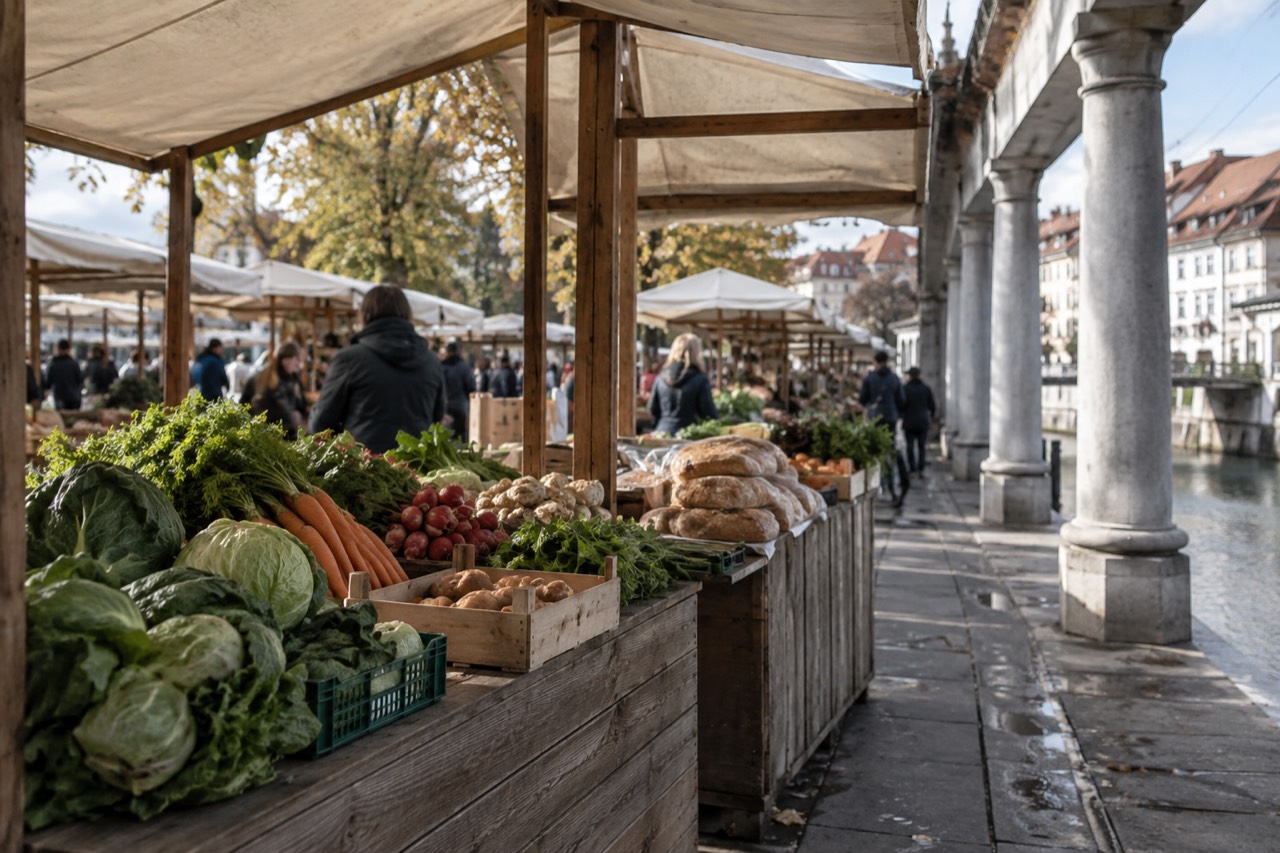
The Central Market on Vodnikov and Pogačarjev trg is the best single place to encounter Slovenian food, with outdoor stalls roughly Monday to Saturday 06:00 to 18:00 in summer and covered halls on weekdays. Around it sit the gostilna restaurants of the old town, and on Fridays from roughly March to November the Open Kitchen food market runs on Pogačarjev trg from 10:00 into the evening.
The market is the honest heart of the city's food scene. Farmers and small producers sell cheese, cured meats, honey, bread and fruit from stalls that have supplied Ljubljana kitchens for generations, and the covered halls run Monday to Friday 07:00 to 16:00 and Saturday 07:00 to 14:00, per the operator's published hours. It is also the place to see what is actually in season, which is the question every Slovenian cook starts from. Our Ljubljana markets guide covers the stalls in detail.
Open Kitchen, Odprta Kuhna in Slovenian, is the weekly event worth building a Friday around. It runs on Pogačarjev trg roughly March to November, from 10:00 to 21:00 and later on warm days, and the official wording is that it happens "every sunny Friday", which is meant literally: the market is cancelled in bad weather, so check the forecast before promising yourself a food night. When it runs, chefs from across the country cook in the open air and the whole square turns into an open-air restaurant.
For sitting down, the gostilna tradition is the thing to look for. These are licensed inns serving regional cooking, and the old town's narrow streets hold a good concentration of them. The practical advice is simple: a menu that is short, changes with the season and lists dishes you recognise from this article is the menu to trust. A menu that runs to six pages of international options is aimed at someone else.
The visitor's own Ljubljana Travel Guide covers where each of these neighbourhoods sits and how to walk between them, which matters because the centre is pedestrianised and most food stops are within fifteen minutes on foot of each other.
Can You Learn to Cook Slovenian Food Yourself?
Yes, and the best way is a cooking class: Ljubljana has a hands-on three-hour class dedicated to štrukelj, the country's signature rolled pastry, rated 4.9 from 90 reviews and starting from $70. It is one of the few tours where the souvenir is a recipe you can actually reproduce at home.
The štrukelj cooking class is exactly what it sounds like. A small group works through the dough, the filling and the rolling, then eats the result, and the whole thing takes three hours. Because štrukelj uses ingredients available in most countries, cottage cheese, filo-style dough or a simple homemade dough, walnuts, butter, it is a genuinely portable skill rather than a one-off afternoon. The listing shows a 4.9 rating from 90 reviews, and the price starts from $70.
Cooking classes suit a particular kind of traveller: someone with a free afternoon, an interest that outlasts the trip and a preference for eating what they have made. If that is you, book early in your stay rather than at the end, because knowing how the food is built changes how you read every restaurant menu afterwards.
If cooking is not your thing but eating is, the alternative is a guided tasting walk. A Ljubljana food tour moves through several kitchens in one evening, which is the efficient way to try potica, štruklji and the cured meats in a single sitting, and our typical Slovenian breakfast piece covers the morning end of the same tradition.
How Does Slovenian Food Change with the Seasons?
Slovenian cooking follows the market calendar closely: spring brings asparagus and herbs, summer moves the table outdoors, autumn is mushroom, chestnut and harvest season, and winter returns to heavy stews, cured pork and potica at Christmas. The dishes do not change as much as their ingredients do, and the same restaurant can feel like two different countries in June and December.
Spring is the quiet superstar. Wild asparagus, a thinner and more bitter cousin of the cultivated kind, appears in omelettes and risottos, and herbs like tarragon, the same one that goes into potica, show up everywhere. Summer is grill season, and in Ljubljana it is also the season when the Open Kitchen market pulls the city's food out onto the square. The coast's seafood is at its best and the Karst pršut is sliced thin and eaten with melon or cheese.
Autumn is when the country eats its richest. Mushroom foraging is close to a national sport, and restaurants build whole menus around what the forests produced that week. Chestnuts, pumpkin and game take over, and the new wine season, associated with the autumn, brings young wines into the gostilne. This is also the season to plan around the weather: September and October are the joint wettest months in Ljubljana at 147 mm each, and the foggiest months of the year, tied with December at 12.4 fog days on the 1971-2000 record, so an outdoor food event is a gamble worth insuring with an indoor backup.
Winter is pork and pastry. The Christmas period brings potica back to every table, sausages and stews dominate menus, and the heavy dishes that feel excessive in July taste exactly right at 0 degrees Celsius, the city's January mean. Hot chestnut sellers appear on the streets, and the Ljubljana Christmas market guide covers the seasonal stalls in full.
The seasonal logic explains why asking "what is Slovenia's famous food" gets slightly different answers in different months. The canon is fixed, but the market list is not, and the cooks here have always followed the second.
Common Questions About Slovenian Food
What Is Slovenia's Famous Food?
Slovenia's most famous foods are štrukelj, a rolled pastry with a sweet or savoury filling, potica, a walnut or tarragon celebration cake, and kranjska klobasa, the protected Carniolan sausage. Around them sit regional classics like Idrija žlikrofi dumplings, bograč stew and kraški pršut ham.
Is Slovenian food the same as Austrian or Italian food?
It shares techniques with both, because the country sits between them, but it is its own tradition. The dishes above are protected or distinctly Slovenian, and the cooking style is denser and more seasonal than either neighbour's everyday food.
Where is the best place to try Slovenian food in Ljubljana?
The Central Market for produce and cured goods, a traditional gostilna restaurant for a full meal, and the Open Kitchen food market on a Friday from roughly March to November, weather permitting.
Can I learn to make štrukelj while visiting?
Yes. The Traditional Slovenian štrukelj Cooking Class in Ljubljana runs three hours, is rated 4.9 from 90 reviews and starts from $70.
Is Slovenian food vegetarian-friendly?
Partly. Štrukelj and potica are often meat-free, buckwheat and dairy dishes are common, and the markets carry excellent produce, but the famous cured meats and stews are pork-based, so vegetarians eat well without eating the whole canon.
What should I bring home from Slovenia's food scene?
Market-bought potica from a bakery, kraški pršut, local honey and a bottle of teran or another regional wine all travel well and are sold at the Central Market and in food shops around it.