Where to Eat in Ljubljana: A Practical Food Guide
Ljubljana's food scene runs from covered market halls and Friday street food to serious Slovenian kitchens and riverside wine bars. This guide maps the neighbourhoods, the dishes and the timings that decide whether you eat well or eat near the square.
Short answer
Eat in the pedestrianised old town for riverside atmosphere, but follow locals towards Trnovo, Metelkova's surrounds and the eastern streets for better value. Time your visit around the Central Market and the Friday Open Kitchen street food event, order štrukelj and žlikrofi, and consider a guided food walk to sample several kitchens in one afternoon.
Ljubljana is a two-night city, and that arithmetic shapes every meal you will plan here. Slovenia's statistical office recorded 2,844,129 overnight stays across 1,392,728 arrivals in the municipality, an average stay of about 2.04 nights, which means most visitors are choosing between roughly six meals. Spend three of them badly, on the first terrace you find after stepping off the coach, and the city's food reputation never gets a fair hearing.
This guide is the antidote. It works through the practical questions in order: which part of town, which dishes, which markets, which timings, and where a guided tour earns its fee. The centre is pedestrianised, everything is priced in euro, and the distances are short enough that a bad restaurant is a choice rather than an accident. A good one is equally easy to reach, once you know which direction to walk.
What Food Is Ljubljana Known For?
Ljubljana's kitchens cook the dishes of the regions around it: štrukelj, the rolled pastry that can be savoury or sweet, potica, the walnut scroll cake served at every celebration, kranjska klobasa, the cured sausage with protected geographical status, and žlikrofi, the small filled dumplings from Idrija. Jota, a sour barley and bean soup from the west, appears whenever the weather turns. None of it is street snack food by origin, but the city's market halls and modern kitchens have made all of it accessible.
The honest way to describe eating in Ljubljana is regional cooking assembled in one place. Slovenia is small, and its food traditions are fiercely local, so a city restaurant with a Slovenian menu is effectively offering a tour of the country's kitchens. Prekmurska gibanica, the layered pastry from the far north-east, sits beside Belokranjska pogača from the south and fish dishes that point towards the Adriatic. That range is the city's real advantage over bigger capitals.
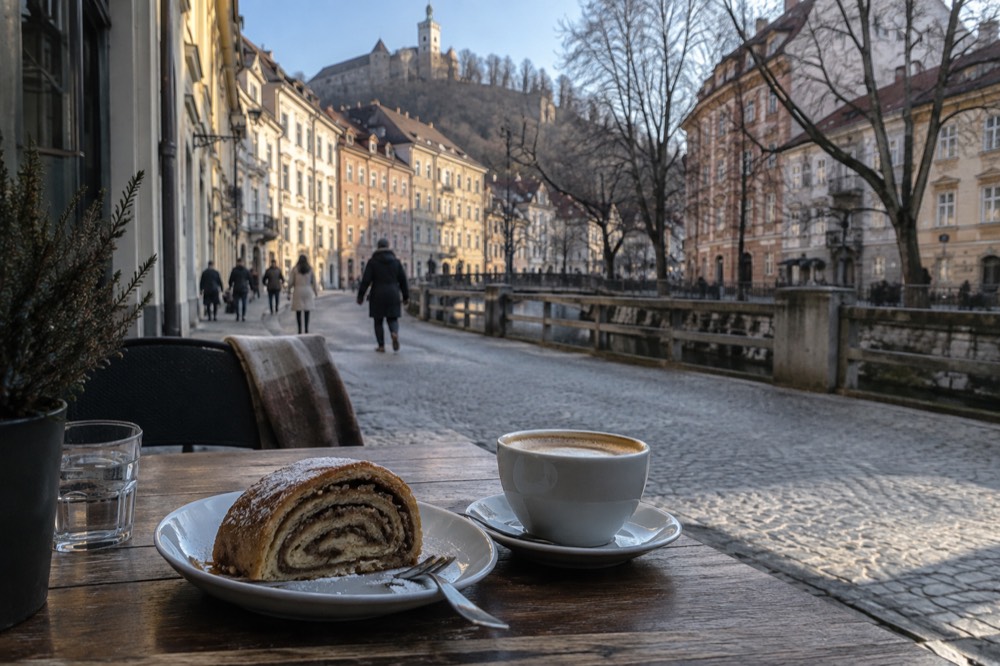
Where this matters for planning: you do not need to leave the city to eat the country. If your stay is short, order widely rather than deeply. One soup, one dumpling dish, one sausage, one pastry across two dinners tells you more about Slovenian food than two visits to any single kitchen. If a dish clicks, the region it comes from becomes your next day trip, and the day trips from Ljubljana guide covers exactly that decision.
| Dish | What it is | Where it comes from |
|---|---|---|
| Štrukelj | Rolled pastry, savoury or sweet, often served with a sauce | Across Slovenia, a house speciality everywhere |
| Potica | Yeast dough rolled around walnut, tarragon or poppy filling | National celebration cake |
| Kranjska klobasa | Cured pork sausage with protected geographical status | Carniola region |
| Idrijski žlikrofi | Small potato-filled dumplings, protected status | Idrija |
| Jota | Barley, beans and sauerkraut or turnip soup | Western Slovenia and Primorska |
| Prekmurska gibanica | Layered pastry with poppy, walnut, apple and cottage cheese | Prekmurje, north-east |
If you want to try several of these without gambling on menu roulette, a guided tasting walk does the ordering for you. The four-hour Slovenian cuisine walking tour with tastings, rated 4.8 across 552 reviews and from $104, moves through central Ljubljana with a local guide who explains each stop. That is the difference between eating štrukelj and understanding why it appears on every menu in the country.
Which Neighbourhood Has the Best Restaurants in Ljubljana?
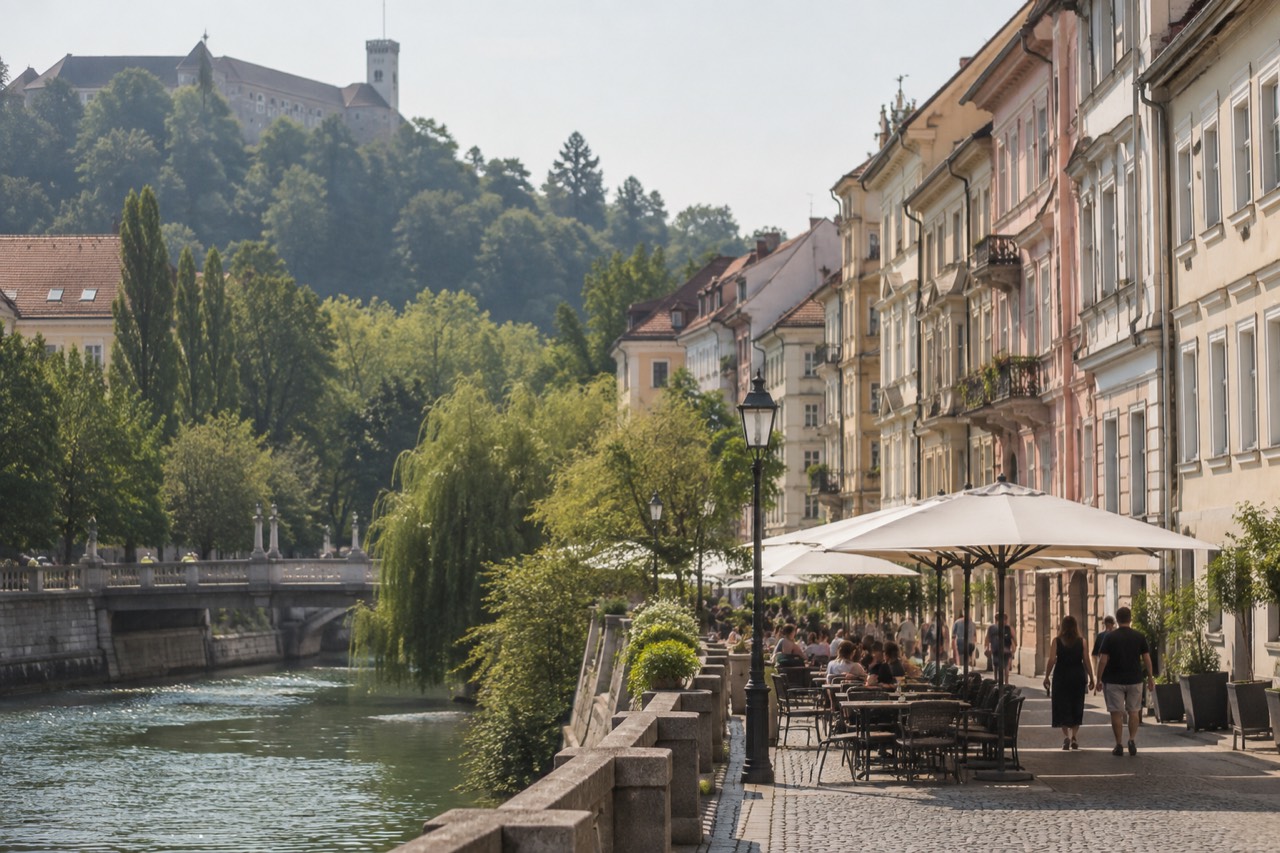
The old town between the Ljubljanica's banks has the densest concentration of restaurants and the most atmosphere, and for a first evening it is the right answer. For the second evening, the streets south of the river towards Trnovo and the area around Metelkova serve more locals, price more gently and take more risks with the cooking. The centre is pedestrianised, so every option is within a walk of perhaps fifteen minutes from Prešeren Square, and the choice is really about mood and money rather than distance.
Start with the geography. The old town, the two banks and the bridges between them hold the riverside terraces, the tourist-facing kitchens and the wine bars with views of the castle hill. The old town guide covers the streets themselves; for eating purposes, the rule of thumb is simple: the closer a table is to Prešeren Square, the more it is charging for the square and the less it is charging for the kitchen. Walk two blocks in any direction and the same cuisine costs less.
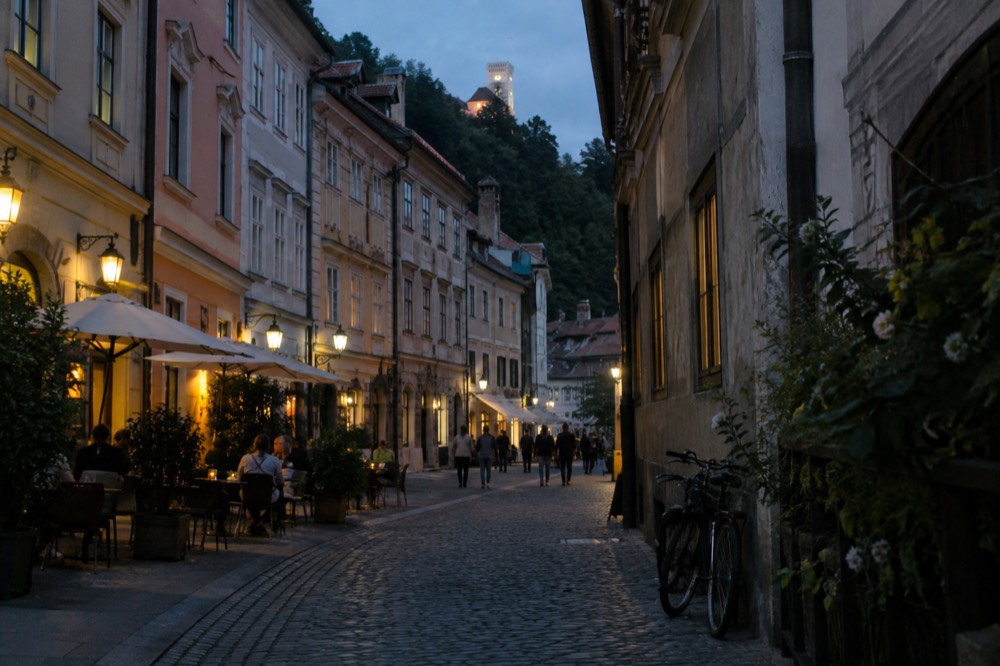
South of the river, Trnovo and the streets around it are where students and locals eat, and the menus reflect that: generous plates, fewer English menus, more of the food people actually order twice. The Trnovo guide walks the neighbourhood in detail. East of the centre, the Metelkova quarter's surroundings have evolved from a nightlife zone into a genuinely interesting eating area, and the Metelkova guide pairs it with an evening out. The centre guide ties the whole walkable core together.
| Area | Strengths | Trade-off | Best for |
|---|---|---|---|
| Old Town riverside | Atmosphere, castle views, terrace dining | Highest prices, tourist menus | First evening, groups |
| Trnovo and south bank | Local crowd, better value, creative kitchens | Fewer views, book ahead | Second evening |
| Around Metelkova | Late hours, young scene, casual food | Hit and miss without research | Night owls, low-key meals |
| Near the Central Market | Morning food, bakery stops, market halls | Daytime only | Breakfast and lunch |
If you would rather eat your way through the city with someone who knows which kitchen does which dish best, the three options above span the formats: a classic cuisine walk with tastings, a combined food and wine adventure, and a quieter wine tasting with appetizers on the river. All three run in the central area, so none of them costs you an afternoon of travel.
Where Do Locals Actually Eat in Ljubljana?
Locals eat away from the main squares, in the neighbourhood restaurants of Trnovo, Šiška and Bežigrad, at the Central Market's covered halls on weekday mornings, and at the Friday Open Kitchen street food event on Pogačarjev trg, which the tourist board runs roughly March to November. They also drink standing, at the riverside wine bars and the small breweries, treating the evening as a moving event rather than one long sit-down dinner.
The single biggest tell is where the queues are. On a Friday in season, Pogačarjev trg fills with Open Kitchen, a street food market where the city's restaurants and producers cook outside. The official wording is "every sunny Friday", and that is literal: the event is cancelled in bad weather, so check before you build your day around it. Full details are in the Odprta Kuhna guide.
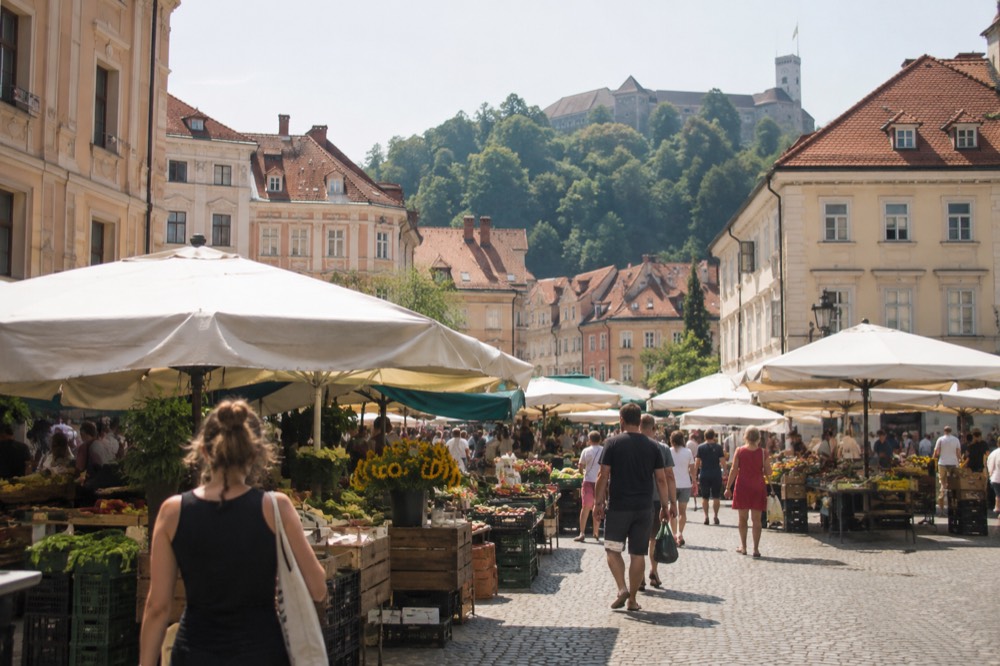
The other local habit worth stealing is the market morning. The Central Market's outdoor stalls on Vodnikov and Pogačarjev trg run roughly Monday to Saturday, 06:00 to 18:00 in summer and 06:00 to 16:00 in winter, with limited Sunday and holiday opening from April to November, while the covered halls run Monday to Friday 07:00 to 16:00 and Saturday 07:00 to 14:00, according to the operator JP LPT's published hours. The Central Market guide covers what to buy and when. Come at seven and you are shopping with cooks, not tourists.
A guided walk is the shortcut past the guesswork, and the Slovenian cuisine walking tour with tastings is the one that covers the most ground in an afternoon: four hours, a 4.8 rating from 552 reviews, from $104, with tastings that map the regional cooking onto the streets you are walking through. Book it for your first afternoon and every later meal decision gets easier.
The deeper answer on where locals eat is in the where locals eat in Ljubljana guide, which lists specific streets and habits. The short version: follow the market, follow the Friday event, and follow anyone carrying a shopping bag rather than a camera.
Can You Eat Well in Ljubljana on a Budget?
Yes, and the strategy is structural rather than a list of cheap dishes: eat your biggest meal at lunch, when many kitchens run set menus below the evening card, buy breakfast and fruit at the Central Market instead of at a cafe, and drink local wine and beer rather than imported labels. The covered market halls, bakery windows and burek sellers keep a full day of eating inexpensive.
The economics of the city help you. Slovenia uses the euro, adopted on 1 January 2007, so there is no currency friction arriving from the eurozone, and the tourist tax is modest at 3.13 euro per person per night, which includes the 2.50 euro tax and the 0.63 euro promotion surcharge. The Ljubljana on a budget and Ljubljana prices guides do the arithmetic in detail.
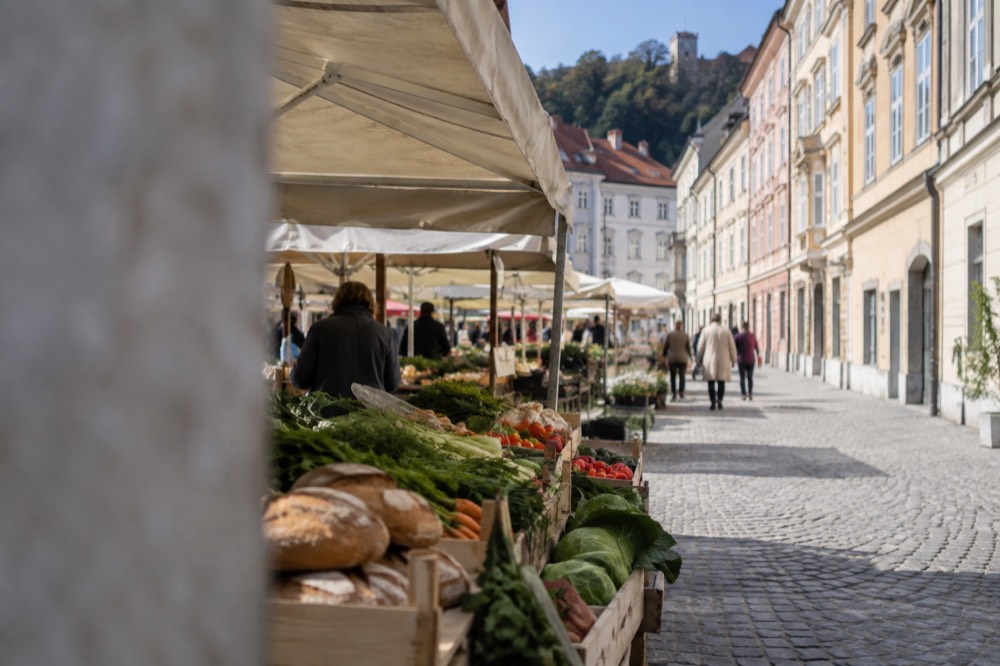
Two structural facts decide the budget question. First, the centre is pedestrianised, so you never need a taxi between restaurants, and city buses do not accept cash on board, only the Urbana card or contactless bank cards, a single zone 1 ride costing 1.50 euro for 90 minutes including transfers. Second, the best cheap food in Ljubljana is not a downgraded version of the expensive food, it is a different category: the market halls, the burek, the bakery breakfast. The breakfast in Ljubljana guide covers the morning end of that spectrum.
| Budget move | What you get | When it works best |
|---|---|---|
| Market breakfast | Bread, cheese, fruit from the halls | Every weekday morning |
| Lunch set menu | A full Slovenian plate at lunch pricing | Weekdays |
| Open Kitchen Friday | Many restaurants cooking outdoors at street prices | Fridays, March to November, dry weather |
| Riverside wine bar | A glass and standing room, no dinner bill | Early evening |
The mistake to avoid is assuming cheap means central. Some of the best value kitchens are a fifteen minute walk into the neighbourhoods, and the walk itself is through one of the more pleasant pedestrian cities in Europe. Treat the distance as part of the meal. A visitor mixing one good dinner with market breakfasts and a Friday Open Kitchen evening spends a fraction of the terrace-every-night budget without eating worse.
What Is a Typical Slovenian Breakfast in Ljubljana?
A Slovenian breakfast in Ljubljana is bread with good butter, local cheese and cured meat, eggs where a kitchen makes an occasion of them, and coffee, with potica or a slice of something sweet if the morning allows it. It is not a cooked English-style plate and it is not a pastry-and-go affair either, it sits between the two. The market halls and the old town's cafe windows serve it from early morning.
The bread is the foundation and it is genuinely good, which is why so much of the breakfast culture is built around it. The typical Slovenian breakfast article on this site covers the traditions, including the national breakfast programme that puts bread, honey and milk in front of schoolchildren to teach them where food comes from. That tells you the national self-image: breakfast is honest, agricultural and unsweetened, with the sweetness arriving later in the day.
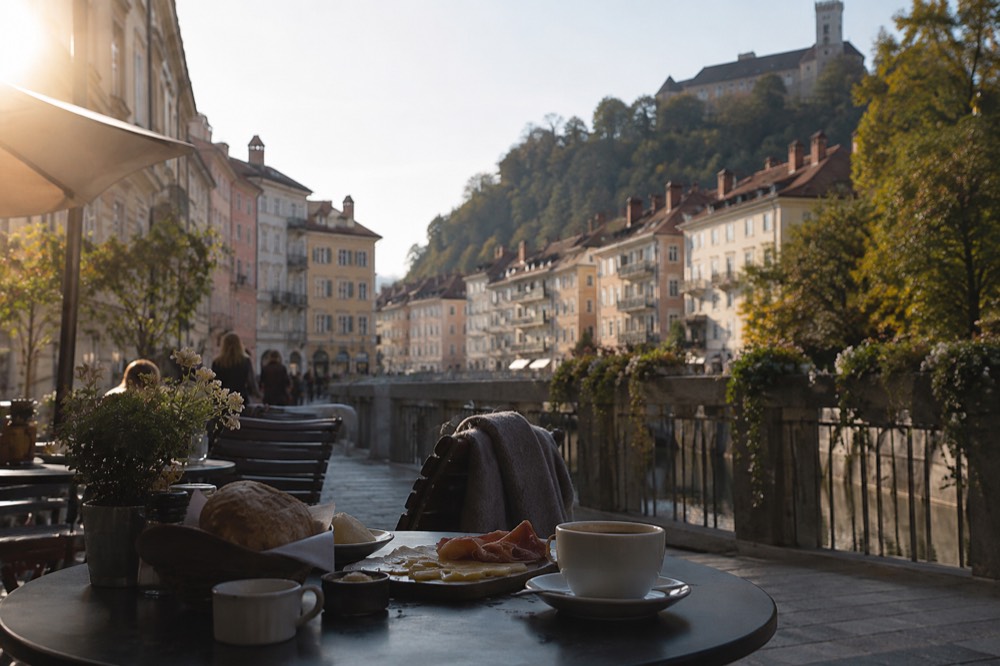
For a visitor, the practical version is a market morning: buy bread at one stall, cheese at another, fruit at a third, and take it to a bench by the Ljubljanica. That breakfast costs less than any hotel version and tastes more like the country. The breakfast in Ljubljana guide lists where to buy each piece of it. On a weekday you will be eating it next to people on their way to work rather than next to a tour group.
The sweet option is potica, and it is worth knowing that it is a celebration cake pressed into breakfast service, not the other way round. A slice with a coffee mid-morning, after the market, is the correct slot for it. The wider set of guides lives on Ljubljana Travel Guide.
Is a Food Tour in Ljubljana Worth It?
A food tour in Ljubljana is worth it on a short stay, because the city's food culture is regional and scattered, and a guide compresses several kitchens, producers and stories into one walk. On a stay of three nights or more, with time to research, you can assemble the same eating yourself. The tours that earn their fee are the ones with tastings built in, a small group and a route through the central streets, and the strongest reviews on the roster belong to exactly that format.
The case for the tour is efficiency. Slovenian food is regional, and the average menu is a map of the country rather than a single tradition, so a guide who can tell you which dish comes from which valley is adding real information, not just narration. The case against is cost, and on a long stay it is a fair case. Two nights is the tipping point, and this city averages 2.04 nights per visitor.
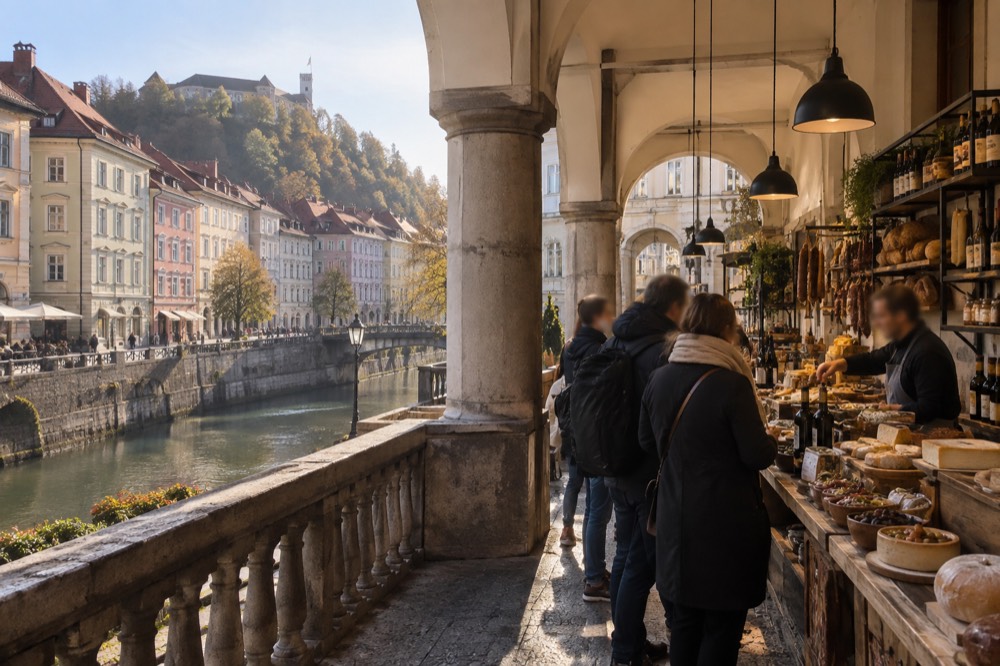
The three-hour Traditional Flavors food journey is the deep option: rated 5.0 from 54 reviews, from $104, three hours of eating through the old food traditions. It suits a visitor who wants the country's cooking explained, dish by dish, rather than a quick sweep.
The cooking class route is a different proposition again. The štrukelj cooking class, three hours, rated 4.9 from 90 reviews and from $70, puts you in a kitchen making the rolled pastry yourself, which is the one dish on every menu in the country and the one most worth understanding from the inside. You leave with a skill, not just a receipt.
| Experience | Format | Duration | Rating | From |
|---|---|---|---|---|
| Slovenian cuisine walk with tastings | Guided walk, tastings | 4 hours | 4.8, 552 reviews | $104 |
| Traditional Flavors food journey | Guided walk, tastings | 3 hours | 5.0, 54 reviews | $104 |
| Štrukelj cooking class | Hands-on class | 3 hours | 4.9, 90 reviews | $70 |
| Wine tasting with appetizers | Boat-based tasting | 2 hours | 4.8, 226 reviews | $64 |
The Ljubljana food tour guide compares every option on the roster in one place, including the free walking tours that touch on food culture without the tastings.
Where Should You Eat on a Rainy Day?
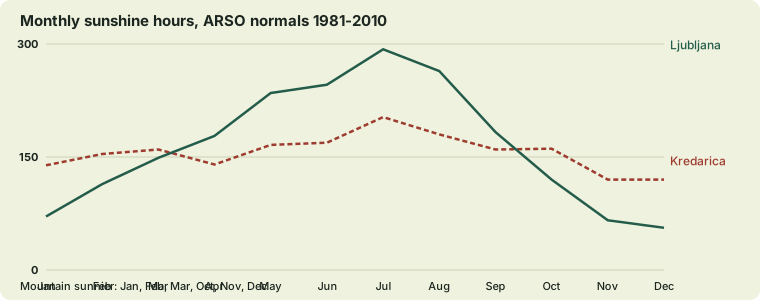
On a rainy day in Ljubljana, eat indoors in the old town's cellar restaurants and covered market halls, or turn the weather into an excuse for a long lunch, because the kitchens are compact and mostly within a few minutes' walk of shelter. September and October are the joint wettest months at 147 mm each, above July's 115 mm, so this is a real scenario, not a hypothetical.
The climate detail matters more here than in most cities. Ljubljana sits in a basin, and in the colder half of the year cold air is trapped under warmer air above, so the city fogs in while the hills a few hundred metres up sit in sunshine. ARSO's 1981-2010 normals give the city just 37 clear days a year against 130 overcast, and October and November each average a single clear day. Fog averages 12.4 days in both September and October, level with December and above January. The best time to visit Ljubljana guide covers the whole calendar.
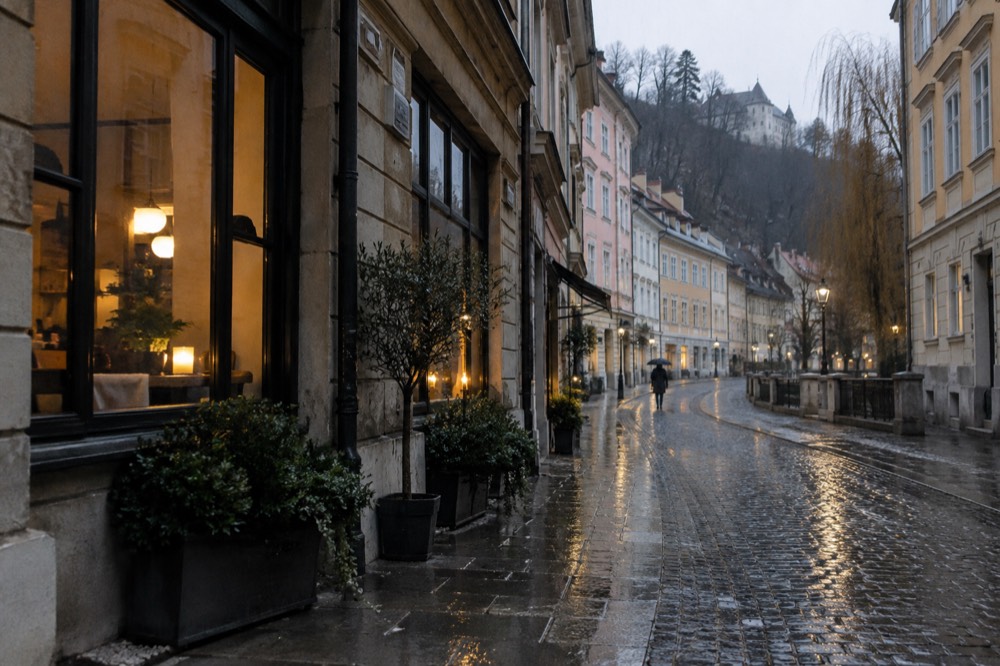
For eating purposes, the response to a grey day is the long lunch. The cellar spaces of the old town, the covered market halls until 16:00 on a weekday, and the restaurants of the pedestrian centre are all built for weather. The rainy day in Ljubljana guide has the full indoor itinerary.
What Should You Drink with Dinner in Ljubljana?
Drink Slovenian wine, which almost none of it leaves the country, and drink the local beer, which has moved from two big brands to a genuine craft scene in a decade. The whites by the glass are usually Rebula, Malvazija and Laški Rizling from the west, the reds are Refošk and the lighter Modra Frankinja, and orange wine is strong enough that a bar without one is unusual. Cviček, the light red-white blend from Dolenjska, is built for food.
Slovenia's wine regions sit on the same latitude band as Burgundy and the wine culture is older than most visitors expect, but the production is small and domestic, so the only reliable way to taste it is here. The slovenian food in Ljubljana guide covers the food side of that culture, and the Ljubljana craft beer guide covers the breweries, several of which pour in the centre.
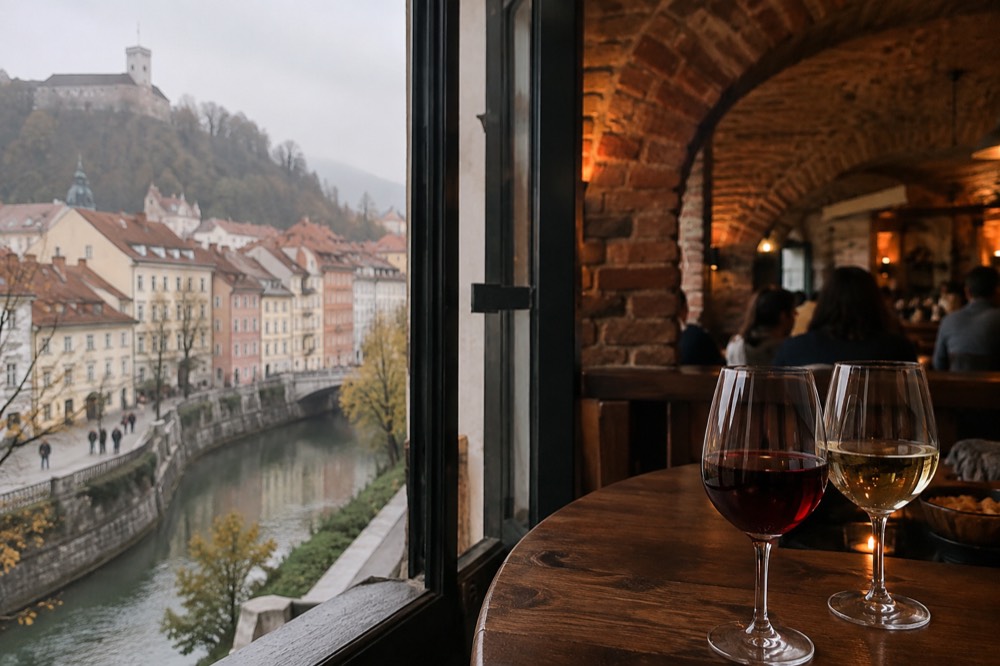
The pairing that locals will recommend, once you ask, is anything from the Vipava Valley, and there is now a tour that goes straight there: the Vipava Valley Wine Express, five hours from Ljubljana, rated 4.9 from 140 reviews and from $126, hopping between wineries with transport handled. For an evening in the city itself, the wine tasting with appetizers runs two hours on a silent electric boat along the Ljubljanica, rated 4.8 from 226 reviews and from $64.
If beer is more your evening, the Boat and Craft Beer tasting tour runs an hour on the river with Slovenian craft pours, rated 4.5 from 37 reviews and from $56, and the Ljubljana nightlife guide picks up where the river cruise ends.
How Do You Plan Two Days of Eating in Ljubljana?
Plan two days of eating around one big dinner, one market breakfast, one long lunch and one event meal, in that order of importance. Book the dinner before you arrive, especially for a weekend, let the market decide breakfast, use the Friday Open Kitchen as the event if your dates allow, and fill the gaps with the neighbourhood kitchens south of the river. Two days is the median stay in this city, and the arithmetic works: six meals, four of them flexible, two of them worth booking.
The reason the plan matters is that Ljubljana's food scene is walkable but not endless, and a short stay punishes improvisation more than a long one. The one day in Ljubljana and 2 days in Ljubljana itineraries build the full sightseeing day around the meals, which is the correct order of operations for a food-first visit.
| Meal | Day 1 | Day 2 |
|---|---|---|
| Breakfast | Covered market halls, bread and cheese | Old town cafe, potica and coffee |
| Lunch | Long lunch in the old town, regional menu | Trnovo or south bank neighbourhood kitchen |
| Dinner | Booked restaurant, riverside or cellar | Open Kitchen on a Friday, or a wine bar evening |
The one booking worth making in advance is the dinner, and the one timing worth building the day around is the market. Everything else in this plan survives a change of weather, which, in a city that averages 147 mm of rain in both September and October, is the kind of flexibility you want.
If you would rather hand the planning to someone whose job it is, the three walks above are the strongest food experiences on the city's roster, and any one of them slots into the afternoon slot of either day.
Common Questions About Eating in Ljubljana
What food is Ljubljana known for?
Štrukelj, potica, kranjska klobasa, idrijski žlikrofi and jota, plus the market culture around them. The city's kitchens cook the food of the regions around it, so a Slovenian menu is effectively a tour of the country.
Where do locals eat in Ljubljana?
Locals eat in the neighbourhood restaurants of Trnovo and the south bank, at the Central Market's covered halls on weekday mornings, and at the Open Kitchen street food event on Fridays from roughly March to November, weather permitting.
Can you eat well in Ljubljana on a budget?
Yes. Eat your main meal at lunch, buy breakfast at the market halls, and drink local wine and beer. The pedestrian centre means no taxi costs between any of it.
Is a food tour in Ljubljana worth it?
On a short stay, yes, because a guide compresses several kitchens and producers into one walk. The cuisine walk with tastings, the Traditional Flavors journey and the štrukelj cooking class are the formats that earn their fee.
What is a typical Slovenian breakfast?
Bread with butter, local cheese and cured meat, eggs where a kitchen makes an occasion of them, and coffee, with a slice of potica if the morning allows it.
When is Open Kitchen in Ljubljana?
Fridays, on Pogačarjev trg, roughly March to November, 10:00 to 21:00 and later on warm days. The official wording is "every sunny Friday", and the event is cancelled in bad weather, so check before you plan around it.