Ljubljana Markets: Central, Flea and Farmers
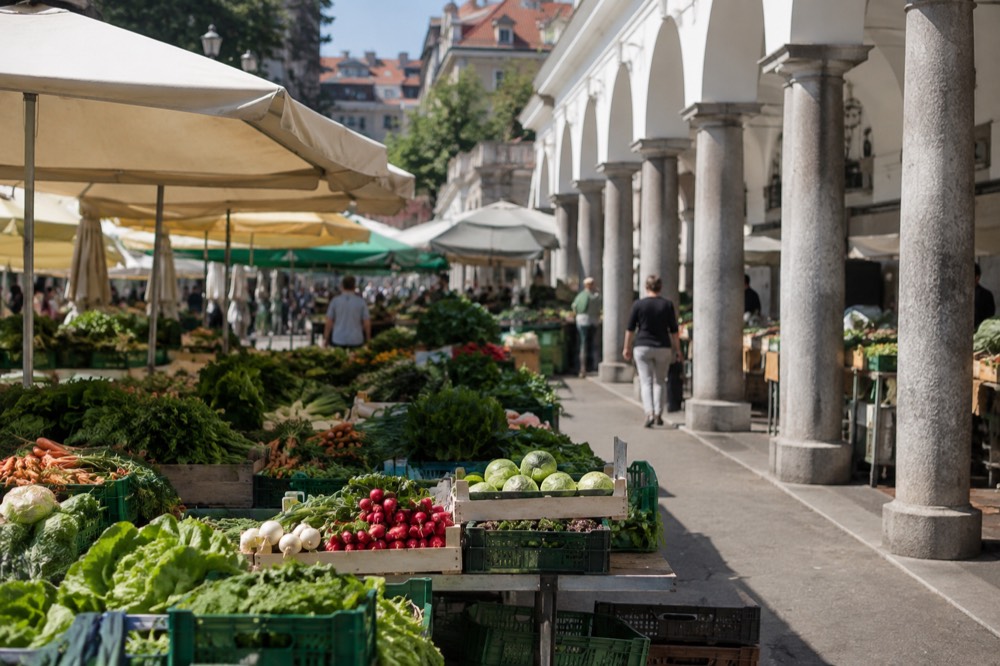
Ljubljana's market culture runs through the whole city: Jože Plečnik's riverside Central Market, the open-air stalls of Vodnikov and Pogačarjev trg, the Friday food street of Odprta Kuhna and the smaller farmers' stands scattered through the neighbourhoods.
Short answer
Ljubljana's main market is the Central Market between Vodnikov trg and Pogačarjev trg, open-air stalls roughly Monday to Saturday from 06:00, with covered halls Monday to Friday 07:00-16:00 and Saturday to 14:00. The flea market stalls cluster around the same square, and the Open Kitchen food market runs on Fridays from March to November.
Ljubljana's market day starts early and it starts at the river. Long before the first coffee is poured on the café terraces along the Ljubljanica, the stalls of the Central Market are stacked with apples from the surrounding hills, štruklji wrapped in cloth, and wheels of cheese from the alpine dairies. The market is not a tourist attraction that happens to sell food. It is where a good part of the city still shops, and it shapes the rhythm of the historic centre in a way few visitors realise before they arrive.
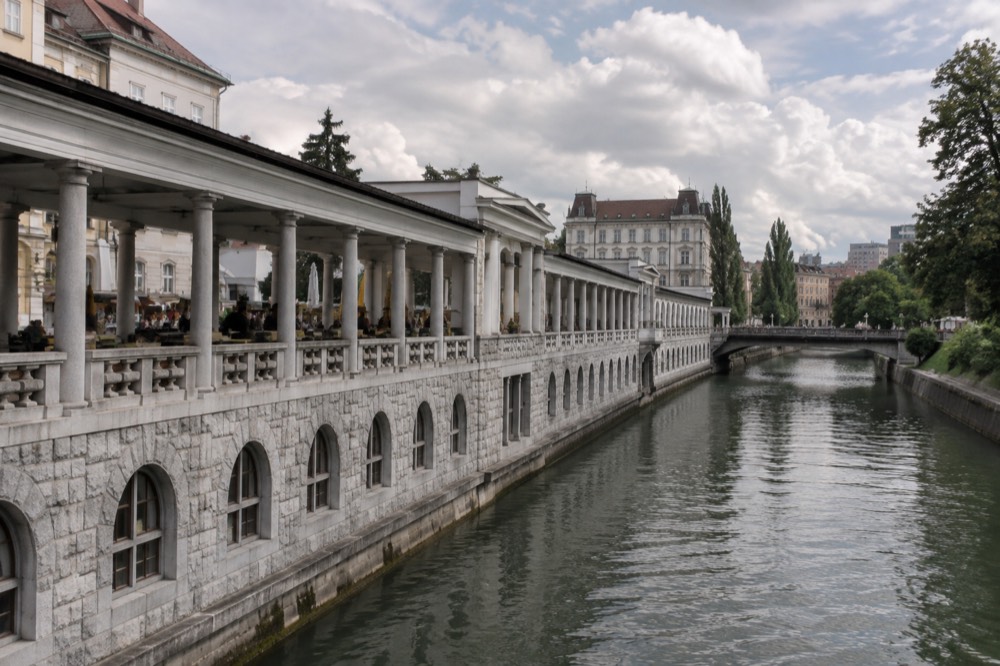
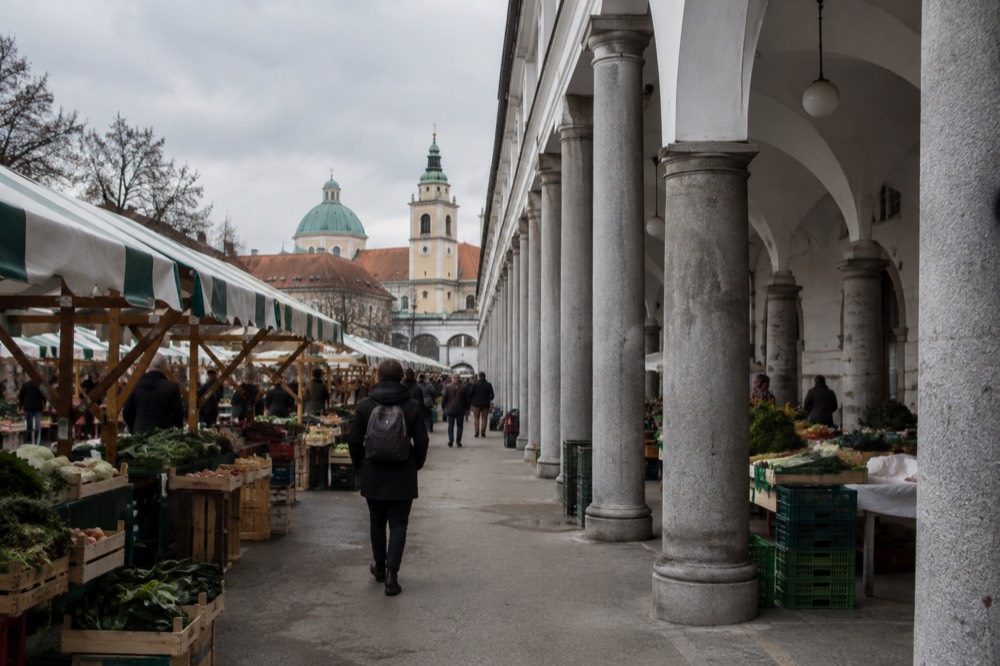
The market complex itself is one of Jože Plečnik's great works, a riverside colonnade of stone pillars and market halls running between Vodnikov trg and Pogačarjev trg, right on the edge of the pedestrianised old centre. A visit can be as short as a walk through on the way to the castle funicular, or a whole morning of tasting, browsing and eating. This guide covers the main markets, the hours that matter, the flea and antique stalls, the Friday food event that has become one of the city's signature experiences, and how to fit all of it into a visit.
What Are the Main Markets in Ljubljana?
Ljubljana has one great central market complex, the Central Market between Vodnikov trg and Pogačarjev trg, plus a cluster of smaller markets and seasonal events around it: the open-air produce and flower stalls on the two squares, the covered market halls, the antique and second-hand stalls that share the space, and the Friday Open Kitchen food market on Pogačarjev trg. Together they form a single walkable market district of a few hundred metres, sitting directly between the river and the cathedral. Almost everything described in this guide can be visited on foot in under half an hour of walking, which is unusual for a European capital and is one of the quiet pleasures of this city.
The Central Market is the anchor. It was designed by Plečnik as part of his larger plan for the riverbank, and its long colonnade facing the Ljubljanica is one of the most photographed stretches of the city. The market is run by the operator JP LPT, which also runs the city's other marketplaces, and it publishes its own hours, which we cover in detail below because they change with the seasons.
Around the central complex sit the seasonal and one-off layers. The Open Kitchen food market, known locally as Odprta Kuhna, takes over Pogačarjev trg on Fridays through the warmer half of the year. The flea and antique sellers set up around the edges of the squares on weekend mornings. And beyond the centre, smaller neighbourhood markets serve the districts where locals actually live, which is where the farmers' produce conversation gets interesting.
If you are planning a first visit and wondering how much time to give all this, the honest answer is: a morning. The stalls are at their best early, the covered halls close mid-afternoon, and the whole district sits conveniently beside the other things you will want to see anyway. The old town walking guide and the Central Market guide both treat the market as a stop on a longer route, and that is the right instinct.
Where Is the Central Market and When Is It Open?
The Central Market sits between Vodnikov trg and Pogačarjev trg, directly across the river from the main old-town core, a two-minute walk from Prešeren Square. The outdoor market on both squares runs roughly Monday to Saturday, 06:00-18:00 in summer and 06:00-16:00 in winter, with limited Sunday and holiday opening from April to November. The covered halls run Monday to Friday 07:00-16:00 and Saturday 07:00-14:00.
Those hours come from the operator's own published schedule, JP LPT, which runs the marketplace and posts the seasonal hours on its site. The early start is not a typo. Market traders in Slovenia begin at six in the morning, and by mid-afternoon the outdoor stalls are packing down. If you arrive at four in the afternoon expecting a bustling market, you will find the tail end of it, and in winter you may find it already gone.
The Sunday detail matters for itinerary planning. Through the main season, April to November, there is limited Sunday and holiday opening, but the covered halls are closed on Sundays year-round. A Sunday visitor gets the square, the cathedral, and the walk along the colonnade, but not the full market experience. Saturday morning is the strongest single time to visit: every stall is out, the halls are open until 14:00, and the square fills with a mix of shoppers and visitors.
Getting there is simple because the historic centre is pedestrianised, a zone of roughly 20 hectares that has been progressively closed to general motor traffic since 2007, per the city's own mobility pages. You walk in, or you arrive by bus and walk the last stretch. The market squares sit right at the edge of the zone, so there is no driving to the stalls themselves. Anyone weighing a car against public transport should read the getting around Ljubljana guide before committing to a vehicle, because the pedestrian centre makes parking the harder half of the problem.
A practical timing note: the market pairs naturally with a morning in the centre and an afternoon further afield. Many visitors spend the morning at the stalls and the afternoon on a day trip, and the tours below are the two most common pairings with a market morning.
What Can You Buy at the Central Market?
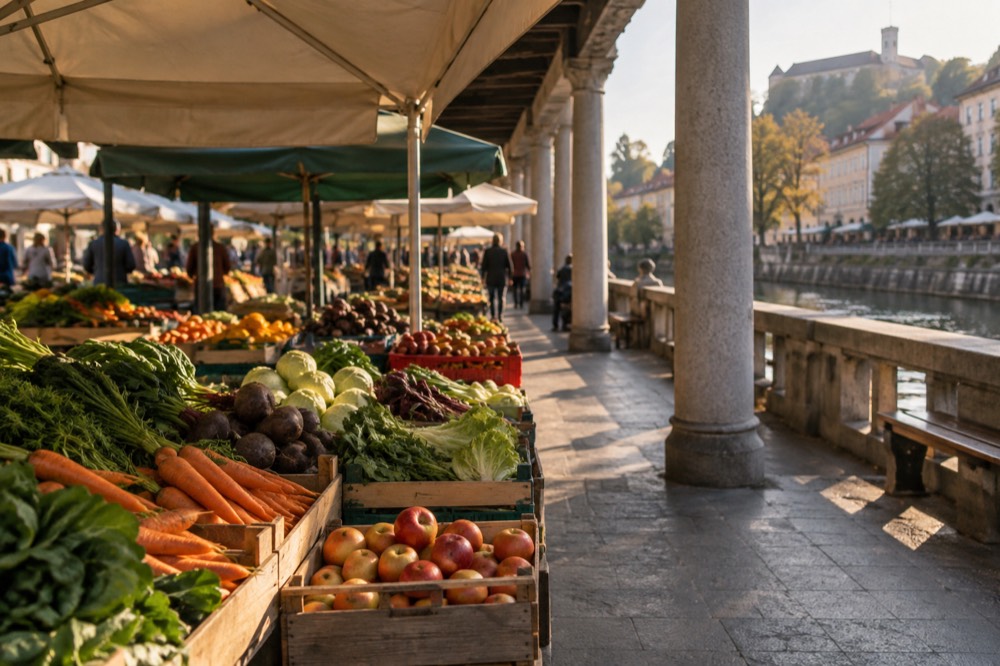
The Central Market sells fresh fruit and vegetables, cheese and dairy, cured meats, bread and pastries, honey, herbs, flowers, fish in the covered halls, and a rotating cast of seasonal products, from pumpkins in October to wild asparagus in spring. It is a working food market first and a sightseeing stop second, and the range is genuinely regional: the produce comes from the Ljubljana basin and the hills around it, and the dairy and cured meats from the alpine regions a short drive north.
The covered halls are where the more permanent traders sit. The fishmonger, the butchers, the bakers and the dairy stalls keep regular hours through the week, and this is where locals do the kind of shopping that does not depend on the weather. The outdoor stalls are the seasonal layer: fruit and vegetables by the crate, flowers, and in late summer the stone-fruit season, apricots and peaches from the valleys, which is worth timing a visit around if you have the flexibility.
For a visitor, three things are worth buying with intent. First, cheese: the alpine dairies sell directly at the market, and a wedge of a hard mountain cheese is one of the most portable souvenirs the country offers. Second, honey: Slovenia is a beekeeping nation, and jars of local honey, including the darker forest varieties, are sold by producers who will let you taste before you choose. Third, bread and pastry from the market bakers, which solves the breakfast problem for a fraction of a restaurant price. The where to eat in Ljubljana guide picks up where the market leaves off for restaurant meals.
| What | Where in the complex | Notes |
|---|---|---|
| Fruit and vegetables | Outdoor stalls, both squares | Seasonal, best before noon |
| Cheese and dairy | Covered halls and outdoor stalls | Alpine producers sell directly |
| Cured meats | Covered halls | Regional salamis and prosciutto-style cuts |
| Bread and pastries | Covered halls | Arrive before 10:00 for the best choice |
| Fish | Covered halls | Limited range, inland city |
| Flowers | Outdoor stalls, Vodnikov trg | Daily, cheapest mid-week |
| Herbs and honey | Outdoor stalls and halls | Producer jars, tastings common |
Prices at a market like this are not fixed the way a supermarket's are, but they are not haggling markets either. You pay the posted or quoted price, and it is generally lower than the same item in a boutique food shop in the centre. The Ljubljana prices guide puts market shopping in the context of the city's overall cost of living.
If tasting your way through the stalls appeals more than shopping, a guided food walk does the same route with a guide who knows the producers. The Slovenian Cuisine Walking Tour with Tastings spends four hours on exactly this territory, rated 4.8 from 552 reviews, from $104.
That tasting walk is one way to spend the middle of the day. The other is to plan the afternoon around the classic excursion from the city: the cave and castle trip that most visitors pair with a market morning, covered below.
What About the Flea Market and Antiques?
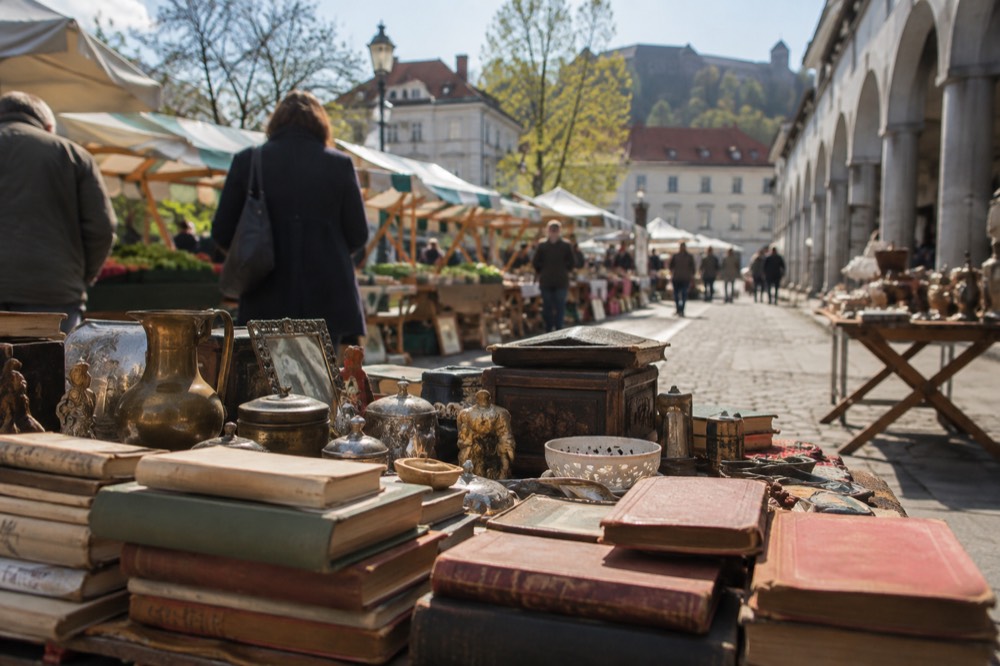
The flea and antique stalls cluster around Vodnikov trg and the edges of the market district, typically on weekend mornings, selling second-hand goods, antiques, books, records, bric-a-brac and vintage items, and the scene is small, informal and well worth an early walk-through if you enjoy browsing. Unlike the food market, this is not a large, formally scheduled operation with a published timetable, so the honest advice is to treat it as a weekend-morning phenomenon rather than a guaranteed attraction, and to check locally during your visit.
What you find depends on the weekend. Old books and postcards, Yugoslav-era memorabilia, vinyl records, tools, jewellery, furniture and the general archaeology of a century of central European household life. Collectors of twentieth-century material culture tend to do well here precisely because Ljubljana is a capital that has not been turned into a flea-market theme park. The sellers are often private individuals clearing an attic as much as professional dealers.
The flea market conversation connects to a broader one about the squares themselves. Vodnikov trg is named after the poet Valentin Vodnik, and it has been a trading space for far longer than Plečnik's colonnade has stood on the riverbank. The Prešeren Square guide covers the other end of the old city's civic geography, and the two squares bracket a walk that takes in the cathedral, the river and the market in under a kilometre.
A few practical points. Bring small cash for the informal stalls, since card readers are not universal among weekend sellers. Go early: the best items move first, and the stalls thin out by early afternoon. And do not build an entire day around it, because the scene is modest in scale. An hour of browsing between the market halls and a coffee stop is the realistic shape of a flea-market visit here.
What Is Open Kitchen and Why Do Fridays Matter?
Open Kitchen, Odprta Kuhna in Slovenian, is a weekly street-food market on Pogačarjev trg that runs on Fridays, roughly from March to November, from around 10:00 to 21:00 and later on warm evenings, where restaurants and food producers from across Slovenia cook from open-air stands. It is the single best food event in the city for a visitor, because it compresses the country's regional cooking into one square on one evening: Istrian pasta, alpine dairy dishes, Balkan grills, natural wine, craft beer and dessert stands, all within a hundred metres of each other.
The event is organised through the tourist board, whose event pages carry the seasonal details. One detail that catches visitors out deserves emphasis: the official wording is that it runs "every sunny Friday", and that is closer to literal than most event copy. The market stands in an open square, and bad weather cancels it. If your visit hinges on Open Kitchen, have a dinner backup, and check the event listing on the day. Everything else covered here is indexed on Ljubljana Travel Guide.
The timing makes Friday the strongest single day to build around a market visit. The covered halls and produce stalls run in the morning, the flea sellers are out if it is the first Friday of a warm month, and by late afternoon the square transforms into the food market. The Odprta Kuhna guide covers the event in depth, and the Ljubljana events guide places it in the calendar year.
For the practicalities: prices are per dish and set by each stand, portions are generous, and the square fills fast between 18:00 and 20:00. Arriving towards the early end, around opening or shortly after, gets you shorter queues and first pick of the stands that sell out. Seating is communal and informal, benches and steps, so dress for sitting outside rather than for a restaurant.
Where Do Locals Buy Farm Produce?
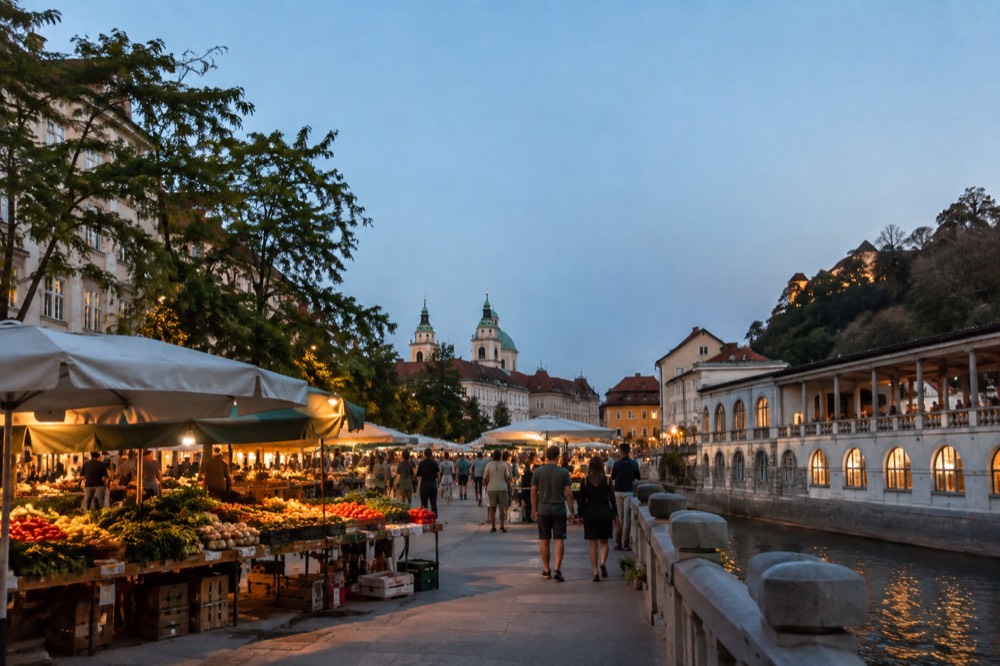
Locals buy farm produce at the Central Market's outdoor stalls and at the smaller neighbourhood marketplaces scattered through the residential districts, where small producers sell directly, and the quality difference between a producer stall and a reseller stall is worth learning to spot: the producer stalls sell fewer items, in uneven sizes, with the dirt still on them. The Ljubljana basin is intensively farmed horticultural land, and the city is surrounded by market gardens, orchards and smallholdings within a short drive, so the distance from field to stall is genuinely short.
The neighbourhood markets matter if you are staying in an apartment and self-catering. They are less photogenic and more functional, and they run on the same early-hours rhythm as the central stalls. The same operator runs the wider network of marketplaces, so the seasonal hours pattern described above is a reasonable guide to the smaller sites too, though individual locations vary and it is worth checking the specific marketplace before making a special trip.
The seasonal calendar of produce is the thing to keep in mind, because a market in Slovenia is a different experience month to month. Spring brings wild garlic and asparagus, early summer brings strawberries and cherries, high summer brings stone fruit and tomatoes, autumn brings pumpkins, chestnuts, apples and the mushroom season, and winter strips the stalls back to storage crops, preserved goods, dairy and cured meats. The best time to visit Ljubljana guide covers the seasonal arguments in full.
One honest caution about the farmers' market idea: the term "farmers' market" is used loosely in travel writing, and a visitor should not expect a curated, signage-heavy affair of the kind found in some western cities. What Ljubljana offers is an older model, a general market where producers and resellers trade side by side, and the pleasure is in learning which stall is which.
| Season | What is at its best | Market character |
|---|---|---|
| March to May | Wild garlic, asparagus, early greens | Fresh, cool mornings, fewer crowds |
| June to July | Strawberries, cherries, stone fruit | Peak colour, busiest stalls |
| August to September | Tomatoes, peppers, late stone fruit | Richest range of the year |
| October to November | Pumpkins, apples, chestnuts, mushrooms | Autumn display, Open Kitchen still running |
| December to February | Storage crops, dairy, cured meats, honey | Thinned stalls, festive market season |
How Do the Markets Fit Into a Day in Ljubljana?
The markets fit best into the first half of a day: an early walk through the outdoor stalls, the covered halls before they close at 14:00 or 16:00, the cathedral next door, then the river and the old town, with the afternoon free for the castle, a boat trip or a day tour, and a Friday evening at Open Kitchen if the timing works. The geography makes this almost effortless, because the market district sits between the two things every visitor does anyway: the riverfront and the cathedral quarter.
Consider the shape of a full day. Start at Vodnikov trg around 08:00 or 09:00, when the stalls are fully set out and the crowds are thin. Walk the length of the colonnade, cross to the covered halls for cheese and bread, and take coffee at one of the stands or cafés on the square. The cathedral is steps away. From there, the Ljubljana Castle funicular is a short walk across the river, and the castle grounds are free to enter, with the funicular and the tower ticketed separately, a distinction worth knowing before you plan the budget.
The afternoon is where the day trips come in, and this is where a market morning pairs naturally with a longer excursion. The Postojna Cave and Predjama Castle tour is the classic pairing: six hours, rated 4.8 from 2,802 reviews, from $132, covering the cave system and the cliff castle in one organised trip. Because the market is done by lunchtime, a departure in the early afternoon costs you nothing of the market experience.
The alternative pairing is Lake Bled, six hours, rated 4.7 from 1,641 reviews, from $86, which also departs with the morning market already behind you. Whichever you choose, book the day trip and the market morning on the same day deliberately: the market rewards an early start, and the tours reward a relaxed departure.
For a shorter or cheaper structure, the free GuruWalk walks are the natural companion to a market morning. Ljubljana Unveiled: A Journey Through Time and Tales is a two-hour tips-based walk rated 4.91 from 1,496 reviews, and it starts from the same historic quarter the market sits in. See this free tour on GuruWalk for the current schedule; the walk is free and you pay what you think it was worth.
Does the Weather Affect a Market Visit?
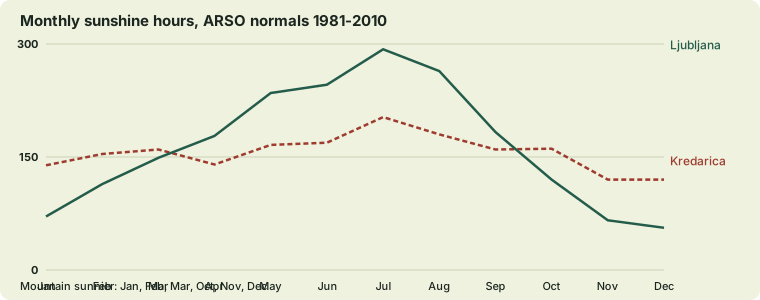
Yes, and more than most guides admit: Ljubljana sits in a basin that fogs in, the foggiest months are September and October as well as December, September and October are also the joint wettest months at 147 mm each, and the city averages just 37 clear days a year against 130 overcast, so an outdoor market plan needs a weather plan behind it. These figures come from ARSO, the Slovenian environment agency, whose climate normals record the city's sunshine, cloud and rain in detail, and they reshape the standard advice about visiting.
The counterintuitive part is worth spelling out. Most travel writing assumes autumn is a dry, golden shoulder season. In Ljubljana, ARSO's 1981-2010 normals make September and October the joint wettest months of the year at 147 mm each, above July's 115 mm. The fog series, which ARSO publishes only for the 1971-2000 period, gives September and October 12.4 fog days each, level with December and above January's 11.3. The early-autumn market square is as likely to be under grey as under sun.
| Month group | Sunshine hours (ARSO 1981-2010) | Rain mm | Fog days (1971-2000) | Market implication |
|---|---|---|---|---|
| June to August | 246 to 293 per month | 115 to 144 | 3.0 to 6.5 | Best odds outdoors, busiest stalls |
| September to October | 183 and 120 | 147 and 147 | 12.4 and 12.4 | Wettest, foggiest shoulder, go early |
| November to January | 56 to 71 | 69 to 129 | 10.4 to 12.6 | Short days, covered halls matter |
| February to May | 114 to 235 | 70 to 109 | 3.0 to 7.6 | Improving fast, spring produce |
The planning consequence is simple. In the warmer months the outdoor stalls are a safe bet. From late September through winter, weight your visit towards the covered halls, the cathedral, the museums and the indoor layers of the city, and keep the outdoor market as a flexible add-on rather than the anchor of a morning. The rainy day in Ljubljana guide is built for exactly this, and the caves, which hold roughly the same temperature year round, are the classic wet-weather excursion.
What Else Is Near the Market District?
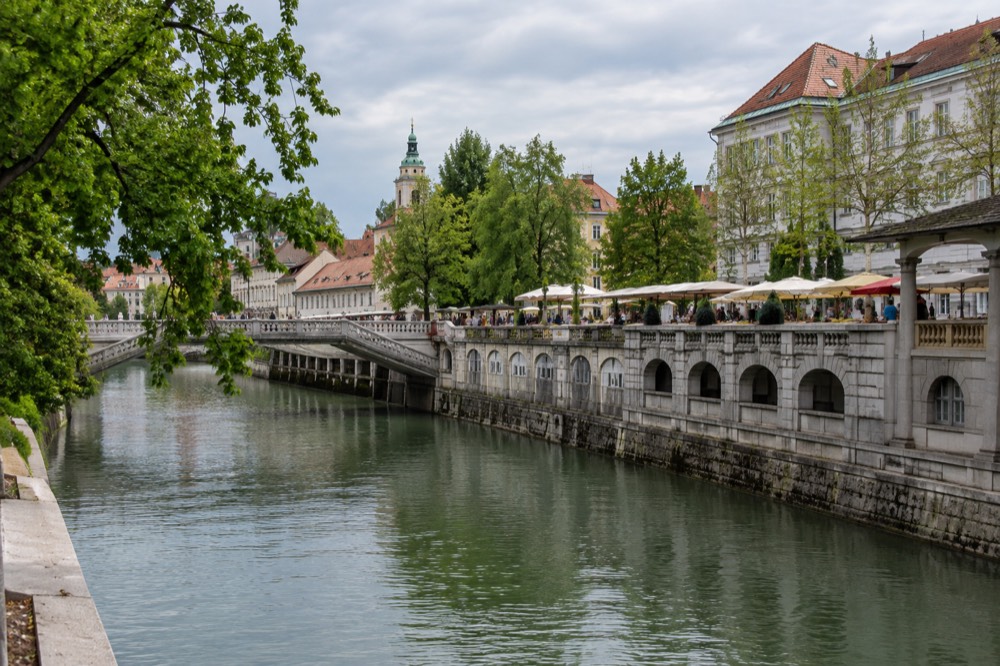
Within a five-minute walk of the market squares you have the Ljubljana Cathedral, the Butchers' Bridge, the riverfront promenade, the funicular to Ljubljana Castle, the Ribja trg pier for river boats, and the boutique and food streets of the old town, which makes the market district the natural starting point for almost any central itinerary. The density here is the reason so many itineraries begin at the river rather than at a museum, and it is worth knowing the order of things before you set out.
Walk it as a loop. Start at Vodnikov trg, take the colonnade south along the river, cross at the Shoemakers' Bridge, Čevljarski most, for the view back at the market from the other bank, then return via the cathedral and the archbishop's palace to Pogačarjev trg. That is twenty minutes of walking that covers the most photographed stretch of the city, and every part of it is pedestrianised.
The Ljubljanica river cruise guide covers the boat departures from the nearby piers, a 50-minute trip that pairs well with a market morning, and the Tivoli Park guide covers the green escape at the other end of the centre if the afternoon stays fine. For architecture readers, the market colonnade is one of the key Plečnik works in the city, and the Plečnik's Ljubljana guide puts it in the context of his whole riverbank plan.
The market district also answers the souvenir question better than the shops do. Honey, cheese, a market-canvas bag, a jar of something from a producer who tells you what it is: these are the souvenirs that survive the trip home. The shopping in Ljubljana guide covers the retail side for everything else.
How Much Time and Money Should You Budget?
Budget one to two hours for a market walk and a morning for the full market-plus-old-town loop, and expect to spend very little unless you want to: browsing is free, a pastry and coffee from a stand is a few euros, a cheese-and-bread picnic for two from the stalls is comparable to a single restaurant main, and the covered halls take cards while the informal weekend stalls prefer cash. The market is one of the few attractions in a European capital where the cost scales almost entirely with your appetite.
The currency is the euro. Slovenia adopted it on 1 January 2007, so there is no money-changing to plan if you are coming from the eurozone, and cards are accepted almost everywhere in the city. The exception worth remembering is the flea and informal stalls, where cash in small notes is still the working method.
One more budget line belongs in any honest account of a Ljubljana visit: the tourist tax. The city charges 3.13 EUR per person per night, a 2.50 EUR tax plus a 0.63 EUR promotion surcharge, collected through your accommodation, with a half rate of 1.57 EUR for ages 7 to 18 and children under 7 exempt. It is small, but it is per night, and it is worth knowing it exists before you see it on your hotel bill.
If you are structuring a whole visit around food and markets, the guided options stack up well. The wine tasting experience with appetizers, a two-hour silent electric boat ride along the Ljubljanica rated 4.8 from 226 reviews, from $64, turns the market-and-river pairing into a single evening. And the Ljubljana food tour guide compares the tasting walks if four hours on foot is more than you want.
For everything else, the trio below covers the three most common ways visitors extend a market morning: the cave and castle day trip, the Lake Bled excursion, and the free tips-based walk through the old quarter.
Common Questions About Ljubljana Markets
What are the main markets in Ljubljana?
The Central Market between Vodnikov trg and Pogačarjev trg is the main market, with open-air stalls, covered halls, weekend flea and antique sellers around the squares, and the Friday Open Kitchen food market on Pogačarjev trg from March to November.
When is the Central Market open?
The outdoor market runs roughly Monday to Saturday, 06:00-18:00 in summer and 06:00-16:00 in winter, with limited Sunday opening from April to November. The covered halls run Monday to Friday 07:00-16:00 and Saturday 07:00-14:00, closed on Sundays.
Where is the flea market in Ljubljana?
The flea and antique stalls cluster around Vodnikov trg and the edges of the market district, typically on weekend mornings. The scene is informal and small, so treat it as a bonus rather than a scheduled attraction and bring small cash.
What is Open Kitchen in Ljubljana?
Open Kitchen, Odprta Kuhna, is a Friday street-food market on Pogačarjev trg, roughly March to November, from around 10:00 to 21:00 and later on warm evenings, where restaurants and producers from across Slovenia cook from open-air stands. It is cancelled in bad weather.
Is the Central Market worth visiting?
Yes, especially on a Saturday morning or a Friday when Open Kitchen runs. It is a working food market in a Plečnik-designed riverside setting, close to the cathedral, the castle funicular and the old town, and it costs nothing to browse.
What should I buy at Ljubljana's markets?
Alpine cheese, local honey, bread and pastry from the market bakers, and seasonal fruit. In late summer the stone fruit is excellent, and in autumn look for pumpkins, chestnuts and mushrooms from the surrounding hills.