Ljubljana Central Market (Vodnikov Trg): Stalls, Hours and Food Tours
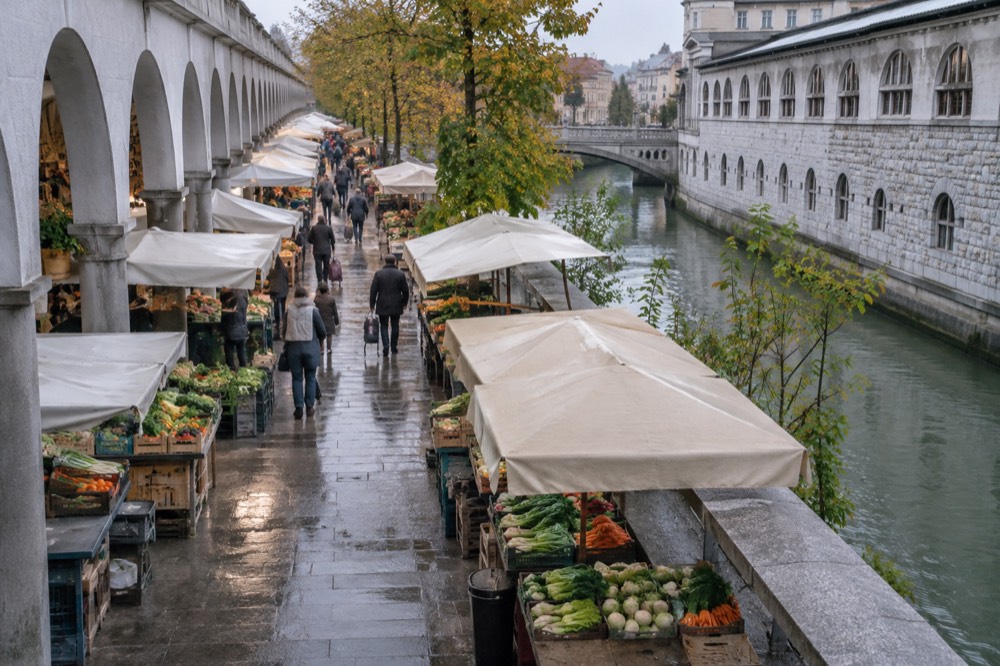
Ljubljana Central Market spreads across Vodnikov trg and Pogačarjev trg between the Old Town and the Ljubljanica, and it is where the city does its shopping, its snacking and, every Friday from spring to late autumn, its open-air eating.
Short answer
Ljubljana Central Market runs across two squares, Vodnikov trg and Pogačarjev trg. Outdoor stalls trade Monday to Saturday from 06:00, closing at 18:00 in summer and 16:00 in winter, and the covered halls open weekdays until 16:00. Entry is free, and on Fridays the Open Kitchen street-food market runs on Pogačarjev trg from 10:00.
Ljubljana Central Market is not a tourist attraction dressed up as one. It is a working market where locals buy pumpkin seed oil, štruklji rolls and bunches of herbs, and where the city's cooks come for the morning's vegetables. The market occupies two adjoining squares, Vodnikov trg and Pogačarjev trg, pressed between the Ljubljanica and the foot of the castle hill, a two minute walk from Prešeren Square. For visitors it doubles as the cheapest possible introduction to Slovenian food, and on Fridays it turns into one of the best lunch spots in the country. This guide covers the hours, the stalls, the Open Kitchen street-food Fridays, the food tours that use the market as a starting point, and the practical details that make a visit easy.
What Is the Ljubljana Central Market?
The Ljubljana Central Market is the city's main produce market, spread across the adjoining squares of Vodnikov trg and Pogačarjev trg in the historic centre. It combines open-air stalls, covered market halls and a riverside colonnade, trades six days a week, and sits within Ljubljana's pedestrianised centre, roughly two minutes on foot from Prešeren Square.
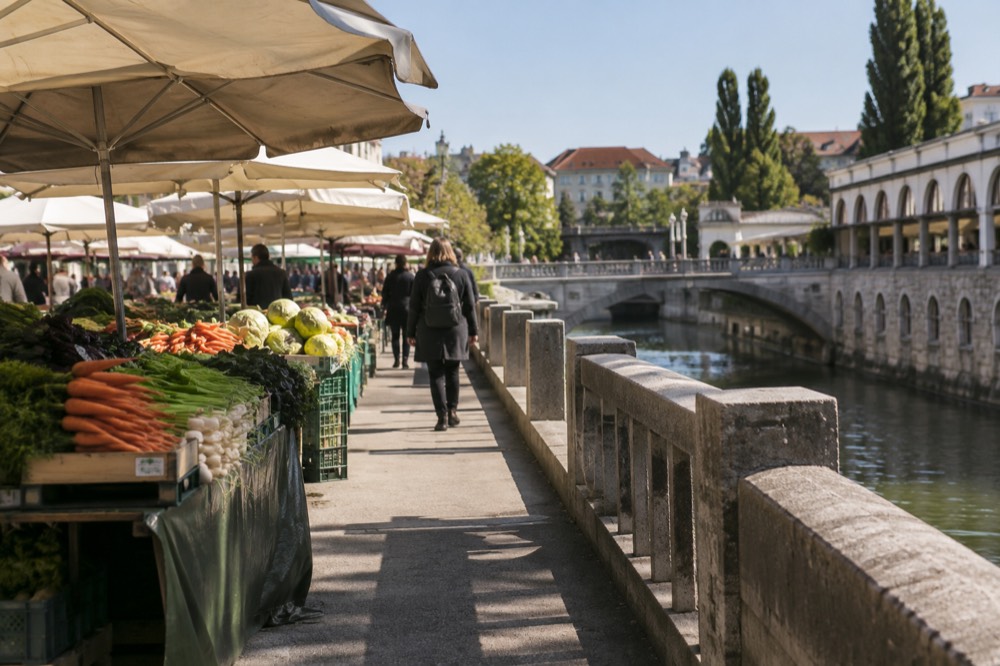
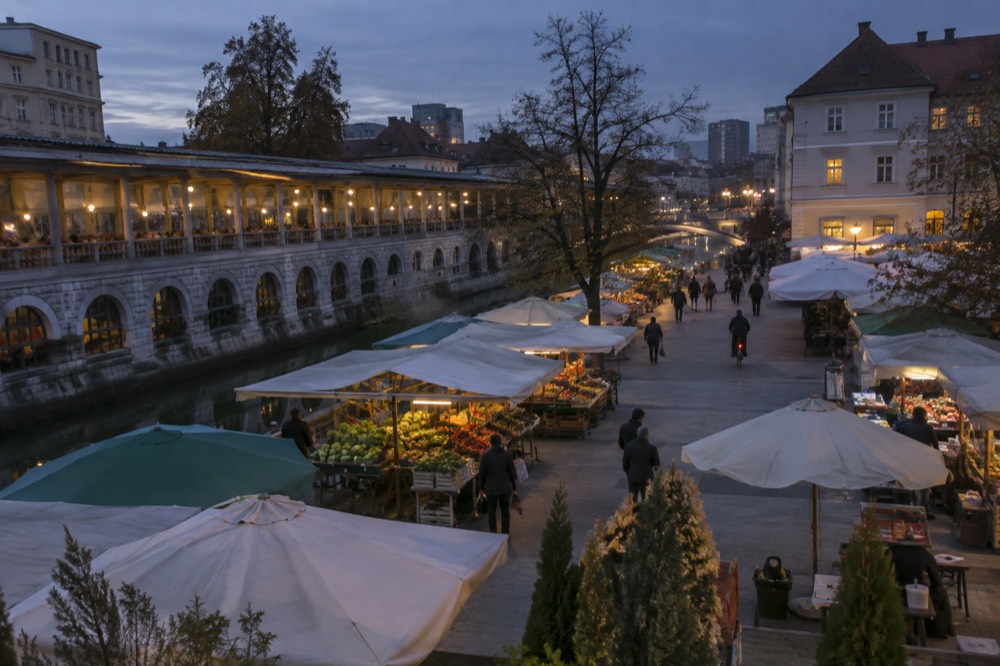
The market is really three markets in one place. The open-air part fills the squares with rows of stalls selling fruit, vegetables, herbs, flowers, honey, cheese and cured meats, and it starts early: 06:00, when most visitors are still asleep. The covered halls beside the square hold the butchers, bakers, fishmongers and dairies, the traders who need a roof and a fridge. Along the river itself runs a long stone colonnade, and under it you find the smaller stalls, the spice sellers, the pickle vendors, the pumpkin seed oil and the wine. The operator of the city's marketplaces, JP LPT, runs the site and publishes the official hours on its marketplace pages.
What surprises most visitors is how central all of this is. The market sits inside the pedestrianised historic core, a zone of roughly 20 hectares closed to general motor traffic and progressively expanded since 2007, according to the City of Ljubljana's own mobility pages. You do not need to plan a trip to reach it. If you are staying anywhere in the centre, you will walk past it, and the smell of the herb stalls will do the rest.
The market is also the honest answer to a question a lot of travellers ask: where do people in Ljubljana actually shop? Not in souvenir shops, and not in the old town's gift boutiques. Here, on a Saturday morning, alongside everyone else. If you want to understand what the city eats, spend half an hour at these stalls before you spend anything in a restaurant.
Where Is Vodnikov Trg and How Do You Get There?
Vodnikov trg sits immediately east of the Triple Bridge, between the Ljubljanica river and the foot of Ljubljana Castle's hill, with Pogačarjev trg continuing east toward the Dragon Bridge. The whole market area is inside the car-free centre, so you arrive on foot, by city bus to a stop on the edge of the zone, or by BicikeLJ shared bike.
Walking is the normal way in. From Prešeren Square, cross the Triple Bridge, and the first stalls are on your right within a minute. From the other direction, the Dragon Bridge deposits you at the top end of Pogačarjev trg. The market is effectively a corridor between the two bridges, and you cannot really get lost. Our overview of the Old Town walking routes places the market on the standard circuit, and the Ljubljana walking tour options all pass through or beside it.
If you are arriving from further out, the city buses matter, and so does one rule: cash does not work on board. Ljubljana's buses run on the Urbana card system, and a single zone 1 ride, valid 90 minutes including transfers, costs 1.50 EUR, with the card itself costing 2.00 EUR to buy. You can also tap a contactless bank card or phone directly, which removes the old trap of needing a card before you can board at all, but coins and notes are still refused. Cards and top-ups are sold at the LPP Passenger Centre on Slovenska cesta, at Urbanomat machines, kiosks and tourist information centres.
| Way in | What to know | Cost |
|---|---|---|
| On foot from Prešeren Square | Cross the Triple Bridge, stalls begin within a minute | Free |
| On foot from the Dragon Bridge | You arrive at the top of Pogačarjev trg | Free |
| City bus, zone 1 | 90 minutes including transfers, no cash on board | 1.50 EUR per ride, 2.00 EUR for the Urbana card |
| Contactless bank card on bus | Accepted on board, no Urbana needed | Same fare |
| BicikeLJ shared bike | Included with the Ljubljana Card for 4 hours | Card holders ride free |
Cyclists and walkers have the run of the centre, and that is the point of the pedestrianised zone. If you are planning a wider trip around the city, the getting around Ljubljana guide covers the buses, bikes and river crossings in detail, and the castle funicular guide covers the ride up the hill that looms directly above the market's stalls.
What Are the Market's Opening Hours?
Outdoor stalls on Vodnikov trg and Pogačarjev trg trade Monday to Saturday, roughly 06:00 to 18:00 in summer and 06:00 to 16:00 in winter, with limited Sunday and holiday opening from April to November. The covered halls open Monday to Friday 07:00 to 16:00 and Saturday 07:00 to 14:00, so the early hours belong to locals and the late morning to everyone.
The hours come from JP LPT, the marketplace operator, and they reward early risers. By 09:00 the market is in full swing, and by early afternoon the outdoor stalls are thinning, especially in winter when the 16:00 close comes around quickly. Sunday is the quiet day: the operator lists limited Sunday and holiday opening for the outdoor market between April and November only, and the covered halls shut entirely. If your visit falls on a Sunday outside that window, plan for the Old Town's cafés instead.
| Part of the market | Days | Hours |
|---|---|---|
| Outdoor stalls, summer | Monday to Saturday | 06:00-18:00 |
| Outdoor stalls, winter | Monday to Saturday | 06:00-16:00 |
| Outdoor stalls, Sundays and holidays | April to November only | Limited opening |
| Covered halls | Monday to Friday | 07:00-16:00 |
| Covered halls | Saturday | 07:00-14:00 |
| Open Kitchen street food | Fridays, roughly March to November | 10:00-21:00, later on warm days |
Timing within the week matters as much as timing within the day. Saturday morning is the market at its fullest and its most sociable, the one morning when the whole city seems to be buying bread and flowers at once. Friday brings a different crowd, because Friday is Open Kitchen day, and the market squares fill with food stands and tables from mid-morning. A quiet, purely local experience is a weekday before 09:00, when the stalls are stocked and the aisles are mostly yours.
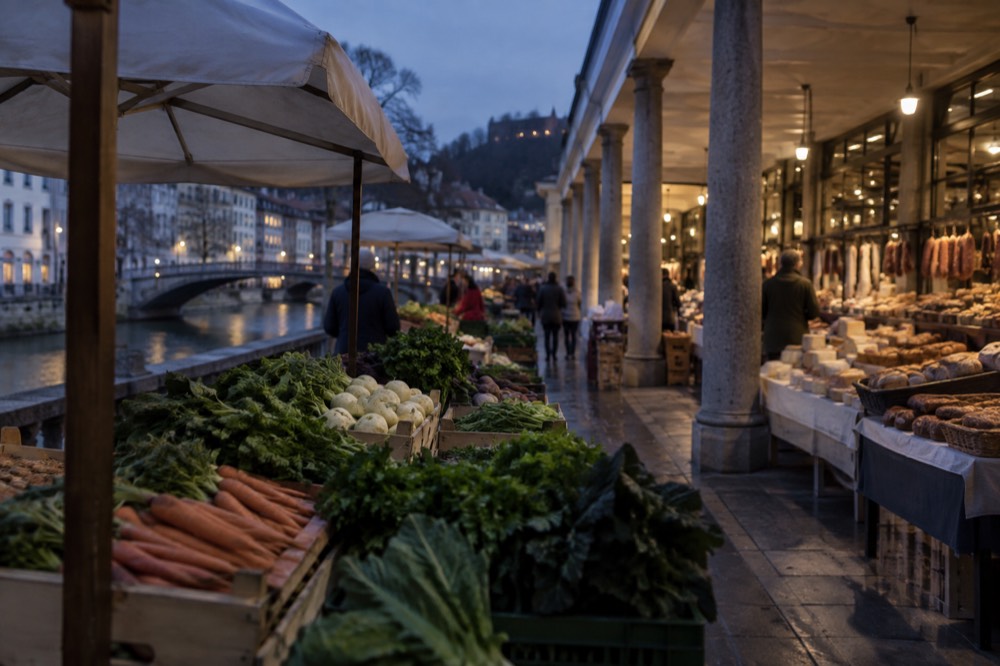
The market's rhythm also follows the weather more than most city sights, because half of it is outdoors. On a wet Tuesday in October the outdoor rows will be sparse and the covered halls will be doing the business. That is not a reason to skip it, but it is a reason to check the sky before you plan your whole morning around the stalls.
If the sky does look doubtful, or if you would rather have the market explained than merely browsed, a guided food walk is the weatherproof option. The Slovenian cuisine walking tour with tastings runs about four hours, is rated 4.8 across 552 reviews, and starts from around $104 per person, with free cancellation so a rainy forecast does not lock you in.
What Will You Find at the Stalls?
Expect fresh fruit and vegetables, herbs, flowers, honey, cheese, cured meats, pumpkin seed oil, spices, pickles and bread, split between the outdoor squares, the covered halls and the riverside colonnade. Prices are market prices rather than souvenir prices, and the stalls take cash and usually card, though a few small vendors still prefer coins.
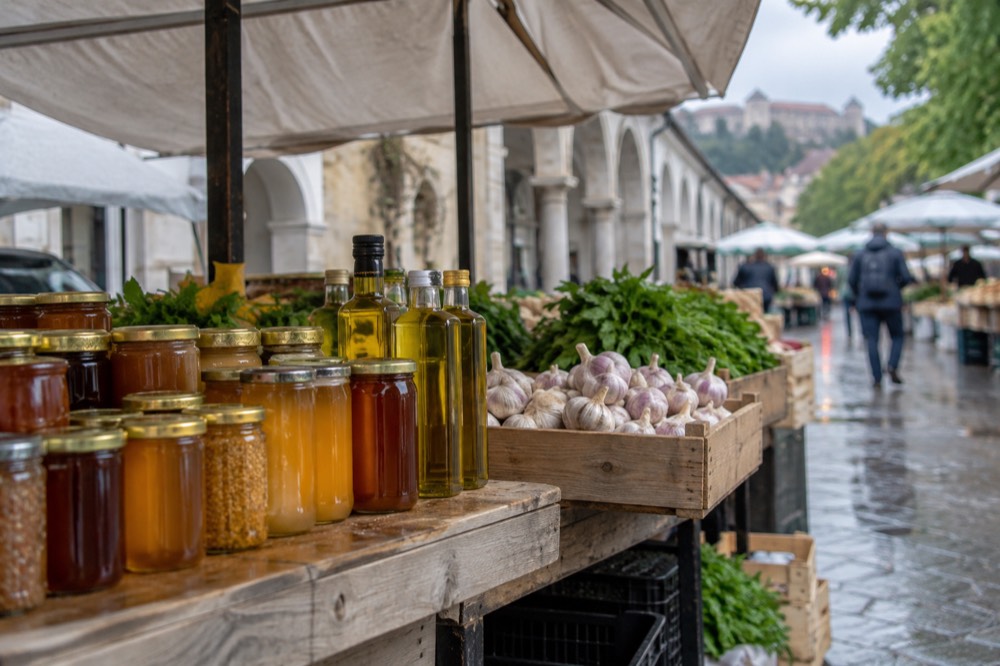
The outdoor squares carry the seasonal produce: apples and pears in autumn, cherries and strawberries in early summer, bunches of herbs all year. The covered halls are where the protein lives, butchers and fishmongers and dairies selling the cheeses the country is known for. Under the colonnade by the river, the specialty stalls cluster: pumpkin seed oil, a Slovenian staple that locals drizzle on nearly everything, jars of honey, sacks of dried mushrooms, and the spice and pickle sellers whose barrels of pickled vegetables are one of the market's small spectacles.
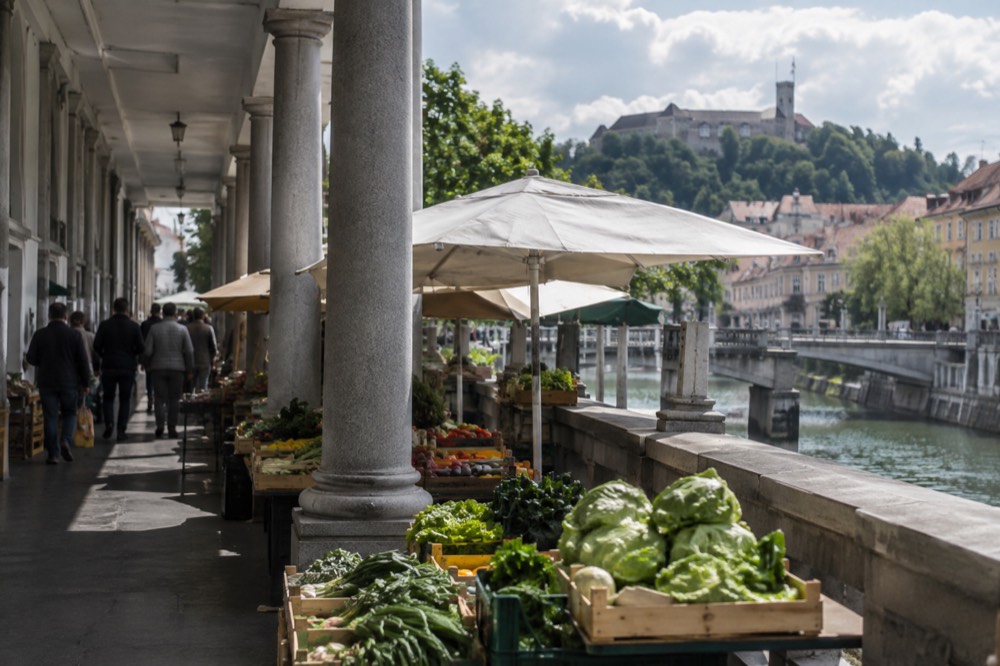
What the market does especially well is the grazing shopping trip. You can assemble a picnic here in twenty minutes: bread from a hall, cheese from a dairy counter, prosciutto-style cured pork, fruit from a stall, a bottle of something from a wine seller. Then you take it ten metres to the riverbank and eat it with the castle above you. It is the cheapest good meal in the centre, and it needs no booking.
For visitors who want the context rather than just the calories, this is where the guided food walks earn their price. A market stall tells you what a food is; a guide tells you why Slovenia eats it, where it comes from and how to say it. The cuisine walking tour with tastings is the one most built around this neighbourhood, and the combined food and wine tour of Ljubljana covers similar ground with wine added.
The market also answers the question of what to buy to take home. Pumpkin seed oil travels well and is genuinely hard to find at this quality elsewhere. Honey, dried herbs and the small jars of preserves all fit in hand luggage. Skip anything already packed for tourists elsewhere; this is the place to buy the things locals actually buy.
What Is Open Kitchen and Why Does It Matter?
Open Kitchen, Odprta Kuhna in Slovenian, is a Friday street-food market on Pogačarjev trg where restaurants, chefs and producers cook in the open air, running roughly March to November from 10:00 until 21:00 and later on warm days. The tourist board's own wording is that it happens every sunny Friday, and that is literal: it is cancelled in bad weather.
That weather clause is the detail most guides miss. Open Kitchen is not a fixed weekly institution with a roof. It is an outdoor food event, and the official page on the Ljubljana tourist board's events site says plainly that it runs on sunny Fridays. On a grey, drizzling Friday in April, the square can be empty. Check the forecast, not just the calendar.
When it does run, it is the single best lunch hour in the city. Restaurants that normally sit behind walls set up grills and counters in the square, and you buy small plates directly from the cooks, moving from stand to stand. The spread runs from Slovenian classics to whatever the city's chefs are currently interested in, and the square fills with tables and a crowd that is half locals, half visitors, all eating. The rest of the planning pages sit on Ljubljana Travel Guide.
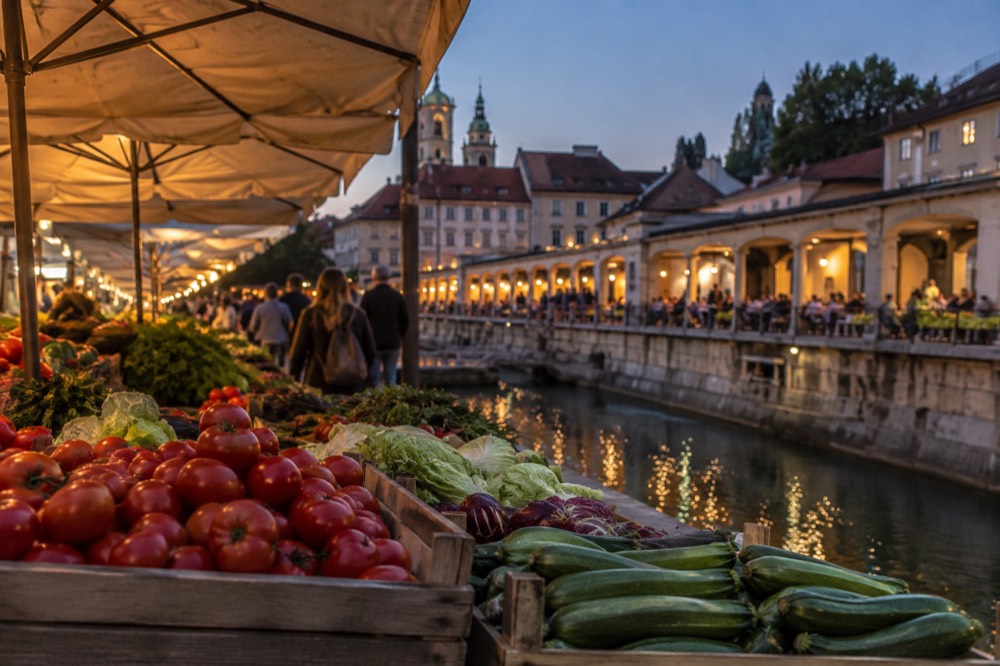
Timing within the day matters here too. Lunch, from around noon to 14:00, is busy but manageable. Evening, from 18:00 onward, is the social hour, when the after-work crowd arrives and the stands stay open late if the evening is warm. If you want to taste a lot without queueing for anything, arrive close to the 10:00 start.
Our fuller Open Kitchen guide covers the event stand by stand, and the Ljubljana events calendar places it among the city's other seasonal fixtures. If your trip does not include a Friday, the market's ordinary stalls still feed you well, and the where locals eat in Ljubljana guide picks up where the stalls leave off.
Can You Tour the Market with a Guide?
Yes, several guided food experiences use the Central Market area and the Old Town around it, from a four-hour Slovenian cuisine walk with tastings to shorter combined food and wine walks, plus a free tips-based GuruWalk walk that pairs the city's sights with snack stops. A guided walk costs from about $34 to $104 per person depending on length and inclusions, and free walks run on a pay-what-you-think-it-was-worth basis.
The standout for market-first visitors is the Slovenian cuisine walking tour with tastings: four hours, rated 4.8 from 552 reviews, from around $104. It walks the city's food traditions and stops to taste as it goes, which is the format that suits the market neighbourhood best. Shorter and cheaper, the boat and walking tour combines a river cruise with an Old Town walk in two and a half hours from $34, and the combined food and wine tour, three hours from around $112, adds Slovenian wine to the route.
| Experience | Length | Rating | From |
|---|---|---|---|
| Slovenian cuisine walking tour with tastings | 4 hours | 4.8 from 552 reviews | $104 |
| Food and wine tour, local foodie adventure | 3 hours | 4.9 from 282 reviews | $112 |
| Wine tasting with appetizers, electric boat | 2 hours | 4.8 from 226 reviews | $64 |
| Traditional food journey | 3 hours | 5.0 from 54 reviews | $104 |
| Best of Ljubljana free walk (GuruWalk, tips-based) | 2 hours | 4.7 from 271 reviews | Free, pay what you think it was worth |
The free option deserves a mention precisely because it is honest about what it is. The Best of Ljubljana walk on GuruWalk is a tips-based tour, free to join with a guide you pay what you think it was worth at the end, and its route takes in the top sights with tastings at stops along the way. It is a good first-day orientation, and it will walk you straight past the market so you know where to come back to.
For something more hands-on, the štrukelj cooking class teaches the rolled pastry that appears at half the market's dairy counters, three hours from $70 with a 4.9 rating from 90 reviews. And for a deeper dive into the old food traditions, the three-hour traditional flavours journey, rated 5.0 from 54 reviews, eats its way through the city's culinary history.
What Practical Details Should You Know Before Visiting?
Entry to the market is free, prices at the stalls are ordinary Slovenian grocery prices, the centre around it is pedestrianised so you cannot drive to the stalls, and the city adds a tourist tax of 3.13 EUR per person per night, half rate for ages 7 to 18, which is collected by accommodation rather than at the market.
Money first. Slovenia is in the eurozone, having adopted the euro on 1 January 2007, so there is no currency to change if you are coming from another euro country. At the stalls, small notes and coins are still the friendliest currency for a two-euro bunch of herbs, though most of the covered halls take cards. The market is not a place where you need to plan a budget; it is the place you come to when you want to spend less than a restaurant would charge.
Transport second. You cannot park at the market, because the historic centre is closed to general traffic, a pedestrian zone the city says covers roughly 20 hectares. Buses stop on the edges of the zone, and the no-cash-on-board rule is the single detail that catches visitors out: an Urbana card costs 2.00 EUR and a ride is 1.50 EUR, or tap a contactless bank card directly. The Ljubljana prices guide and the Ljubljana on a budget guide both work through what things cost across the city.
| Practical item | Figure |
|---|---|
| Market entry | Free |
| Tourist tax | 3.13 EUR per person per night, half rate 1.57 EUR for ages 7-18, under 7 exempt |
| Bus ride, zone 1 | 1.50 EUR, 90 minutes including transfers |
| Urbana card | 2.00 EUR to buy, cash not accepted on board |
| Currency | Euro, adopted 1 January 2007 |
| Schengen status | Internal land and sea checks abolished 21 December 2007, air checks 30 March 2008 |
Third, the paperwork that surrounds a Slovenian trip is lighter than most of Europe. Slovenia is a member of the European Union, uses the euro and sits inside the Schengen area, with internal land and sea border checks abolished on 21 December 2007 and air checks following on 30 March 2008, per the Slovenian government's own EU membership pages. Arriving from Italy, Austria, Hungary or Croatia, there are no routine border checks and no money to change.
That climate detail is the one to plan around. An autumn visit to the outdoor stalls is a coin toss in a way a summer visit is not, and the covered halls are the reliable half of the market. The best time to visit Ljubljana guide works through the whole year month by month.
What Else Should You Combine with the Market?
The market sits inside a five minute walk of the Triple Bridge, the Dragon Bridge, Prešeren Square and the funicular up to Ljubljana Castle, so the natural plan is a circuit: market first thing, Old Town bridges mid-morning, then the castle after the crowds build. Add the Plečnik House or a river cruise if you have a full day.
The geography does the planning for you. Vodnikov trg ends at the Triple Bridge; cross it and you are on Prešeren Square, the city's main stage, covered in our Prešeren Square guide. Walk the market's other end and you reach the Dragon Bridge, with its four brass dragons, which the Dragon Bridge guide covers along with the best angles for photographs. Between the two, the riverside colonnade runs along the Ljubljanica, and the Ljubljanica river cruise guide explains the boat trips that leave from the same bank.
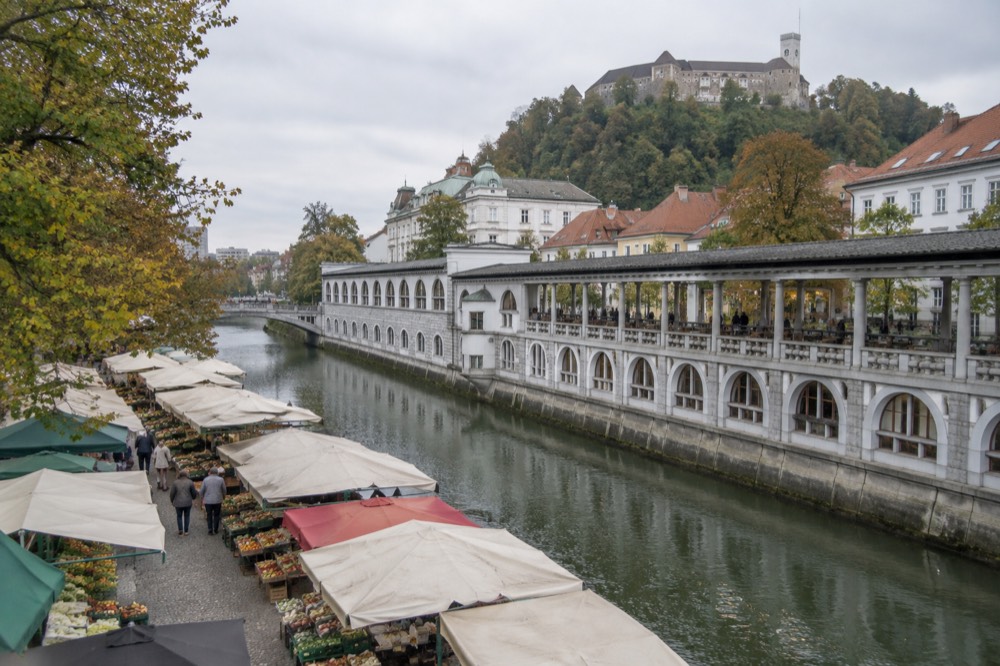
The castle is the obvious afternoon. The funicular leaves from beside the river a few minutes' walk from the market, and a castle ticket including the funicular costs 19.00 EUR for an adult, per the castle's own price list, though note that the castle grounds themselves are free to enter and only the funicular, tower and attractions carry a ticket. The Ljubljana Castle guide works through what is worth paying for.
If food is the thread of your whole day, keep it going. The where to eat in Ljubljana guide covers the restaurants, the Slovenian food in Ljubljana guide explains the dishes you will have seen at the stalls, and the Ljubljana markets overview places the Central Market among the city's other marketplaces. For a fuller pairing, the traditional flavours food journey runs three hours and is rated 5.0 from 54 reviews, from $104.
A reasonable single morning looks like this: stalls at 08:00 with coffee from a stand or a nearby café, the covered halls by 09:00 before the Saturday crush, the colonnade and the riverbank by 10:00, and then either Open Kitchen if it is a sunny Friday, or the bridges and the castle hill if it is not. That is half a day, one small spend, and the part of Ljubljana that most visitors say later felt the most real.
If a guided version of that morning appeals, these three are the food experiences most worth checking:
Common Questions About the Ljubljana Central Market
Is the Ljubljana Central Market free to enter?
Yes. The market is a public marketplace and entry costs nothing; you only pay for whatever you buy at the stalls. The covered halls are equally free to browse.
What are the Central Market's opening hours?
Outdoor stalls trade Monday to Saturday, roughly 06:00 to 18:00 in summer and 06:00 to 16:00 in winter, with limited Sunday and holiday opening from April to November. The covered halls open Monday to Friday 07:00 to 16:00 and Saturday 07:00 to 14:00.
Where exactly is the market held?
Across two adjoining squares in the pedestrianised centre: Vodnikov trg and Pogačarjev trg, between the Triple Bridge and the Dragon Bridge, beside the Ljubljanica river.
What is Open Kitchen?
Open Kitchen, Odprta Kuhna, is a Friday street-food market on Pogačarjev trg, running roughly March to November from 10:00 to 21:00 and later on warm days. The tourist board's wording is every sunny Friday, and it is cancelled in bad weather.
Can I pay by card at the stalls?
Most covered-hall traders take cards, and many outdoor stalls do too, but small vendors prefer cash. Note that the city's buses take no cash at all: use an Urbana card or tap a contactless bank card.
Which day is best for visiting the market?
Friday for Open Kitchen, Saturday morning for the fullest, most local atmosphere, or a weekday before 09:00 for quiet browsing with fully stocked stalls. Avoid Sunday, when the covered halls are shut and outdoor opening is limited.