Ljubljana Cathedral (St Nicholas): What to See and How to Visit
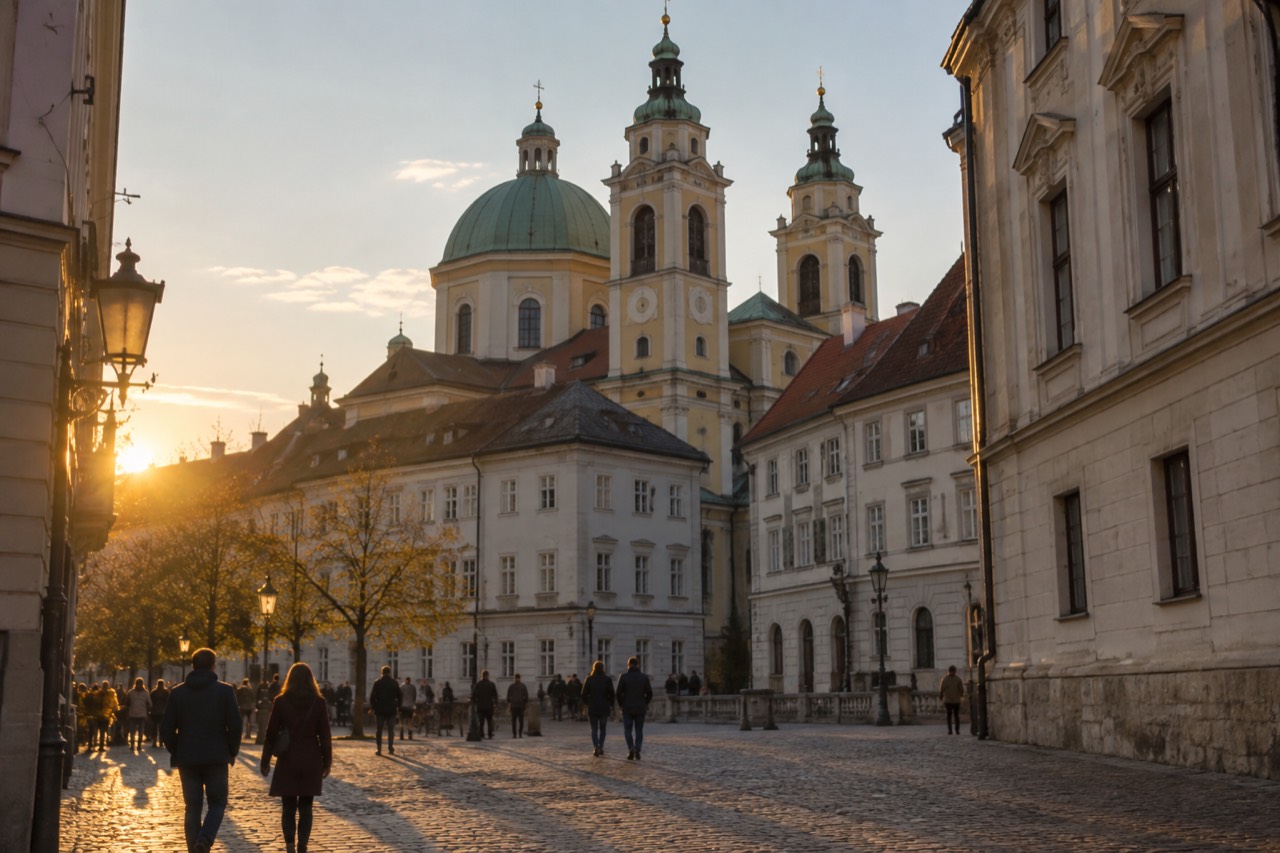
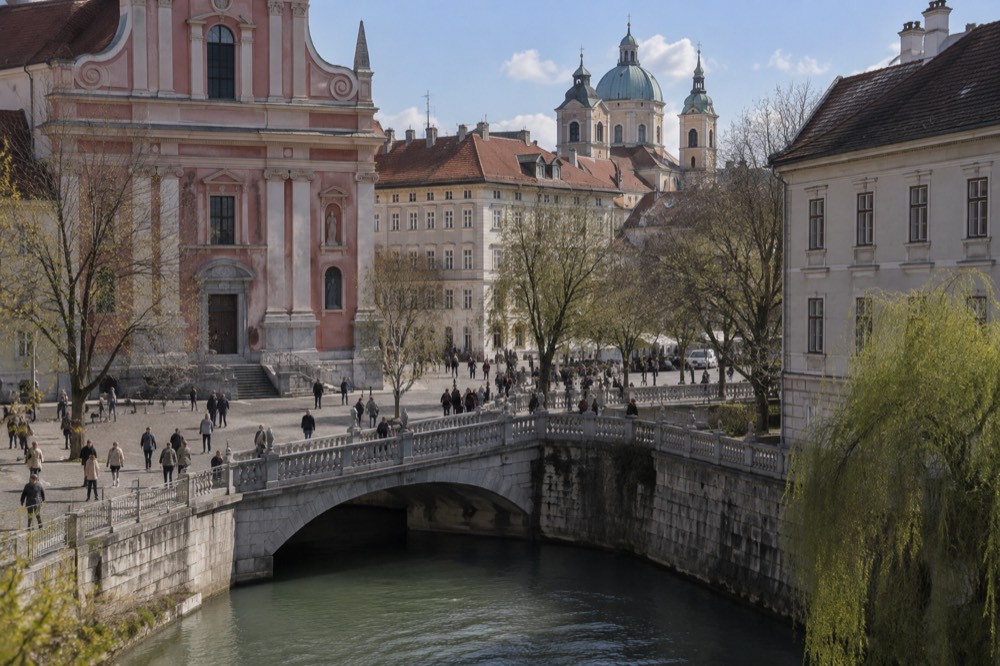
Ljubljana Cathedral, dedicated to St Nicholas, is the city's mother church, standing a few steps from the Ljubljanica and the Central Market with its dome visible from across the basin.
Short answer
Ljubljana Cathedral (St Nicholas) is the city's cathedral church, set beside the Ljubljanica between the Central Market and the foot of Castle Hill. Expect a green dome, twin bell towers, painted interior vaults and an active parish life. Most visitors spend 20 to 40 minutes inside and pair it with the market, the river bank and the walk up to Ljubljana Castle.
Ljubljana's skyline answers to two shapes: the castle on its hill, and a green dome just behind the river. The dome belongs to the Cathedral of St Nicholas, the mother church of a city that grew up around river trade, fishing and the bridges that crossed the Ljubljanica. St Nicholas is the traditional patron of fishermen and boatmen, which is why a landlocked capital's grandest church carries the name of a sea saint. The building sits at Ciril-Metodov trg, a one-minute walk from the Central Market and the water, and it is the single most prominent piece of ecclesiastical architecture in the city centre.
What Is Ljubljana Cathedral (St Nicholas)?
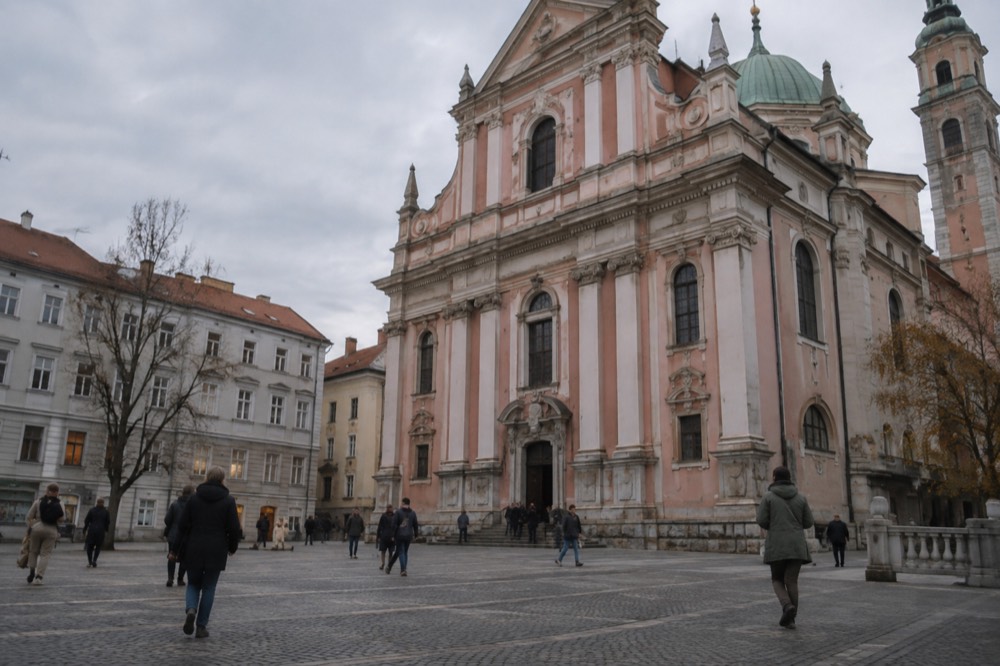
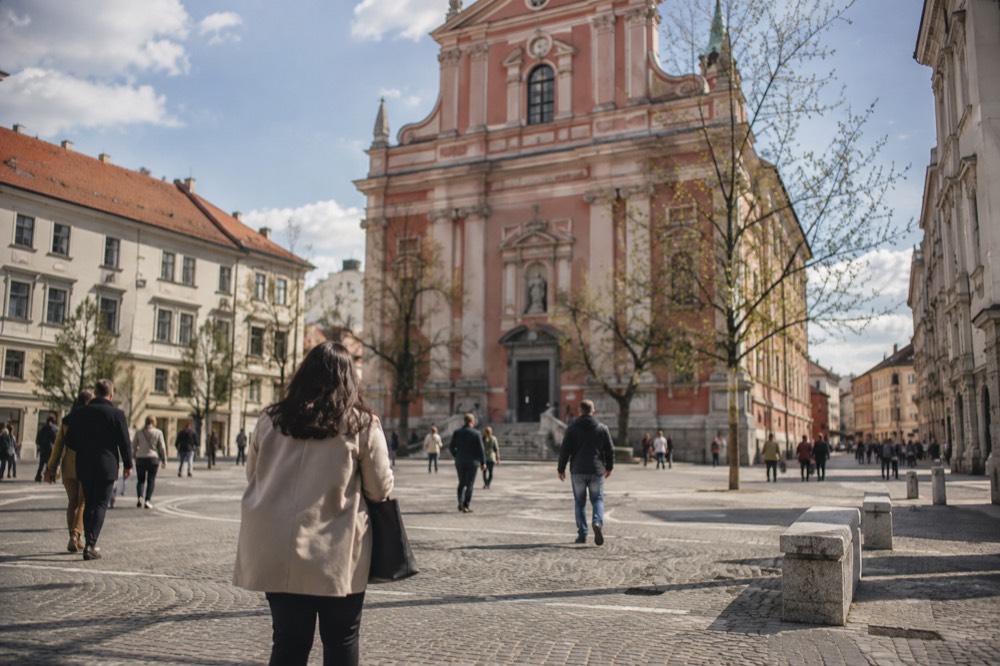
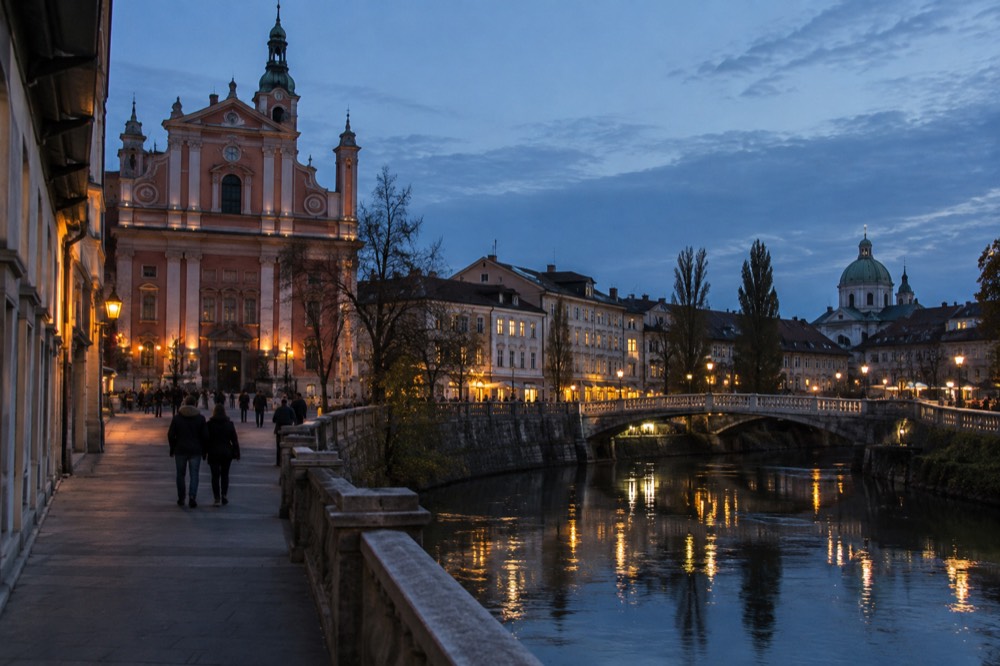
The Cathedral of St Nicholas is Ljubljana's Roman Catholic cathedral and the seat of the city's archdiocese, a domed baroque church with twin bell towers that dominates the eastern edge of the old centre. It is an active parish church rather than a museum, so a visit means stepping into a working place of worship between Masses, and the whole thing, outside walk-in gaps, takes most people well under an hour. It is the church you see from Prešeren Square when you look past the Franciscan church's pink facade, and the one whose dome photographs best from the river bank at dawn or dusk.
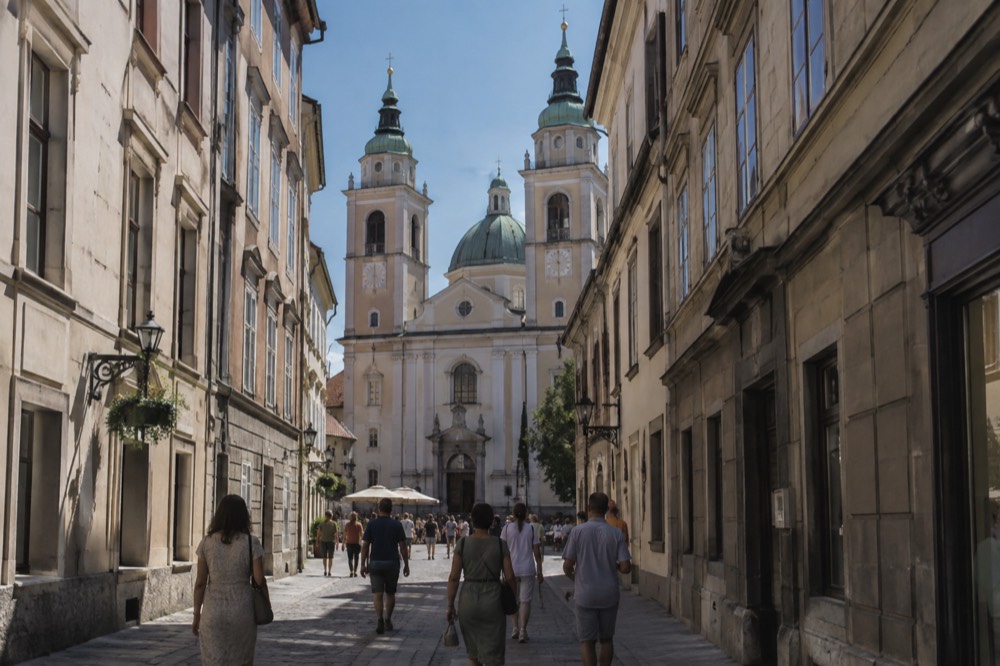
The dedication tells you a great deal about the city. Before Ljubljana was a capital, it was a river town whose wealth moved on the Ljubljanica, and St Nicholas watched over the people who made their living on the water. The church stands a short walk from where boats still dock today, including the departure points for the Ljubljanica river cruise, and the connection between the cathedral and the river is not just symbolic. On a practical visit, the two belong to the same half-hour of walking: church, market, bank, bridge.
What surprises many first-time visitors is how close everything in this city sits to everything else. The cathedral is around the corner from the Central Market, a few minutes' level walk from Prešeren Square, and roughly at the midpoint of the route between the river and the base of the castle funicular. You do not plan a trip to the cathedral. You fold it into a morning, and this guide explains how.
Where Is the Cathedral and How Do You Reach It?
The cathedral stands at Ciril-Metodov trg, on the eastern edge of the pedestrianised old centre, about five minutes' walk from Prešeren Square and two minutes from the Central Market's riverside halls. No car can reach the door because the historic centre is closed to general traffic, so you arrive on foot, by city bus to a stop on the ring of the pedestrian zone, or by taxi to the nearest vehicle-accessible street. That pedestrianisation is the single most useful planning fact for anyone arriving by car: park outside the centre and walk in.
The city's buses are run by LPP, and a single zone 1 ride costs 1.50 EUR with a 2.00 EUR Urbana card, valid for 90 minutes including transfers. One detail that catches visitors out: buses do not accept cash at all, though contactless bank cards and mobile wallets are now accepted on board, per the operator's published payment rules. Buy or top up an Urbana at the LPP Passenger Centre on Slovenska 56, at Urbanomat machines, kiosks or tourist information centres.
| Way in | Where it leaves you | Walking time to the door | Notes |
|---|---|---|---|
| On foot from Prešeren Square | Edge of the pedestrian zone | About 5 minutes | Level, signposted, past the Triple Bridge |
| On foot from the bus station | Just outside the centre | About 10 minutes | Straight down Slovenska, then left at the river |
| City bus (LPP) | Ring stops such as Karlovška or Slovenska | 3 to 8 minutes | No cash on board; contactless or Urbana only |
| Taxi or transfer | Nearest drivable street | 2 to 5 minutes | The centre itself is off-limits to traffic |
| Airport transfer | City centre drop-off | Then walk | Ljubljana Airport sits about 26 km north of the city |
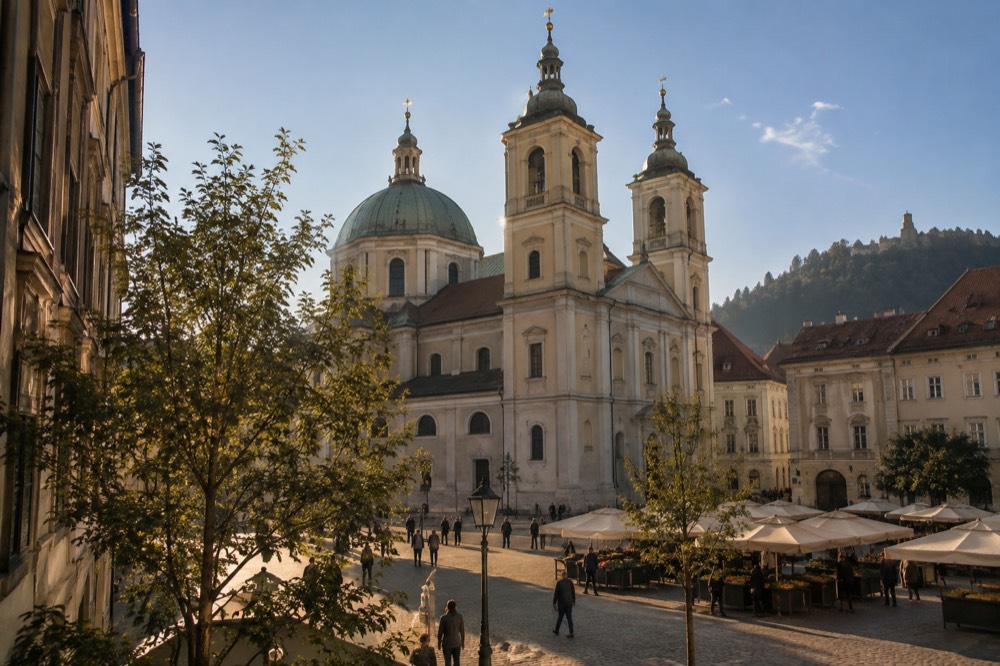
The nearest landmark most people actually navigate by is the market itself. Stand at Vodnikov trg among the outdoor stalls, face the river, and the cathedral's dome is immediately behind and above you. From the old town side, cross at the Triple Bridge or the butchers' bridge, Čevljarski most, and the church appears within a block. If you are doing a first-day orientation, the free GuruWalk walk Ljubljana Unveiled covers the Old Town's core sights and is a sound way to fix the geography before you branch off on your own.
What Will You See Inside the Cathedral?
Inside, the cathedral is a single grand vaulted space under a painted dome, with frescoed ceilings, side chapels, a carved choir and a high altar as the focal points, and the interior reads as one continuous decorative programme rather than a collection of separate monuments. Give your eyes a minute to adjust from the street, then look up: the dome and the vault paintings are the reason people remember this church. The style is baroque, built to overwhelm gently, with light, colour and height doing the work.
The bronze doors deserve a slow look, because they are the building's most-discussed exterior feature and most visitors walk straight past them. Stop at the main west doors before you go in and read the relief scenes cast into the metal; they are a modern addition to a much older building and they carry the church's story in a form you can study in two minutes. Around the outside, the twin towers and the dome reward a slow circuit of the whole block, especially from the market side in the morning when the light comes up the river valley.
Inside, the practical viewing order most visitors fall into works well: the nave first, then the side chapels along both aisles, then a slow look back toward the organ and choir from near the entrance, then the dome from directly underneath the crossing. The interior is an active liturgical space, so the altar area, sacristy doors and roped sections are working parts of the church rather than exhibits. Treat it as you would any parish cathedral: quiet voice, no flash, nothing climbed or touched.
| Feature | Where to look | What to notice |
|---|---|---|
| Green dome and lantern | From outside, any angle | The shape that anchors the city skyline, best from the river bank |
| Twin bell towers | West facade | The paired towers framing the main entrance |
| Bronze doors | Main west entrance | Relief scenes cast in metal, worth two slow minutes |
| Painted vaults and dome | Look up from the nave | The decorative programme that gives the interior its character |
| Side chapels | Both aisles | Smaller altars, each with its own decoration and lighting |
| High altar and choir | East end of the nave | The liturgical focal point; view from the nave, do not enter the sanctuary |
One honest note on planning: the cathedral is a working church, and opening hours for visitors bend around the Mass schedule, weddings, funerals and parish events, which means a posted schedule can be true on Monday and irrelevant on Saturday. Check the parish's own notice or the tourist information centre on the day. If the doors are shut, do not treat it as a lost cause: the market, the river bank and the walk up to Ljubljana Castle fill the gap easily, and you can return an hour later.
How Long Should You Spend at the Cathedral?
Most visitors spend between 20 and 40 minutes inside the cathedral, plus ten to fifteen for the exterior and doors, so the realistic total is under an hour for the building itself. The cathedral's real cost to your itinerary is not time but placement: it sits directly on the market-to-castle walking line, so the efficient move is to fold it into the morning you were already going to spend in the old centre rather than making a dedicated trip.
The best pairing is a Saturday or Friday morning. The Central Market's outdoor stalls run roughly 06:00 to 18:00 in summer and 06:00 to 16:00 in winter, Monday to Saturday, with the covered halls open weekday mornings and Saturday until early afternoon. Arrive with the market, buy something for later, step into the cathedral while your legs are still fresh, then decide between the river bank and the climb to the castle. On Fridays from roughly March to November, the Open Kitchen food market runs on Pogačarjev trg from 10:00 into the evening, weather permitting, and the official wording is "every sunny Friday", which is literal: it cancels in bad weather.
| Time of day | The cathedral | Around it |
|---|---|---|
| Early morning | Quietest, best interior light as sun climbs | Market stalls setting up, thin crowds |
| Mid-morning | Steady visitor flow, easy to enter between services | Market at full tilt, peak street life |
| Midday | Possible Mass or closure windows, check locally | Lunch options all around the old centre |
| Afternoon | Good light on the west facade and doors | Market winding down, castle queues easing |
| Evening | Exterior only for most of the year, check the parish notice | Dome lit against the sky, river bank at its best |
If you are compressing the city into a single day, the cathedral belongs in the first half. The one day in Ljubljana route practically writes itself through this block: Prešeren Square, the Triple Bridge, the market, the cathedral, then the funicular or the footpath up to the castle, with the late afternoon free for the river. Visitors with two or three days can afford to be lazier, but the geography keeps pulling everything back to this same corner, so it is worth doing the cathedral-and-market morning properly once rather than rushing it twice.
What Sights Sit Within Walking Distance?
Everything in Ljubljana's old centre is within a 15-minute walk of the cathedral, and the immediate five-minute circle contains the Central Market, the Ljubljanica river bank, the Triple Bridge, Prešeren Square and the foot of Castle Hill. The cathedral is the natural hinge of this cluster: it is the point where the market, the river and the castle routes all meet, which is why almost every walking tour in the city passes its doors.
| Sight | Walk from the cathedral | Why it pairs well |
|---|---|---|
| Central Market (Vodnikov and Pogačarjev trg) | 1 to 2 minutes | The cathedral's doorstep neighbour; do both in one morning |
| Ljubljanica river bank and piers | 2 minutes | Departure point for boat trips, best dome photos |
| Triple Bridge (Tromostovje) | 4 minutes | The crossing that leads to Prešeren Square |
| Prešeren Square and the Franciscan church | 5 minutes | The other great church facade of the city |
| Ljubljana Castle and funicular base | 5 to 8 minutes | Uphill finish; grounds free, funicular and tower ticketed |
| Plečnik House | About 20 minutes, or a short bus ride | Guided tours on the hour, book ahead |
The castle pairing deserves its own sentence, because it is the most common morning in the city and the cathedral sits directly on its path. The castle grounds are free to enter; the funicular and the Viewing Tower are not, and a castle ticket including the funicular costs 19.00 EUR for an adult per the castle's own price list. If you would rather have the story than the stairs, a guided walk that ends with the funicular ride up is the comfortable option, and it starts close to where you will already be standing. The rest of the planning pages sit on Ljubljana Travel Guide.
For architecture-minded visitors, the Plečnik House rounds out the same theme from a different angle: Jože Plečnik shaped much of the riverside and bridge-scape you walked to reach the cathedral, and his house museum runs guided tours on the hour with a 12 EUR ticket that includes the guide. It is a short bus ride or a brisk walk north-west of the centre, and it is the one nearby sight that genuinely needs a booked time slot rather than a walk-in.
Why Is the Cathedral One of the City's Best Bad-weather Stops?
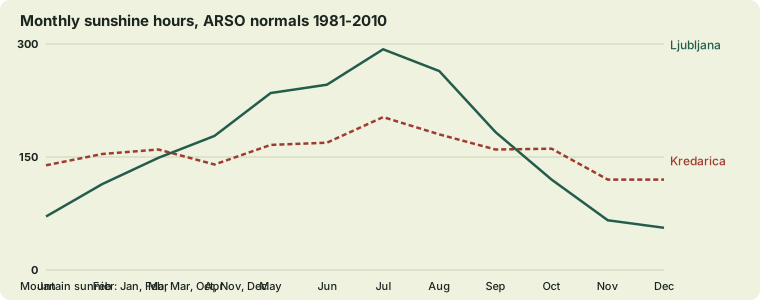
Because it is indoors, free of queues, and sits in the middle of a covered cluster: the market halls, the river bank and the museum quarter all stand within minutes, and Ljubljana genuinely needs that cluster, since ARSO's 1981-2010 normals give the city 1362 mm of rain a year across 153 days with measurable rain, with September and October the joint wettest months at 147 mm each, above July's 115 mm. A wet Saturday in autumn is a normal Saturday here, not bad luck.
The fog numbers are the detail most guides miss. ARSO's 1971-2000 series, the only period for which fog is published, gives Ljubljana 91.2 days with fog a year, and the foggiest stretch is not midwinter: September and October average 12.4 fog days each, level with December's 12.6 and well above January's 11.3. The cause is the basin the city sits in, where cold air traps under warmer air above in the colder half of the year. The practical consequence is simple: on a grey, dripping morning, the cathedral, the market halls and the museums are the plan, and the hills can wait for the afternoon.
| Month | Mean temperature (C) | Rain (mm) | Clear days | Notes for visitors |
|---|---|---|---|---|
| January | 0.3 | 69 | 2 | Frost and fog; indoor mornings, hilltop afternoons when it clears |
| April | 10.8 | 99 | 3 | Spring light on the dome, market season building |
| July | 21.3 | 115 | 5 | Warmest month; cathedral is a cool, dim break from the heat |
| September | 16.0 | 147 | 2 | Joint wettest month, 12.4 fog days; plan indoor backups |
| October | 11.2 | 147 | 1 | One clear day on average; the most overcast stretch of autumn |
| December | 1.2 | 107 | 2 | Christmas-market season; the dome above the stalls |
Figures above are ARSO 1981-2010 normals for the Ljubljana Bežigrad station, with fog days from the 1971-2000 series, published in the official climate tables. Our rainy day in Ljubljana guide builds a full wet-weather day from exactly this pattern, and the national museums' first-Sunday-of-the-month free admission, confirmed on four separate official institution sites, is the budget version of the same plan.
Which Tours and Day Trips Pair Well with a Cathedral Visit?
The cathedral needs no booked ticket, so the tours that pair with it are the ones that use it as a landmark rather than a destination: a city walking tour that passes its doors, a food walk that starts at the neighbouring market, and a half or full-day trip that departs from stops within a ten-minute walk. If you book only one guided experience for your stay, make it either an Old Town walk or one day trip, because the city itself is compact enough to cover unguided.
| Experience | Duration | Rating | From | Why it fits a cathedral morning |
|---|---|---|---|---|
| Guided walk with funicular to the castle | 2 hours | 4.6 from 650 reviews | $24 | Starts near the old centre, ends on Castle Hill |
| Slovenian cuisine walking tour with tastings | 4 hours | 4.8 from 552 reviews | $104 | Food walk through the market-and-old-town block |
| Electric boat tour on the Ljubljanica | 50 minutes | 4.6 from 149 reviews | $17 | Departs from piers minutes from the door |
| Cave and castle tickets and tour | 6 hours | 4.8 from 2802 reviews | $132 | The country's flagship day trip, direct from the city |
| Lake Bled and Bled Castle trip | 6 hours | 4.7 from 1641 reviews | $86 | The most-booked day out from Ljubljana |
| Ljubljana Unveiled free walk (GuruWalk) | 2 hours | 4.91 from 1496 reviews | Free, pay what you think it was worth | Orientation walk that fixes the geography on day one |
The free walks deserve a plain word of explanation, because "free" needs a caveat on this site. The GuruWalk walks, including Ljubljana Unveiled, run on a pay-what-you-think-it-was-worth basis, and GuruWalk is the platform that lists them; that is the honest way to describe them, not as costing nothing. Ljubljana Unveiled runs two hours from Roman roots to the dragon bridge and is the single best first-morning spend of zero euros in the city. The Snacking Love Walk, also on GuruWalk, is listed as free with a tasting that carries a fixed extra cost, so treat it as a cheap walk rather than a free one.
The day-trip logic is straightforward. Postojna Cave and Predjama Castle make up the country's flagship underground-and-cliff combination, a six-hour trip from Ljubljana, and the cave holds roughly 10 C year round, which makes it as reliable in an August heatwave as in an October downpour. Bring a layer regardless of the weather outside; visitors arrive in shorts and are cold for 90 minutes. The separate adult prices are 34.90 EUR for the cave and 24.00 EUR for the castle per the operators' own price lists, and a booked tour from Ljubljana bundles transport with both entries.
The Bled alternative is the other half of the city's day-trip demand. Lake Bled carries more search interest than the entire capital, and a six-hour trip with castle entry covers the lake, the viewpoints and the cliff castle in one booked seat. Our Ljubljana to Lake Bled guide covers the independent version, including the rail detail most guides get wrong: Bled Jezero station sits 1.5 km from the lake, while the better-known Lesce-Bled station is 4 km out on a different line.
For a same-city afternoon, the cuisine walk is the natural cathedral companion, because it works the same block: the market stalls, the old food traditions, the riverside. Four hours with tastings, rated 4.8 across 552 reviews, from $104. If you would rather be on the water, the 50-minute electric boat tour on the Ljubljanica runs from $17 and gives you the dome from the river, which is the best angle on it that exists.
Do You Need the Ljubljana Card to Visit the Cathedral?
No. The cathedral is a parish church and the Ljubljana Card is a sightseeing pass, so the two do not interact; the card covers the castle funicular, the river cruise, city buses, a guided walking tour, four hours of BicikeLJ bike share and one entry each to more than 30 museums and galleries, at 41 EUR for 24 hours, 49 EUR for 48 and 54 EUR for 72 per the official price table. The card is a museum-and-transport product, and the cathedral block is a walk-in neighbourhood.**
The card's arithmetic only works if you will actually stack the paid items. A castle ticket including the funicular is 19.00 EUR and a river cruise is about 15 EUR, so those two alone come to roughly 34 EUR before a single museum, which is why the 24-hour tier at 41 EUR pays for itself on any museum-heavy day. The official Ljubljana Card page publishes the full covered list. If your day is market, cathedral, river bank and castle grounds, all of which cost nothing at the door, skip the card and spend the difference on lunch.
What Should You Know Before You Go?
Dress with shoulders covered, plan around the Mass schedule rather than against it, keep photography discreet and flash-free, and expect the doors to close without warning for parish events, because this is a working cathedral and not an attraction with a guarantee attached. Check the parish notice or the tourist information centre on the day, and if the church is shut, the market and river bank next door are the consolation prize.
A few practical points worth carrying with you. Slovenia is in the European Union, the eurozone and the Schengen area, per the government's own summary, so there is no currency to change and no border formalality arriving from Italy, Austria, Hungary or Croatia. Prices are in euros everywhere. The city centre is pedestrianised, so any taxi drops you at the edge of the zone and you walk the last few hundred metres. And the tourist tax, 3.13 EUR per person per night including the promotion surcharge, appears on your hotel bill rather than anywhere near the church.
For visitors with limited mobility, the flat run from Prešener Square through the Triple Bridge to the market and cathedral is the friendliest stretch of the old centre, all cobbles and level riverbank. The castle climb that follows is the opposite, which is what the funicular is for. Families will find the cathedral a short, contained stop that sits well between market snacks and the castle, and our Ljubljana with kids guide builds the same block into a family day.
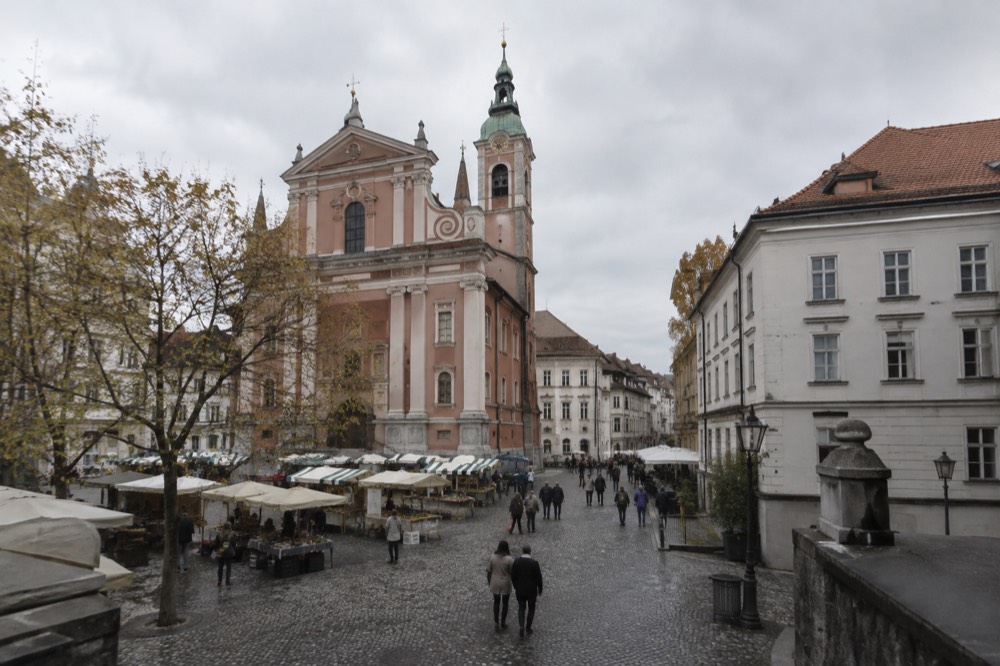
Photographers should work the morning. The dome catches the early light from the river side, the market awnings give foreground interest at Vodnikov trg, and the whole composition falls apart by early afternoon when the sun flattens. The photography spots in Ljubljana guide ranks the angles, and the river-bank shot of the dome is on the shortlist. In December the Christmas market stalls cluster within sight of the church, and the Ljubljana in December pairing of stalls, fog and a lit dome is the most atmospheric month of the year, provided you accept that the sun may not appear.
Common Questions About Ljubljana Cathedral
Is Ljubljana Cathedral free to enter?
The cathedral is a working parish church rather than a ticketed attraction, but opening for visitors bends around the Mass schedule and parish events, and any requested donation is set locally rather than published as an entry price. Check the parish notice or the tourist information centre on the day of your visit.
Why is the cathedral dedicated to St Nicholas?
St Nicholas is the traditional patron saint of fishermen and boatmen, a fitting dedication for a city that grew up on the trade and fishing traffic of the Ljubljanica. The river still runs a few dozen metres from the church door.
How far is the cathedral from Ljubljana Castle?
The cathedral sits at the foot of the castle hill, roughly a five to eight minute walk to the funicular base, with the climb itself on top. The castle grounds are free to enter; the funicular and the Viewing Tower require tickets, at 19.00 EUR for an adult castle ticket including the funicular.
Can you take photographs inside the cathedral?
Discreet, flash-free photography of the interior is generally tolerated when no service is running, but the church is an active place of worship first and a sight second. Avoid photographing during Mass, keep quiet, and respect any roped-off areas.
What is the best time of day to visit the cathedral?
Mid-morning is the sweet spot: the market next door is at full tilt, the interior light is strong, and the crowds have not peaked. Check the Mass schedule first, because a midday service closes the visitor doors without much notice.
Is Ljubljana Cathedral worth visiting?
Yes, as the anchor of the market-and-river block rather than as a standalone destination. Twenty to forty minutes inside, a circuit of the exterior doors and dome, and you have seen the city's mother church; pair it with the Central Market and the walk to the castle and it becomes the spine of a whole morning.