Ljubljana to Vienna by Train: Routes, Borders and Stop-Offs
The Ljubljana to Vienna rail link is one of the most practical ways to pair Slovenia's capital with Austria's, and the border crossing is now a formality most travellers never notice.
Short answer
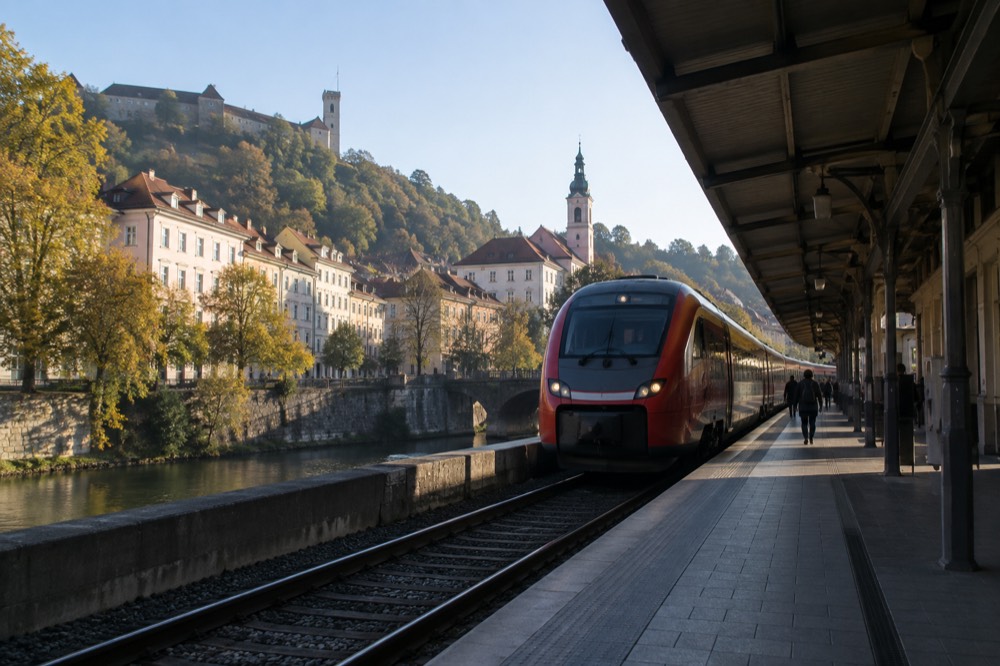
Yes, you can travel from Ljubljana to Vienna by train, with direct daytime services on the route. Both cities are in the Schengen area and both use the euro, so there are no border checks and no currency exchange. Fares and timetables change by season, so check the operator's live listing before booking.
Two capitals, one rail line, and a border you will almost certainly cross without realising it: the Ljubljana to Vienna journey is one of the most underrated rail trips in central Europe. Slovenia joined the European Union on 1 May 2004, adopted the euro on 1 January 2007, and abolished border checks at its internal land borders on 21 December 2007, with air checks following on 30 March 2008. Practically, that means the trip from Ljubljana to Vienna involves no passport control, no currency exchange and no customs stops, just a train rolling through Alpine foothills and Austrian farmland.
This guide covers the route options, what the border situation actually means, where it is worth breaking the journey, and how to plan the trip around Ljubljana's famously foggy weather. Where a fare or a timetable figure is not published in a verifiable source, this page says so rather than guessing, because rail pricing in particular changes with the season and the day of the week.
Is There a Direct Train from Ljubljana to Vienna?
Yes. Direct daytime trains connect Ljubljana and Vienna, so the journey can be made in a single seat without changing. Both Slovenia and Austria are in the Schengen area, so there is no border formality at all, and both countries use the euro, so there is nothing to change or declare. Exact departure times and fares vary by date, so treat the operator's timetable as the source of truth when you book.
The direct service is the headline option, but it is not the only one. Travellers who cannot find a convenient direct departure can route via Villach in Austria, changing there for a mainline connection north, or via the Spielfeld-Straß corridor toward Graz and on to Vienna. Both routings add a change of train but open up stop-off possibilities that the direct run skips.
A word on fares: this site does not publish a Ljubljana to Vienna rail price, because the operators use dynamic pricing and no static, verifiable fare table exists for the route. What is reliably true is that booking early on long-distance services in this region generally costs less than buying on the day of travel, and that international tickets can be bought through the Slovenian and Austrian rail operators' own websites. If a third-party reseller quotes a price, compare it against the operator's own listing before paying.
While you are planning travel out of the city, these are three of the most-booked departures from Ljubljana that visitors pair with a longer itinerary:
How Long Does the Journey Take and What Does the Route Look Like?
The Ljubljana to Vienna trip is a genuine day journey rather than a short hop: the direct train crosses the whole of Austria's southern rail corridor, and the routing via Graz or Villach takes longer still. The line climbs out of the Ljubljana basin, crosses the Karst plateau and the Slovenian-Austrian border near Spielfeld, then runs up the Mur valley toward Graz and the Vienna plain. No single published journey time is stable across the year, so check the live timetable for your date.
The scenery is the reason to take the train rather than fly. The first hour is Ljubljana's own basin, with the Ljubljana moor and the Karst edge to the south. After the border the landscape becomes the rolling vineyards of southern Styria, then the Mur river valley, and finally the wide farmland of eastern Austria as the train approaches Vienna. Sit on the right-hand side leaving Ljubljana for the better views in the border stretch, though the track curves enough that neither side is a bad choice.
The practical planning point is that this is a trip you build a day around. A morning departure from Ljubljana puts you in Vienna with the afternoon and evening free, which is enough to see the city centre's pedestrianised core and the ring road's major buildings. An afternoon departure means arriving at night, which only makes sense if your Vienna hotel is booked and you are not trying to sightsee the same day.
| Route option | Changes | Character | Best for |
|---|---|---|---|
| Direct daytime train | None | One seat, border crossed at speed | The straightforward choice |
| Via Villach | One | Alpine routing through western Austria | Travellers combining Carinthia or the Soča |
| Via Graz | One | Styrian vineyards and the Mur valley | A Graz stop-off or cheaper connections |
| Overnight options | Varies | Sleep on the move, arrive early | Maximising days in Vienna |
If you are still deciding how many days to give each city, our guides to spending one day in Ljubljana and a weekend in Ljubljana cover the city side of the split, and the Ljubljana city break guide handles the whole two-capital structure.
Do You Pass Through Border Checks Between Slovenia and Austria?
No. Slovenia has been in the Schengen area since 21 December 2007, when it abolished checks at its internal land and sea borders, and air checks followed on 30 March 2008. Austria is a founding Schengen member, so the Ljubljana to Vienna train crosses an internal border with no routine passport control, no customs stop and no currency exchange, since both countries use the euro.
The Slovenian government's own statement of the position is unambiguous: Slovenia "became a member of the Schengen Area on 21 December 2007 and as of that day abolished border control at its internal land and sea borders with EU Member States", with air borders following on 30 March 2008, as published on gov.si. The euro side is equally clean: Slovenia adopted the single currency on 1 January 2007, per the European Commission's own page on Slovenia and the euro.
Two caveats keep this honest. First, Schengen rules allow member states to reintroduce temporary internal checks at any time, and Austria has periodically done so on some of its borders, so carry your passport or national ID card regardless. Second, if you are travelling with a non-EU passport, the entry checks into the Schengen area happen at your first point of entry, not on this train, so the Ljubljana to Vienna leg itself stays check-free.
The currency point matters more than it sounds. Travellers who pair this trip with a Zagreb or Venice extension often assume they need Croatian kuna or Swiss francs, but Croatia joined both Schengen and the euro on 1 January 2023, and Italy is a eurozone founder, so the same euro wallet works in every direction from Ljubljana except toward Hungary, which retains the forint. Our Ljubljana to Zagreb guide and the Ljubljana to Venice guide cover those corridors in detail.
| Border fact | Date | What it means on this route |
|---|---|---|
| Slovenia joins the EU | 1 May 2004 | Full free movement of people |
| Slovenia adopts the euro | 1 January 2007 | No currency exchange at the border |
| Schengen land and sea checks abolished | 21 December 2007 | No passport control on this train |
| Schengen air checks lifted | 30 March 2008 | No re-checking if you flew in first |
| Croatia joins Schengen and the euro | 1 January 2023 | The Zagreb extension is internal too |
Where Should You Break the Journey Between Ljubljana and Vienna?
The two best stop-offs are Graz, Austria's second city, sitting directly on the eastern routing, and Maribor, Slovenia's second city, close to the border on the same line. Travellers with more time route west instead: Lake Bled adds an alpine lake and castle, and Postojna Cave adds one of Europe's most-visited show caves, both easily done from Ljubljana before the train north. A broken journey turns one long travel day into a two-day sightseeing corridor.
Maribor is the natural first stop: it is the last major Slovenian city before the border, it sits on the Drava river, and its old town is compact enough to cover between two trains. Graz is the bigger prize, a UNESCO-listed old core with a hilltop clock tower, and its position on the main line means a Graz overnight costs almost no extra rail time. The western alternative, via Villach, suits travellers who want the Alps: that routing pairs naturally with a Lake Bled stop, and Bled carries more visitor demand than the entire city of Ljubljana, which tells you how the day-trip economy around it works.
The karst detour deserves a special mention because of geography. Postojna Cave lies southwest of Ljubljana, off the Vienna line, but it is close enough to the main Slovenian rail network that a cave visit slots neatly into the day before a morning departure north. The cave holds about 10 C year round, per the operator's own published figures, which makes it as reliable in a December fog as in a July heatwave, and the visitor route runs 3.7 km, partly on the cave train, over roughly an hour and a half. The six-hour combined tickets-and-tour option from Ljubljana, which covers both Postojna Cave and the cliff-built Predjama Castle, is rated 4.8 across 2,802 reviews and starts from $132, and it is the most efficient way to do both in one booking.
Separate entry prices are published by the operators themselves: Postojna Cave lists 34.90 EUR for an adult and Predjama Castle lists 24.00 EUR, though a combined ticket figure is not published in a form this site can verify, so buy the two separately or through a tour unless the operator's own page shows a confirmed combination. The cave's timetable is a month-by-month grid rather than a fixed daily list, with departures spread between 09:00 and 18:00 and more slots in summer than midwinter, so link the official timetable rather than trusting any static list.
| Stop-off | Country | On which routing | Why break here |
|---|---|---|---|
| Maribor | Slovenia | Via Graz | Drava old town, last city before the border |
| Graz | Austria | Via Graz | UNESCO old core, hilltop Uhrturm |
| Villach | Austria | Via Villach | Alpine gateway to Carinthia |
| Lake Bled | Slovenia | Detour before departure | The lake, island and castle |
| Postojna Cave | Slovenia | Detour before departure | 3.7 km show cave at a steady 10 C |
For the Bled detour, the six-hour Lake Bled and Bled Castle trip is the most popular format, and the Ljubljana to Lake Bled guide covers the transport options in full, including the two-station rail detail that most advice gets wrong.
What Are Tickets, Classes and Reservations Like on This Route?
Long-distance trains between Ljubljana and Vienna offer first and second class, seat reservations are handled at booking rather than on the platform, and international fares are dynamic, so no fixed price is published that holds across the year. Booking through the operating railways' own sites gives you the live fare, and early booking on this corridor is reliably cheaper than turning up on the day. This site deliberately prints no rail fare for this route because no verifiable static figure exists.
Practical advice that does hold: buy international tickets before you reach the station, because ticket offices at Ljubljana's station are not open around the clock and queue at peak times. Keep the booking reference accessible offline, since cross-border trains in this region are increasingly conductor-scanned. And if your itinerary might change, check the fare conditions at the point of sale, because the cheapest international tickets are often the least flexible, and the difference between a flexible and a restricted fare is the kind of figure only the live listing can state truthfully. Other pages covering the same trip are gathered on Ljubljana Travel Guide.
 machine and departure board inside a glass-roofed station concourse](/images/uploaded/guides/ljubljana-to-vienna/body-6.jpg)
Luggage on European long-distance trains is self-service: you carry it on and stow it in the racks at the end of the coach or above the seats, and there is no checked-baggage system. If you are ending your Ljubljana stay on departure morning, the luggage storage in Ljubljana guide explains where to leave bags for a few hours, and the Ljubljana train station guide covers the station itself, from its platforms to its connections with the city bus network.
What Is Leaving Ljubljana Like, and What Should You Know About the Weather?
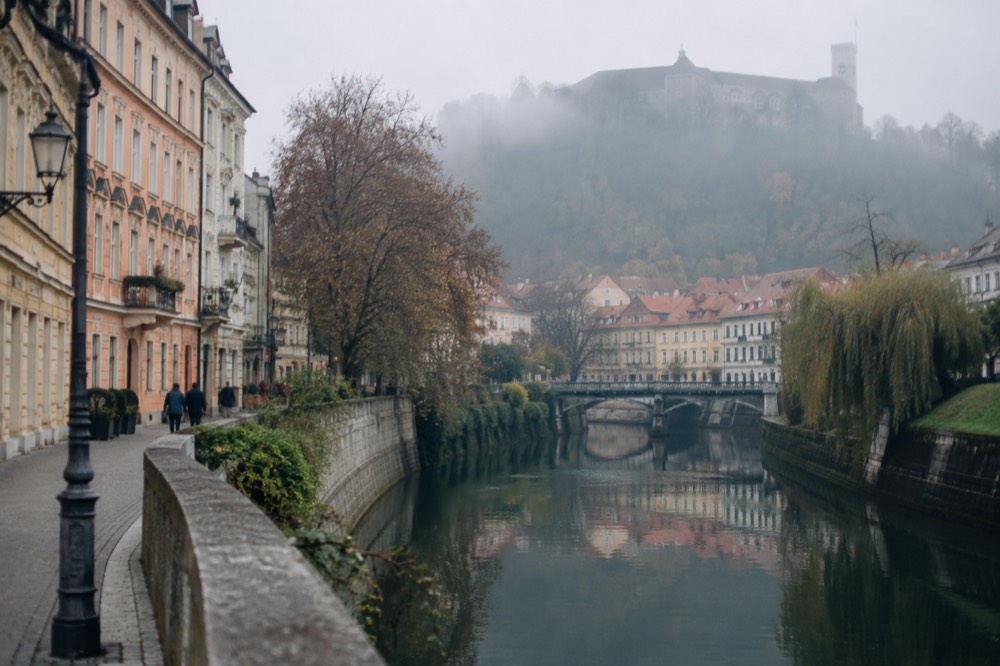
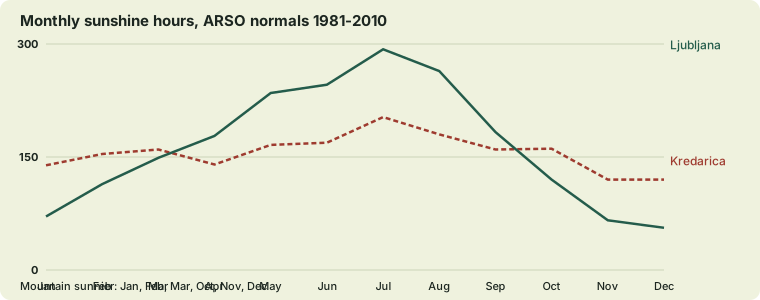
Ljubljana sits in a basin that fogs in heavily from September through the winter, and ARSO's climate normals record just 56 hours of December sunshine in the city against 120 hours at Kredarica, 2514 m up on Triglav. September and October average 12.4 fog days each, level with December and above January's 11.3, per ARSO's 1971-2000 series, the only period for which fog is published. Plan a Vienna departure with the fog season in mind.
This is the information-gain point most guides miss: the same inversion that greys out Ljubljana makes the hills above it sunny, and the practical consequence for a rail traveller is that a dismal-looking departure morning in the city does not mean a dismal journey. The train climbs out of the basin within the first half hour, and the fog often sits below you like a lake as the line rises. In the other direction, if you are returning from Vienna in winter, expect the reverse: bright Austrian plains, then a descent into cloud as the train drops toward the Ljubljanica valley.
| Month | Ljubljana sunshine (h) | Kredarica sunshine (h) | Ljubljana fog days |
|---|---|---|---|
| January | 71 | 139 | 11.3 |
| July | 293 | 203 | 3.7 |
| September | 183 | 160 | 12.4 |
| October | 120 | 161 | 12.4 |
| December | 56 | 120 | 12.6 |
The sunshine figures are ARSO's 1981-2010 normals; the fog series exists only for 1971-2000 and is labelled accordingly, and the two periods must never be mixed in one comparison. Precipitation tells the same story: September and October are the joint wettest months at 147 mm each, above July's 115 mm, so the early-autumn shoulder is not the dry window travellers assume. For the full seasonal picture, see the best time to visit Ljubljana guide.
Is the Train Better Than Flying or Driving from Ljubljana to Vienna?
For most travellers, yes: the train runs city centre to city centre, there is no airport transfer at either end, and the Schengen and euro situation means the whole journey is one continuous ride with no formalities. Flying only wins on raw speed, and the airport-to-city transfers at both ends eat much of that advantage, while driving means dealing with Vienna parking and an Alpine-adjacent motorway in winter. The train is also the only option that turns the travel day itself into scenery.
Ljubljana's airport at Brnik is about 26 km from the city, and Vienna's main airport sits well outside the Austrian capital too, so a flight involves two long ground transfers around a short hop. The train departs from Ljubljana's station, a short walk or bus ride from the pedestrianised centre, and arrives at Vienna Hauptbahnhof, which is itself on the city's U-Bahn network. Driving gives you freedom in between, but both capitals restrict central traffic, and Ljubljana's historic core is closed to general motor traffic as a roughly 20-hectare pedestrian zone, expanded progressively since 2007, which makes a car a liability at the Slovenian end of the trip.
| Mode | City-centre to city-centre | Formalities | Flexibility |
|---|---|---|---|
| Direct train | One seat, both termini central | None, Schengen internal | Multiple daily routings |
| Flight | Two airport transfers required | Standard airport security | Schedule-bound |
| Car | Door to door, parking at both ends | None, Schengen internal | Total, but winter roads |
If you do drive, note that the car rental in Ljubljana guide covers the local market, and that no nightly hotel or car-hire rate is published on this site because both are date-specific. The train, by contrast, needs no vignette, no winter tyres and no parking plan, which is why it is the default recommendation for this corridor.
How Do You Plan the Arrival End in Vienna?
Vienna Hauptbahnhof is the main arrival point for trains from the south, and it connects directly to the city's U-Bahn, tram and regional rail networks, so the transfer into the centre is a single short hop rather than a journey in itself. Arriving by train also drops you south of the historic core, which means the major sights are a straightforward line northward. Buy a local transport ticket in the station, not on the platform, and check whether your Vienna accommodation is walkable before committing to a taxi.
A few practical notes carry over from the Ljubljana end of the trip. Vienna, like Ljubljana, is at its greyest from October onward, but it sits outside the basin inversion, so its winter gloom is ordinary central-European cloud rather than the trapped fog Ljubljana specialises in. If you are returning to Slovenia and want one last taste of the city before boarding, the free Ljubljana Unveiled walk, a tips-based GuruWalk tour rated 4.91 across 1,496 reviews, covers the Old Town from Roman roots to the Dragon Bridge in about two hours, and it is a sensible way to spend a departure-morning if your train leaves at midday.
GuruWalk's free walks work on a pay-what-you-think-it-was-worth basis, which makes them easy to slot into a travel day without a fixed budget line. The Unveiled walk is the highest-reviewed of the eight free walks on this site's roster, and it ends near the river, a short walk from the station direction.
Before you lock the whole plan in, it is worth pairing this route with the wider day trips from Ljubljana guide, because most Vienna itineraries start with a final day trip inside Slovenia, and the most popular of those is Bled. The six-hour Lake Bled and Bled Castle trip from Ljubljana, rated 4.7 across 1,641 reviews and from $86, is the classic choice, and it fits the day before a morning train north.
The three departures below are the ones most travellers book alongside a Vienna or wider Austria itinerary, and they can all be reserved with free cancellation on the operator's live listing:
Common Questions About Travelling from Ljubljana to Vienna by Train
Is there a direct train from Ljubljana to Vienna?
Yes, direct daytime trains run between the two capitals, and the journey can also be routed with one change via Villach or Graz. Departure times vary by date, so check the operator's live timetable when booking.
Do you need a passport to travel from Ljubljana to Vienna?
There are no routine border checks on the route, because Slovenia and Austria are both in the Schengen area; Slovenia abolished internal land and sea checks on 21 December 2007. Carry a passport or national ID anyway, since Schengen members can reintroduce temporary internal checks.
Do you need to change money between Slovenia and Austria?
No. Both countries use the euro; Slovenia adopted it on 1 January 2007. The same euro cash and cards work on both sides of the border.
How long does the train from Ljubljana to Vienna take?
It is a full-day journey on the direct service, and routings via Graz or Villach take longer. No single journey time is stable year-round, so this site does not publish one; the operator's timetable for your travel date is the reliable source.
Where should you break the journey between Ljubljana and Vienna?
Maribor and Graz are the natural stop-offs on the eastern routing, while travellers heading west can detour to Lake Bled or Postojna Cave from Ljubljana before departure. Postojna Cave holds about 10 C year round, so it works in any weather.
Is the train better than flying from Ljubljana to Vienna?
For most travellers, yes. The train connects two central stations with no [airport transfers](https://tpk.ro/o5VLPVUy), no border formalities and no currency exchange, and the scenery through Styria is part of the point of the trip.