Plečnik's Ljubljana: A Walking Route
One architect reshaped Ljubljana more thoroughly than any other, and his work sits within a walkable kilometre of the river. This route strings it together in order, with the opening hours, prices and tour options that make the plan work.
Short answer
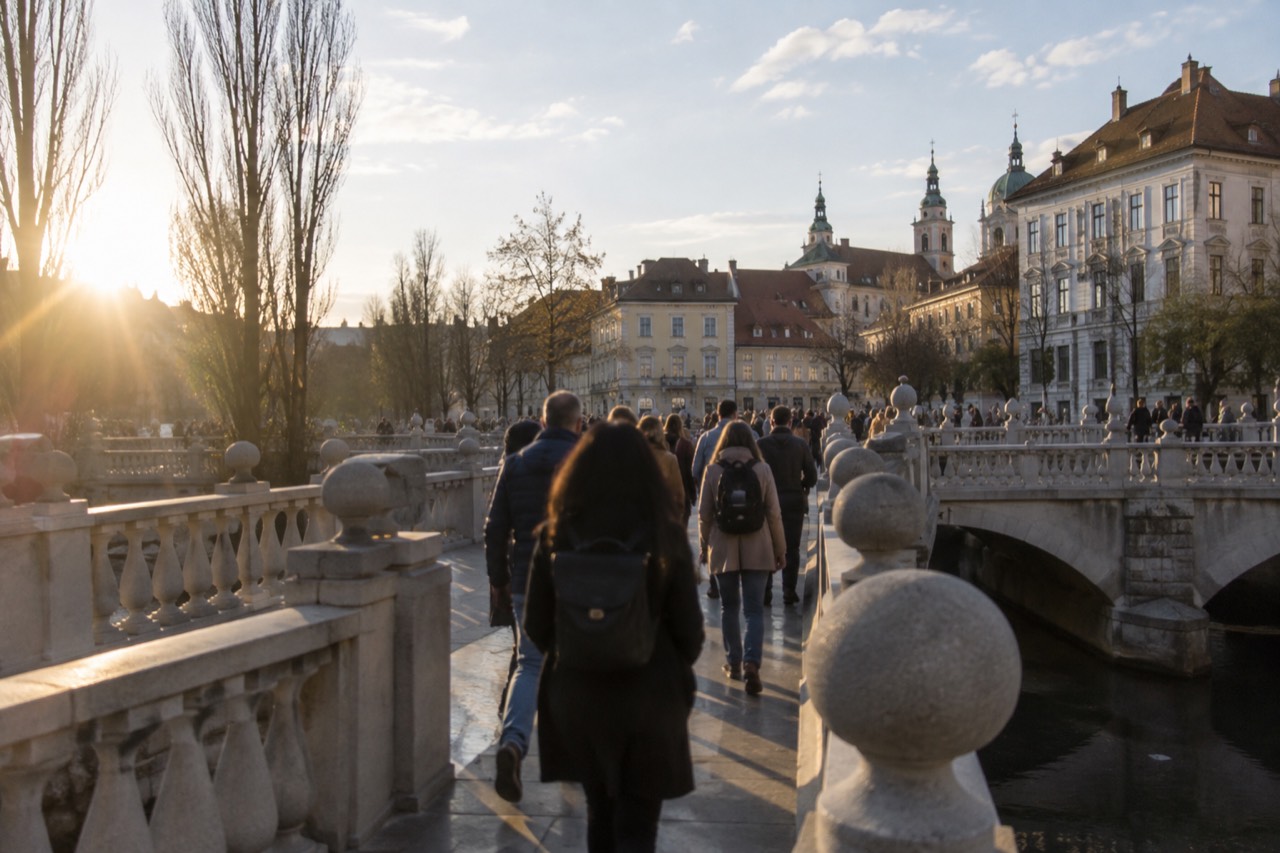
Jože Plečnik's Ljubljana is walkable in one long morning, roughly 3 km from Prešeren Square to the Plečnik House in Trnovo. The core sights, Tromostovje, the embankments, Čevljarski most, the Central Market and the National and University Library, are free to see from outside. The Plečnik House costs 12 EUR and admits by guided tour on the hour, closed Mondays.
Ljubljana is one of the few European capitals where a single architect's hand is visible almost everywhere you look, and that architect is Jože Plečnik. He spent the interwar decades remaking a modest provincial town into a city with a coherent style all of its own: stone bridges, riverside colonnades, a market that doubles as a monument and a library that reads like a temple. The remarkable thing for a visitor is how tightly packed it all is. Nearly everything Plečnik built in the centre sits within a ten minute walk of the Ljubljanica, which makes his city one of the most rewarding walking routes in Central Europe.
This guide strings those buildings together in a sensible order, starting at Prešeren Square and ending at the Plečnik House in Trnovo, with the extensions to Šiška and Žale for anyone with a second half day. It also answers the practical questions that decide whether the walk works: what costs money, what closes on Monday, and where the hills above the basin are worth the climb if the fog rolls in. For the wider picture of the city's layout, our old town walking guide covers the ground between the landmarks.
Who Was Jože Plečnik and Why Did He Shape Ljubljana?
Plečnik was a Slovenian architect who trained in Vienna under Otto Wagner, worked in Prague, and then spent three decades rebuilding his home city's riverside, bridges, market and public spaces into a single unified composition. His style mixes classical stone forms with modern, sometimes playful details, and Ljubljana is the only European capital where one architect's vision was applied so completely to the urban fabric. That is why UNESCO inscribed his Ljubljana works on the World Heritage List, and why the walk below exists at all.
He is often described as the man who turned Ljubljana into "an open-air museum", and the phrase is not far off. Tromostovje, the Triple Bridge, is his most photographed intervention: he took a single 19th century bridge and flanked it with two pedestrian spans at angles, so that a river crossing became a small public square in motion. From there his work runs along the river in both directions, up to the Central Market colonnades and the Cobbler's Bridge, and inland to the National and University Library, his largest interior commission.
What makes the route rewarding is the connective tissue. Plečnik did not just build isolated landmarks, he designed the embankments, the poplar-lined quays, the staircases down to the water and the bridge balustrades as one continuous landscape. Walking his Ljubljana you are not ticking off monuments, you are reading a single argument about what a city should feel like, made in stone.
The Route at a Glance: How Long Does a Plečnik Walk Take?
The core route is about 3 km on foot and takes a comfortable half day, three to four hours, at museum pace. Start at Prešeren Square, cross Tromostovje, follow the left bank to the Central Market, loop over Čevljarski most, then climb to the National and University Library before continuing across the river to Trnovo for the Plečnik House. Add an hour each for the Šiška church and Žale cemetery extensions, which sit outside the centre and need a bus or a longer walk.
The order below is deliberate. It front-loads the free, always-open river work in the morning, then reaches the two ticketed interiors, the library reading room is not open to casual visits but the building can be viewed from outside and from its stairwell, and the Plečnik House, at the point of the day when a sit-down guided tour is welcome. The Plečnik House runs tours on the hour and closes on Mondays, so anyone planning the full route should avoid starting on a Monday.
| Stage | Sights | Distance | Cost |
|---|---|---|---|
| 1 | Prešeren Square, Tromostovje | 0.3 km | Free |
| 2 | Left bank embankments, Central Market colonnades | Short riverside stroll | Free |
| 3 | Čevljarski most, right bank quay | A few minutes' walk | Free |
| 4 | National and University Library exterior and stairwell | Brief uphill climb | Free |
| 5 | Vegova street, Križanke exterior | A few minutes' walk | Free |
| 6 | Trnovo church and the Plečnik House | 1.2 km | House 12 EUR, guided |
| 7 | Extensions: Šiška church, Žale cemetery | bus or 30+ min walk | Free |
If you would rather have someone else hold the narrative, a guided walk is the efficient option. These three picks cover the Plečnik core from different angles: a classic group walk of the Old Town, a cave-and-castle day trip if you want a contrast day, and a Lake Bled trip for the classic Slovenian pairing.
The classic group walking tour, a guided walk of the Old Town's main sights, is the closest match to this route: it covers the river bridges and the market, and it carries a 4.8 rating from 406 reviews. Book it for your first morning and do the Plečnik route yourself the next day, when you will recognise half the stone work already.
Prešeren Square, Tromostovje and the Three Bridges
Prešeren Square is the natural start because every Plečnik line in the city leads back to it. Tromostovje, his Triple Bridge, sits on its north side and is the single most useful orientation landmark in Ljubljana: three bridges in one, with stone balustrades and poplar trees, crossing to the Old Town market quarter. Give the square twenty minutes at the start of the day, before the crowds build, and note the statue of France Prešeren, the national poet, watching over it all.
The square itself is a product of the same urban programme that reshaped the whole centre. The historic centre of Ljubljana is pedestrianised, a car-free zone of roughly 20 hectares that was progressively expanded from 2007, which is why this route never has to fight traffic. The city's own mobility pages document the zone, and you can feel the effect within one block: the streets around Tromostovje belong to people, café tables and the occasional bicycle. Our Prešeren Square guide covers the square's other landmarks, including the Franciscan Church whose pink facade frames every photo of the Triple Bridge.
Tromostovje rewards a slow look. Stand at the middle of the central span and face upstream: the two side bridges splay away at shallow angles, each with its own staircase to the lower quay, so a pedestrian can descend to the water, walk the embankment and climb again without ever leaving Plečnik's stonework. It is a small idea, a bridge that behaves like a square, and it changed how the city uses its river. The Triple Bridge guide goes deeper into the design if you want the full story before walking on.
The Ljubljanica Embankments and Čevljarski Most
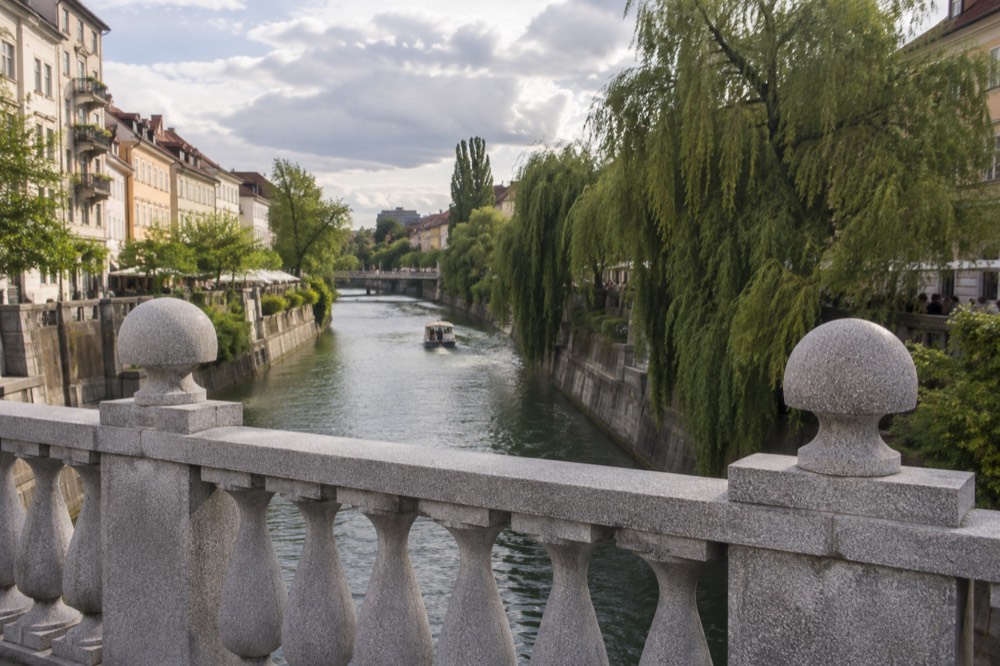
From Tromostovje, follow the left bank, the market side, downstream and you are on Plečnik's finest continuous work: the stone embankments, staircases and tree-lined quays of the Ljubljanica, designed as one composition so the river becomes a public room rather than a barrier. The Cobbler's Bridge, Čevljarski most, sits a few hundred metres along, a wide single-span bridge with balustrades and columns that Plečnik intended as the ceremonial axis between the two cathedral squares.
The quays are the part of the route most visitors under-appreciate, because they read as ordinary riverbank until you notice the design discipline: the same stone, the same rhythm of steps, the same lamps, running kilometre after kilometre. Descend one of the staircases to water level and walk a stretch down there. The river is slow and green, and the [Ljubljanica river cruise](/attractions/ljubljanica-river-cruise/) departs from these very quays, a fifty minute electric boat trip that shows the embankments from the one angle the architect could not design for, the water itself.
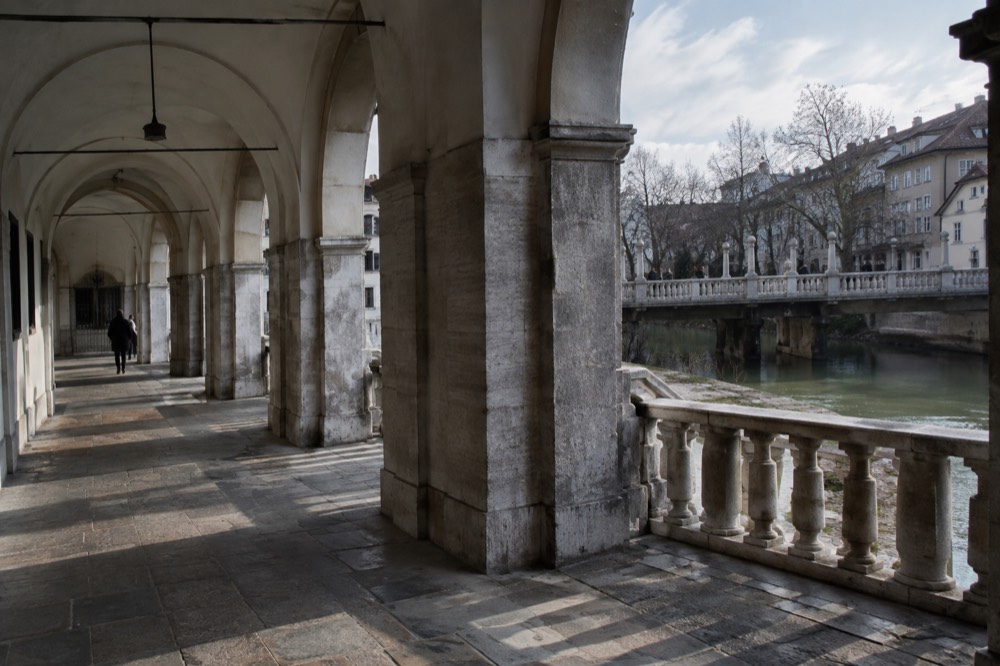
Čevljarski most is the second bridge on the route and the better one to linger on. Its name comes from the cobblers who worked on an earlier bridge on the site, and its columns and stone balusters give it a more formal, almost Roman character than the Triple Bridge. From its centre, look back towards Tromostovje and forward to the market colonnades: this is the axis Plečnik was building, a processional route along the river that ties his whole plan together. The full index of guides sits on Ljubljana Travel Guide.
For anyone who wants the architecture explained rather than merely admired, the Art and Architecture walking tour is built for exactly this stretch: ninety minutes through Ljubljana's art and buildings, a perfect 5 from 23 reviews, from $17. It is the cheapest way to put a trained guide behind the stone you are looking at.
The Central Market and the Market Colonnades
The Central Market is Plečnik's largest single commission in the city and the best place on the route to eat. His colonnades run along the river between Tromostovje and the Cobbler's Bridge, a long classical arcade with the produce stalls spilling onto Vodnikov and Pogačarjev trg in front. The outdoor market runs roughly Monday to Saturday, 06:00 to 18:00 in summer and 06:00 to 16:00 in winter, and the covered halls keep shorter weekday hours.
Time your walk to arrive mid-morning and the market doubles as breakfast. Stalls sell everything from pumpkin seed oil to burek, and the colonnades themselves, with their long row of columns facing the river, are the architectural centrepiece. The market operator's own pages publish the seasonal hours, and our Central Market guide maps the stalls and the best stops. One date-specific tip worth planning around: if your visit falls on a Friday between March and November, the Odprta Kuhna open kitchen food event takes over Pogačarjev trg from 10:00 into the evening, though it runs, in the tourist board's own words, on "every sunny Friday", meaning it is cancelled in bad weather.
| Market area | Days | Hours |
|---|---|---|
| Outdoor stalls, summer | Mon-Sat | 06:00-18:00 |
| Outdoor stalls, winter | Mon-Sat | 06:00-16:00 |
| Covered halls | Mon-Fri | 07:00-16:00 |
| Covered halls | Sat | 07:00-14:00 |
| Open Kitchen | Fridays, Mar-Nov, weather permitting | from 10:00 |
Behind the colonnades, look up the slope and you will see the bell tower of Ljubljana Cathedral, whose interior Plečnik also touched, and beyond it the start of the climb to the castle. The Ljubljana Castle guide covers the hilltop; note that the castle grounds are free to enter while the funicular and the tower are not, so a castle detour can cost nothing but the climb.
The National and University Library
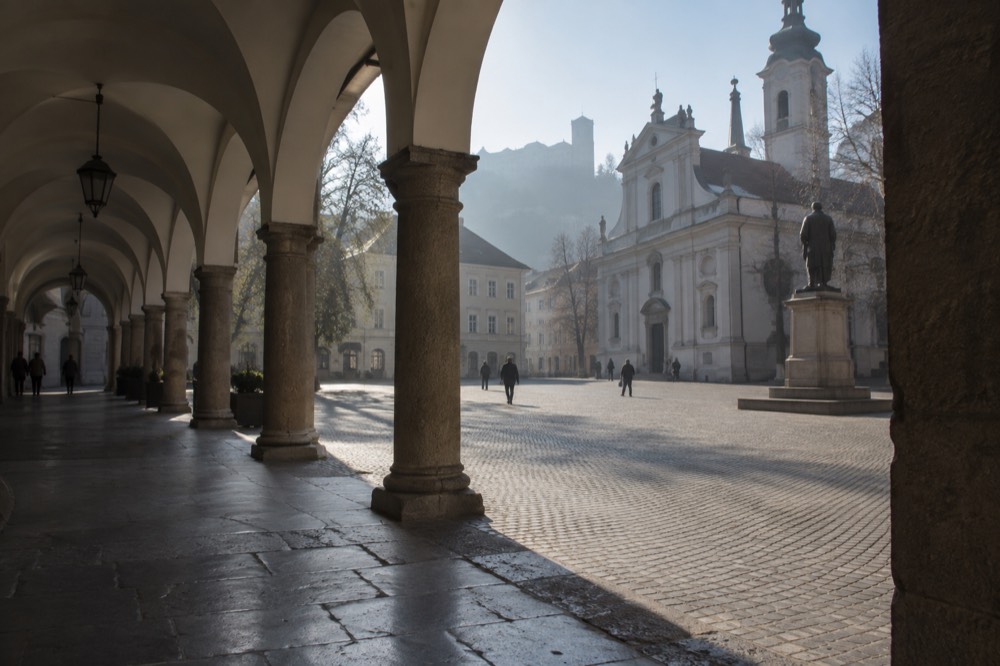
The National and University Library is Plečnik's masterpiece interior and the one building on the route whose facade genuinely divides opinion: a dark brick and stone block with windows set like a woven pattern, facing a small square a few minutes uphill from the market. The reading room is a working national library, not a tourist attraction, so casual visits are limited, but the famous staircase and the exterior are worth the detour on any Plečnik walk.
The library's facade uses a mix of red brick and pale stone blocks in alternating bands, and its small windows are set in a grid that reads from a distance like fabric. The interior is the reason architects make pilgrimages here: a dark, columned vestibule that opens into a floodlit reading room, a deliberate progression from shadow to light that Plečnik designed as a metaphor for the journey from ignorance to knowledge. Check the library's own visitor rules before assuming you can enter the reading room; access for non-members is restricted and the building is primarily a working institution.
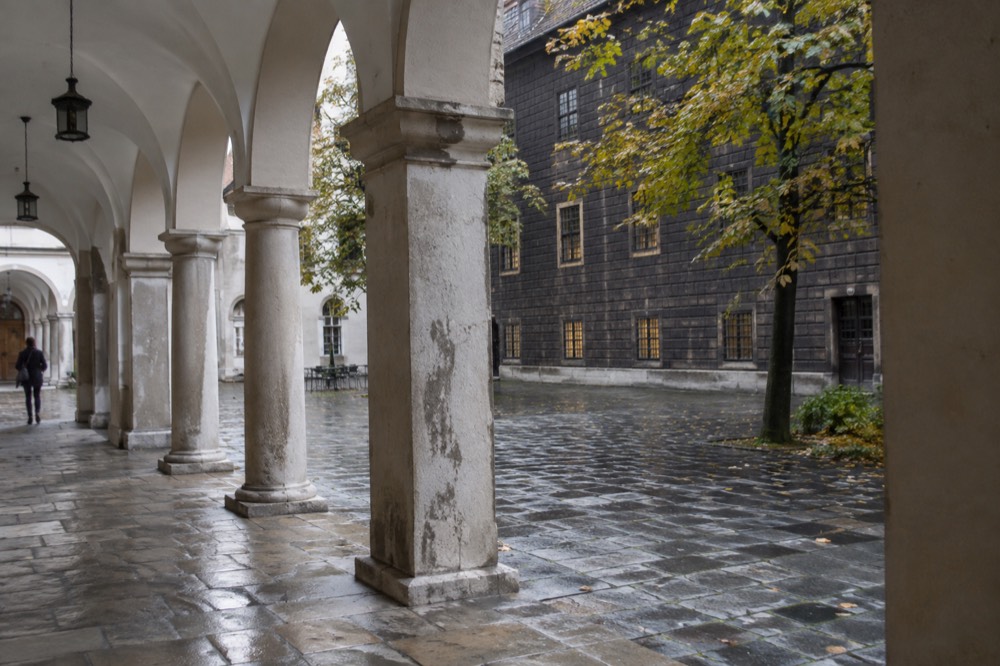
From the library, continue along Vegova street, a landscaped avenue with a line of trees and the National Museum and the university buildings alongside it, towards Križanke. The Križanke summer theatre, a monastery courtyard Plečnik converted into an open-air venue, is one of his most charming smaller works, and the walk between it and the library takes five minutes through the leafiest street on the route.
For the fuller cultural picture, the National Gallery sits at the top of this same district, closed Mondays, 10 EUR for the permanent collection, and pairs naturally with the library on a wet afternoon.
Trnovo: The Church on the Embankment and the Plečnik House
Trnovo is where the route leaves the postcard zone and becomes a neighbourhood walk. Plenčnik's Trnovo Church of St Anne faces the Ljubljanica across a broad embankment he also designed, and a short walk away, on Rakovnik street, stands the Plečnik House, the small house where the architect lived and worked until his death, now a museum. It admits by guided tour only, tours run on the hour, it costs 12 EUR including the guide, and it is closed on Mondays.
The house is the emotional end point of the route. It is modest, a narrow dwelling with a glass-walled studio extension, and the guided tour walks you through his study, his drawing room and the studio where the plans for the bridges you crossed this morning were drawn. Because entry is guided only, on the hour, it is the one stop on this walk that rewards booking ahead or at least arriving on the hour. The museum's own visit page publishes the tour times and the 12 EUR price, and our Plečnik House guide covers what the tour includes.
| Stop | Admission | Hours | Closed |
|---|---|---|---|
| Plečnik House | 12 EUR, guided, on the hour | Tue-Sun 10:00-18:00 | Monday |
| Trnovo church exterior and embankment | Free | Always viewable | Never |
| National Gallery (nearby detour) | 10 EUR permanent | Tue-Sun 10:00-18:00 | Monday |
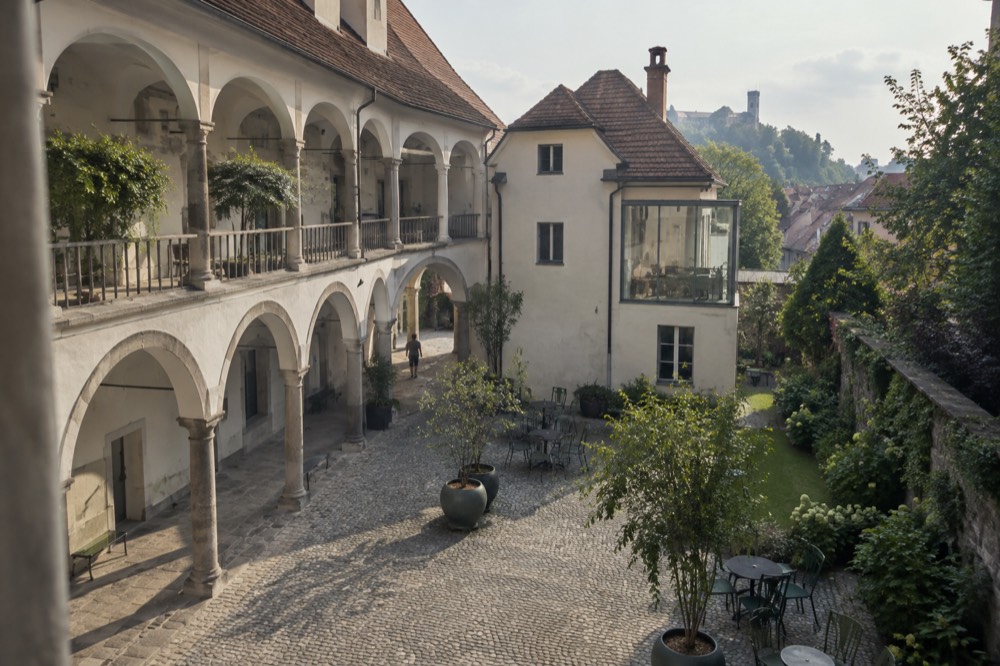
The Trnovo church itself deserves twenty minutes. Its wide facade with a columned porch sits directly on the river embankment, and the green quay in front of it is one of the places where Ljubljana locals actually sit, rather than tourists. The Trnovo area guide covers the neighbourhood, its riverside cafés and its position as the quiet end of the Plečnik axis.
The classic group walking tour is the best fit if you decide the self-guided version needs a narrator after all: the Old Town group walk covers the riverside core, rated 4.8 across 406 reviews.
Extensions: Šiška, Žale and the Rest of Plečnik's City
Two extensions complete the set for anyone with a second half day. The Church of St Francis of Assisi in Šiška, across the river in a residential district, is Plečnik's most austere sacred building, a grey stone hall with a tall square tower, reachable by bus or a half hour walk from Trnovo. Žale cemetery, further north, is his largest late work, a walled city of funerary chapels arranged around a central axis, and it is one of the most remarkable cemetery designs in Europe.
Žale is the surprise of the Plečnik itinerary. Where most cemeteries are fields of headstones, Žale's central section is a walled complex of small chapels, each in a different national or religious style, arranged along a processional route that ends at the funeral hall. It is a place of real architectural seriousness, quiet, free to enter, and a twenty minute bus ride from the centre. Pair it with Šiška's church on the same northern loop and you have a complete second day.
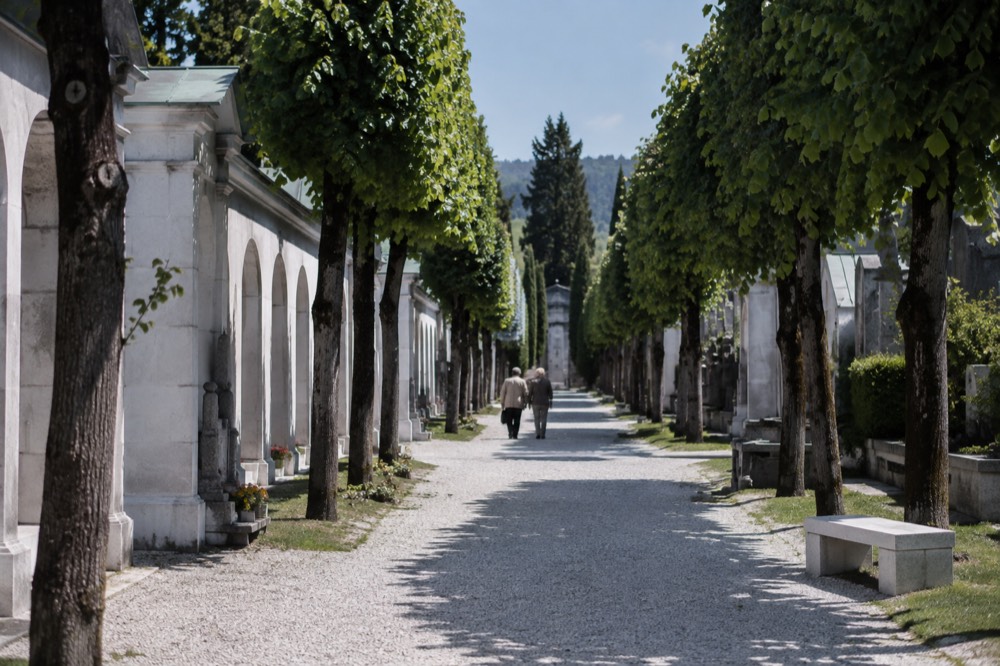
Back in the centre, two smaller works fill gaps in a spare hour. The Zois pyramid and the riverside elements of the Tivoli Park edge, and the colonnade of the Dragon Bridge approach, belong to the same era of city planning, though the Dragon Bridge itself predates Plečnik and is a Secessionist design, covered in our Dragon Bridge guide. Walking the full route plus both extensions covers roughly every major Plečnik work accessible without a car.
When to Walk: Weather, Fog and the Basin
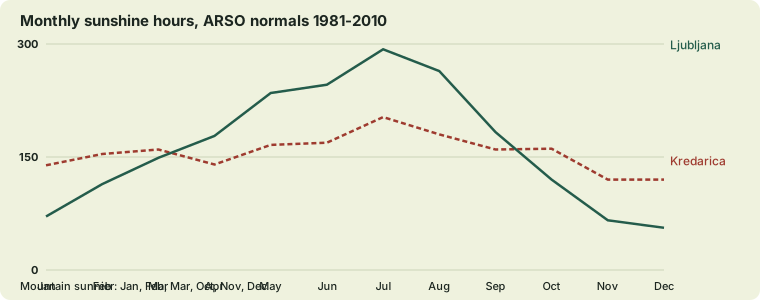
Ljubljana sits in a basin, and from October to March that matters: ARSO's climate normals record just 56 hours of sunshine in December against 120 at Kredarica, high on Triglav, because cold air traps fog and low cloud over the city while the hills above sit in sun. For a walking route, the practical answer is to walk the river in the morning fog, which is atmospheric on the embankments, and go up, the castle hill, Šmarna gora, or a Bled day trip, when the afternoon clears.
The counterintuitive detail is the autumn. September and October average 12.4 fog days each, level with December and above January's 11.3, on ARSO's 1971-2000 normals, the period that publishes fog figures. Those same two months are the joint wettest of the year at 147 mm each, ahead of July's 115 mm, on the 1981-2010 normals. The two reference periods must not be mixed, but the planning conclusion is safe: early autumn in Ljubljana is foggier and wetter than most guides admit, so build a weather-proof option into any autumn itinerary.
| Month | Sunshine, city (h) | Sunshine, Kredarica (h) | Rain (mm) | Fog days |
|---|---|---|---|---|
| January | 71 | 139 | 69 | 11.3 |
| July | 293 | 203 | 115 | 3.7 |
| September | 183 | 160 | 147 | 12.4 |
| October | 120 | 161 | 147 | 12.4 |
| December | 56 | 120 | 107 | 12.6 |
The wet-weather answer for this route is built in. The colonnades of the Central Market and the arcades along the river give you covered walking for a good stretch of the core route, and the museums that pair with the walk, the National Gallery, the City Museum, the Plečnik House itself, are all indoor stops. Our rainy day in Ljubljana guide has the full list, and remember the national institutions open free of charge on the first Sunday of every month.
Guided Tours That Cover Plečnik's City
A guided walk is worth it on this route for one reason: Plečnik's work is heavy with symbolism and light on signage, and a guide turns stone into story. The classic group walking tour of the Old Town covers the riverside core, the Art and Architecture tour is a ninety minute deep dive into buildings and design, and the guided walk with the funicular ride adds the castle viewpoint at the end. All three run year round and all three can be booked with free cancellation.
| Tour | Duration | Rating | From |
|---|---|---|---|
| Classic group walking tour | 2-3 hours | 4.8 from 406 reviews | price on the operator's live listing |
| Art and Architecture walk | 1h 30m | 5 from 23 reviews | $17 |
| Guided walk with funicular to the castle | 2 hours | 4.6 from 650 reviews | $24 |
The guided walk with the funicular ride is the best-value combination if you want the route and the view in one booking: an Old Town walk first, then the funicular up to the castle hill, from $24, rated 4.6 from 650 reviews. If you would rather explore Plečnik's city at your own pace, this guide's route stands alone, and the free GuruWalk options, including the tips-based Old Town walk from Roman roots to the Dragon Bridge, rated 4.91 from 1496 reviews, cover the same streets for nothing but the tip.
Whichever way you walk it, the route is the point. Plečnik's Ljubljana is not a collection of sights to be driven between, it is a single designed landscape best read at walking pace, one bridge, one colonnade and one staircase at a time. And if the basin fog closes in mid-walk, that is not a failure of the plan, it is the city's own weather doing what the architect's stone work does best: framing the river in soft grey.
For the day after the walk, the same trio of options covers the classic contrasts: the Old Town group walk if you want the narrative, the Postojna Cave and Predjama Castle day trip for the underground, or Lake Bled and its castle for the mountain day.
Common Questions About Plečnik's Ljubljana
Can you see Plečnik's Ljubljana in one day?
Yes. The core route from Prešeren Square to the Plečnik House is about 3 km and takes three to four hours at a comfortable pace, and all of it except the Plečnik House is free to see from outside. Add the Šiška church and Žale cemetery extensions only if you have a second half day.
Is the Plečnik House worth visiting?
For anyone with an interest in architecture, yes. It is the house where the architect lived and worked, it is small and personal rather than monumental, and entry is by guided tour on the hour, 12 EUR including the guide, closed Mondays. Book or arrive on the hour, since walk-ins between tours are not admitted.
Which Plečnik sights are free?
Nearly all of the outdoor work: Tromostovje, the embankments, Čevljarski most, the Central Market colonnades, the library facade, Križanke's courtyard exterior and the Trnovo church are all free and viewable at any hour. The ticketed items are the Plečnik House at 12 EUR and, if you extend into museums, the National Gallery at 10 EUR.
What is closed on Mondays in Plečnik's Ljubljana?
The Plečnik House, the National Gallery, the City Museum and most state museums close on Mondays, so a Monday start will miss the one ticketed stop on the route. The river, the bridges and the market colonnades are always open, and the covered market halls run on their own schedule.
Do you need a guide for the Plečnik walking route?
No, the route is flat, signposted enough and entirely walkable solo with this guide. A guide adds interpretation rather than navigation: the classic group walking tour covers the Old Town core, and the ninety-minute Art and Architecture walk is the most directly Plečnik-focused option. Both can be cancelled free of charge.
When is the best time of year to walk Plečnik's Ljubljana?
April to September, when the city records its sunniest months and the market is in full swing. Note that September and October are both foggier and wetter than most guides suggest, at 12.4 fog days and 147 mm of rain each, so in autumn plan a covered alternative such as the National Gallery or the market halls.