Shopping in Ljubljana: The Streets, Markets and Prices That Matter
Ljubljana's shopping happens on foot: a car-free centre, a market that opens at six in the morning and closes by mid-afternoon, and museums whose shops are closed on Mondays like the museums themselves.
Short answer
Ljubljana's shopping is concentrated in a pedestrianised historic centre of roughly 20 hectares, anchored by the Central Market on Vodnikov and Pogačarjev trg, which runs Monday to Saturday from 06:00 and closes by 18:00 in summer. Slovenia uses the euro, museums are free on the first Sunday of each month, and almost everything shuts on Monday and partly on Sunday.
Where Is the Best Shopping in Ljubljana?
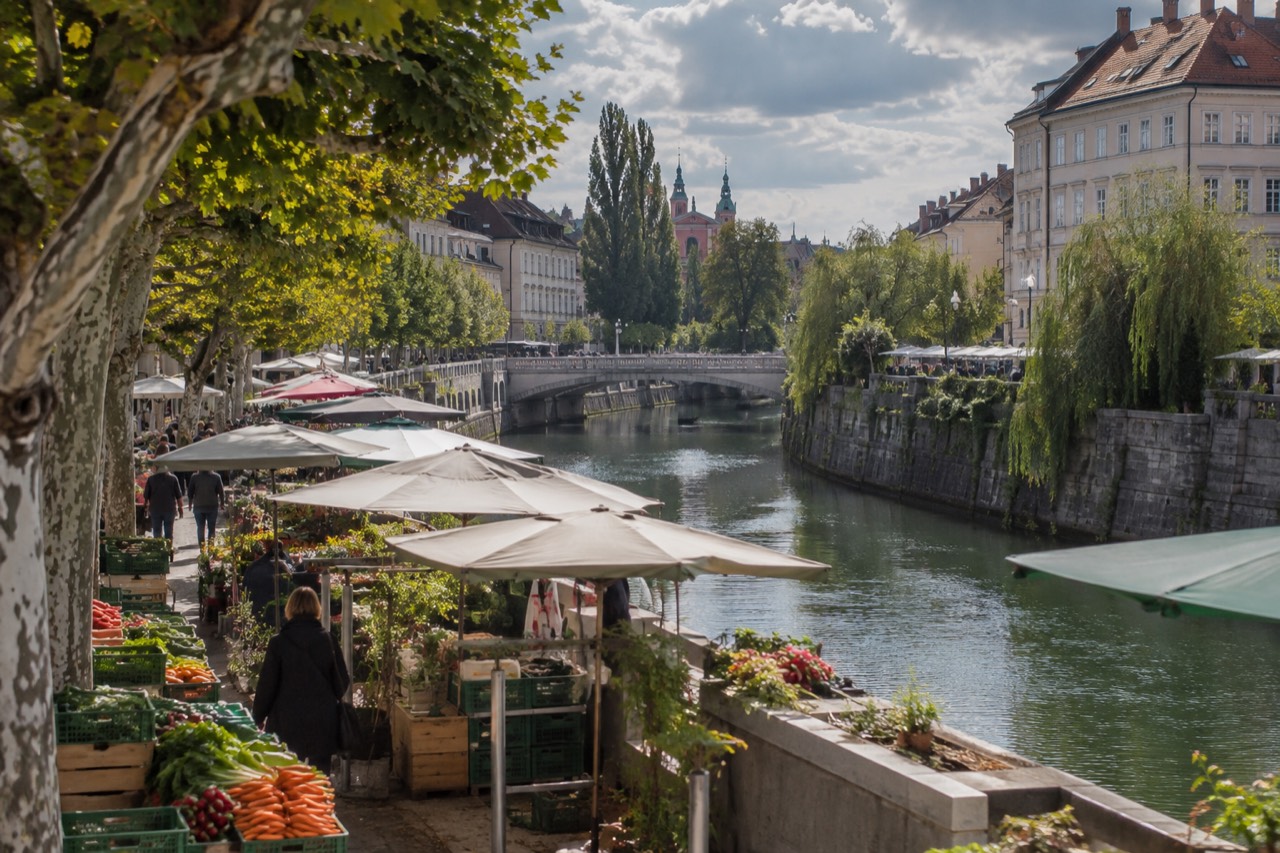
The main shopping area in Ljubljana is the pedestrianised historic centre, a zone of roughly 20 hectares that has been closed to general motor traffic in stages since 2007, with the Central Market on Vodnikov and Pogačarjev trg as its working heart and Prešernov trg and the Old Town streets carrying most of the rest. Everything is walkable, and nothing worth visiting is more than about twenty minutes apart on foot.
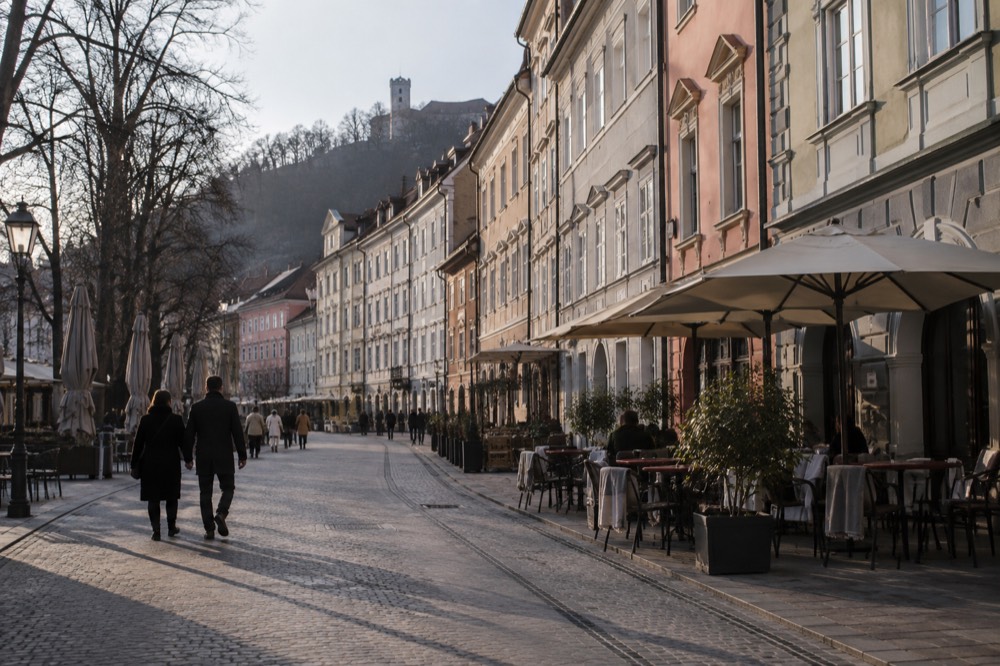
That single planning fact changes the shape of a shopping day more than any other. There is no retail district to drive to, no mall on the edge of town that locals will send you to for the serious buying. The centre is the shopping, and it was designed, progressively and deliberately, around people on foot. If you arrive by car, you park at the edge and walk in; the Old Town and the streets around Prešeren Square are where the hours disappear.
The practical geography is simple. The river splits the centre, the Triple Bridge and Čevljarski most stitch the two banks together, and the market sits at the eastern end of the pedestrian web. Cross the river to the Trnovo side and the character changes from souvenir-and-specialist to residential-and-quiet, which is covered in our Trnovo guide. For a full walking route past the shops, the free walking tour scene is a good orientation on day one.
What you will not find is a large department store culture. Ljubljana is a small capital, the settlement itself counted 293,244 people at the start of 2026, and its retail reflects that: small shops, specialist sellers, a market rather than a supermarket culture in the centre, and a lot of eating and drinking woven between the buying. Plan for browsing rather than blitz shopping, and the city rewards you.
What Can You Buy at the Central Market?
The Central Market sells fresh produce, flowers, herbs, cheese, honey, bread and seasonal fruit from open stalls on Vodnikov and Pogačarjev trg roughly Monday to Saturday 06:00 to 18:00 in summer and 06:00 to 16:00 in winter, with covered halls open Monday to Friday 07:00 to 16:00 and Saturday 07:00 to 14:00, and only limited Sunday opening between April and November. It is the most useful single shopping address in the city.
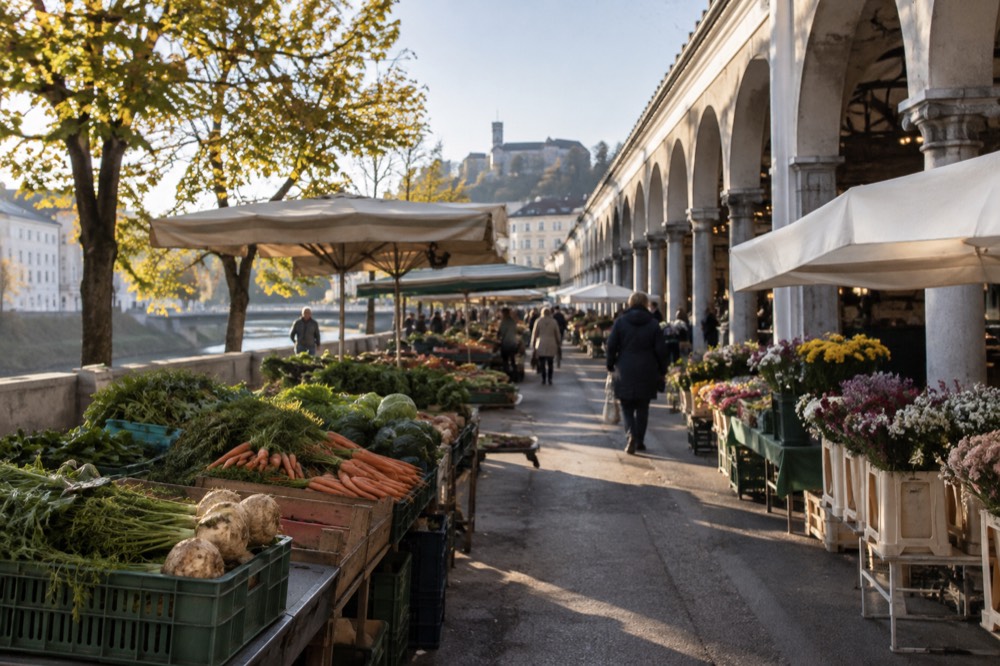
The hours are the thing to internalise, because they are earlier than most visitors expect. This is a working market that opens at six, serves the city's cooks and restaurateurs in the first hours, and empties by mid-afternoon, especially on Saturdays when the covered halls shut at 14:00. Arrive at 11:00 hoping for a lazy market morning and you will catch the tail of it; arrive at 08:00 and you get the market at its best. The full stall-by-stall detail, including what to buy from the covered halls, is in our Central Market guide.
The covered halls are the weather insurance. On the days when the open-air square is damp or fogged in, the halls keep the cheese, cured meat and pantry goods trading regardless, and they close earlier than the stalls do, so treat them as the morning's anchor. Between the two you can assemble a genuinely local basket: whatever fruit is in season, herbs, honey, and the kind of bread and cheese that makes a picnic on the Ljubljanica banks a better lunch than most restaurants.
What the market is not is a souvenir market. It sells food, and it sells it to people who live here as much as to people visiting. That is exactly its value: it is the one shopping experience in the centre where nothing has been arranged for tourists. The Ljubljana markets guide covers the smaller neighbourhood markets if you want the version locals actually queue at.
On Fridays between roughly March and November, Pogačarjev trg also hosts Open Kitchen, the street-food market, from around 10:00 to 21:00 and later on warm days. The official wording is "every sunny Friday", and it means it literally: the market is cancelled in bad weather. If your shopping day is a Friday, check the forecast before you build the afternoon around it. Our Odprta Kuhna guide goes into the detail.
For visitors who want the food angle taken further, a guided version exists: a Slovenian cuisine walking tour with tastings moves through the old food traditions with a local explaining what is on the stalls, and it is the natural upgrade on guessing your way around the market on your own.
That guided option is one way to spend a market morning, but it is far from the only way to structure a shopping day in Ljubljana. Most visitors end up mixing a city experience with at least one trip out, and the three options below are the ones that pair most naturally with a shopping itinerary: the cave and castle day trip that fills a whole afternoon, the Lake Bled excursion that most first-time visitors book, and the free Old Town walk that costs nothing but a tip.
Between the market and the food walks there is also the free orientation option: the Old Town walk on GuruWalk, a free tips-based tour from Roman roots to the Dragon Bridge, which will hand you the geography that makes the shopping streets legible in a single morning.
What Souvenirs and Food Gifts Are Worth Bringing Home?
The gifts worth carrying out of Ljubljana are edible: honey, pumpkin seed oil, wine and spirits, dried herbs and market-bought cheese, bought at the Central Market or from specialist food shops in the pedestrian centre, because Slovenia's exportable strengths are pantry goods rather than crafts, and everything is priced in euro with no duty complications inside the Schengen area.
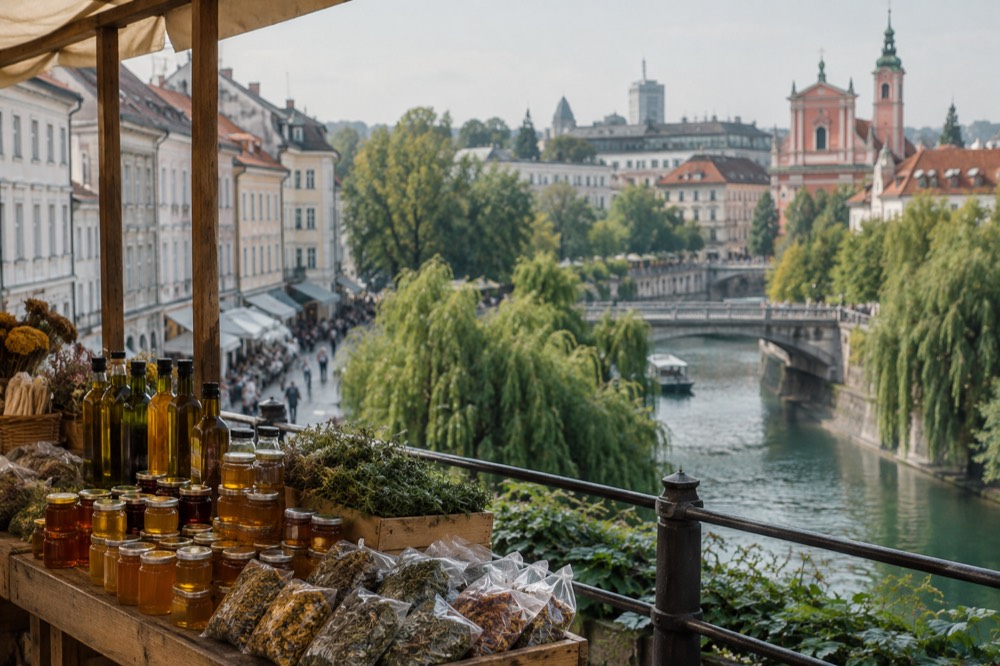
Start with the honest framing: this is not a city of handmade-craft shopping streets in the way some medieval towns are. What Ljubljana does exceptionally well is food retail, and the best souvenir strategy is to lean into it. Honey in its many Slovenian varieties, pumpkin seed oil, herbal liqueurs, wine from the country's small regions: all of it packs well, all of it is bought where locals buy it, and none of it needs a paragraph of explanation when you hand it over at home.
| Category | What to look for | Where to buy it | Notes |
|---|---|---|---|
| Honey and beeswax | Regional honeys, propolis, wax products | Central Market stalls, specialist food shops | Slovenia has a strong beekeeping tradition; ask the stallholder which variety suits what |
| Oils and pantry | Pumpkin seed oil, walnut oil, dried herbs | Covered market halls | Halls close at 16:00 weekdays, 14:00 Saturday |
| Wine and spirits | Slovenian white and red wine, herbal brandies | Wine shops in the centre, tasting rooms | A guided tasting with appetizers on an electric boat along the Ljubljanica is one way to choose before you buy |
| Cheese and cured meats | Aged cheese, cured pork products | Covered halls, delicatessens | Check your home country's import rules for meat and dairy before buying |
| Books and prints | Architecture and Plečnik titles, city prints | Museum shops, bookshops in the centre | Museum shops shut when the museums shut, Mondays |
| Flea and vintage | Second-hand clothes, records, bric-a-brac | Weekend flea stalls along the river embankment, Metelkova's surroundings | Informal; days vary, ask at the tourist information centre |
On the non-food side, the strongest thread is architecture. Jože Plečnik's Ljubljana is the city's defining export intellectually, and the museum shops around it stock the books, models and prints. The Plečnik House itself is guided-entry only with tours on the hour, which is a booking constraint worth knowing before you build a Plečnik-shopping afternoon around it, and the wider Plečnik's Ljubljana guide covers the buildings that the books will be about.
Two honesty notes. First, wine bought in Slovenia travels home without border formalities if you are returning to another Schengen country, since Slovenia abolished internal land and sea border checks on 21 December 2007 and air checks on 30 March 2008; the euro, adopted on 1 January 2007, means no currency arithmetic either. Second, no museum shop in this city is open on a Monday, because the museums themselves are not, and that includes the National Gallery.
If a shopping afternoon leaves you with time to spare and a decision to make about the evening or the next day, the most-booked option from the city is the combined cave and castle day trip, which takes a full six hours and runs with free cancellation on the listing.
How Much Does Shopping in Ljubljana Cost?
Everyday shopping in Ljubljana is priced in euro, with a single bus ride at 1.50 EUR in zone 1 including 90 minutes of transfers, an Urbana card itself at 2.00 EUR, museum entries mostly between 6.50 and 12 EUR, and the Ljubljana Card at 41 EUR for 24 hours, 49 EUR for 48 and 54 EUR for 72, which covers the castle funicular, the river cruise, buses and more than 30 museums and galleries, one entry each.
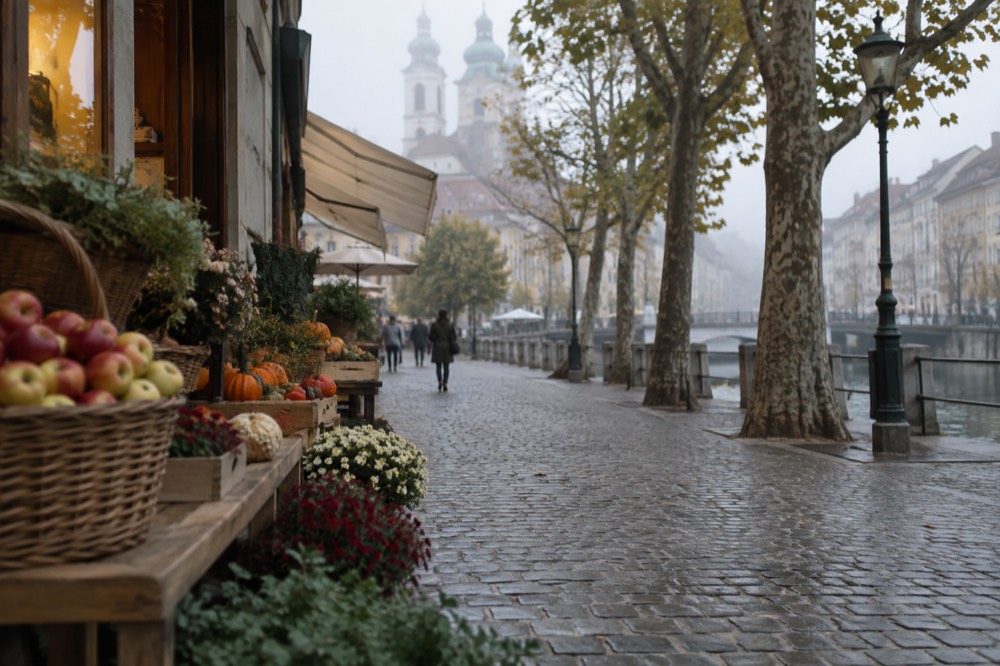
The shopping-specific numbers sit inside a wider cost picture, and the wider picture is covered in depth in our Ljubljana prices and Ljubljana on a budget guides. What matters here is the transport arithmetic that shopping trips actually run on, because the market, the centre and most shops are reached on foot or by bus, and the bus rules catch people out.
| Item | Figure | Note |
|---|---|---|
| Urbana card purchase | 2.00 EUR | One-off cost for the rechargeable card |
| Single bus ride, zone 1 | 1.50 EUR | 90 minutes including transfers |
| Cash accepted on buses | No | Contactless bank cards and phone wallets are accepted on board |
| Castle ticket including funicular | 19.00 EUR | Covers the Viewing Tower and exhibitions |
| Funicular only, return | 6.00 EUR | Single is 3.30 EUR |
| Ljubljanica river cruise | 15 EUR | Roughly 50 minutes with Barka, May to September season |
| Typical museum entry | 6.50-12 EUR | National Gallery permanent collection is 10 EUR |
| Tourist tax | 3.13 EUR per person per night | Applies to accommodation, not to purchases |
The card question is the one serious calculation, and it should be made with real numbers rather than enthusiasm. The card's 24-hour tier costs 41 EUR. A castle ticket with funicular is 19.00 EUR and a river cruise is 15 EUR, so those two alone are 34 EUR before a single museum. Add one paid museum at 7 to 10 EUR and the 24-hour card has paid for itself, provided you actually do all three inside 24 hours. The 48 and 72-hour tiers change the maths in favour of slower visitors.
| Card tier | Adult | Child 6-14 | What it includes |
|---|---|---|---|
| 24 hours | 41.00 EUR | 26.00 EUR | Castle funicular, river cruise, city buses, guided walking tour, BicikeLJ bike share for 4 hours, one entry each to more than 30 museums and galleries |
| 48 hours | 49.00 EUR | 31.00 EUR | Same inclusions, longer window |
| 72 hours | 54.00 EUR | 35.00 EUR | Same inclusions, longer window again |
The card auto-deactivates when its hours expire, and each included attraction can be entered once. It is sold in the city as a physical pass, and a bookable version exists through the usual listings with its own validity terms, which is worth a look if you would rather have it arranged before you land.
One purchase that behaves differently is the sightseeing version of the card sold as a bookable product, which is the same commercial idea delivered with hotel pickup logistics. Either way, the decision rule is the same: two anchor attractions plus one museum inside the window and the card wins.
Is Anything Open on Sunday in Ljubljana?
Sunday is the weakest shopping day in Ljubljana: the Central Market's outdoor stalls have only limited Sunday opening between April and November, the covered halls are shut, most private shops in the centre close or open briefly, while the castle, the funicular and most tourist-facing attractions run 365 days a year, so the Sunday strategy is to flip the day, attractions first and whatever market trading exists in the morning.
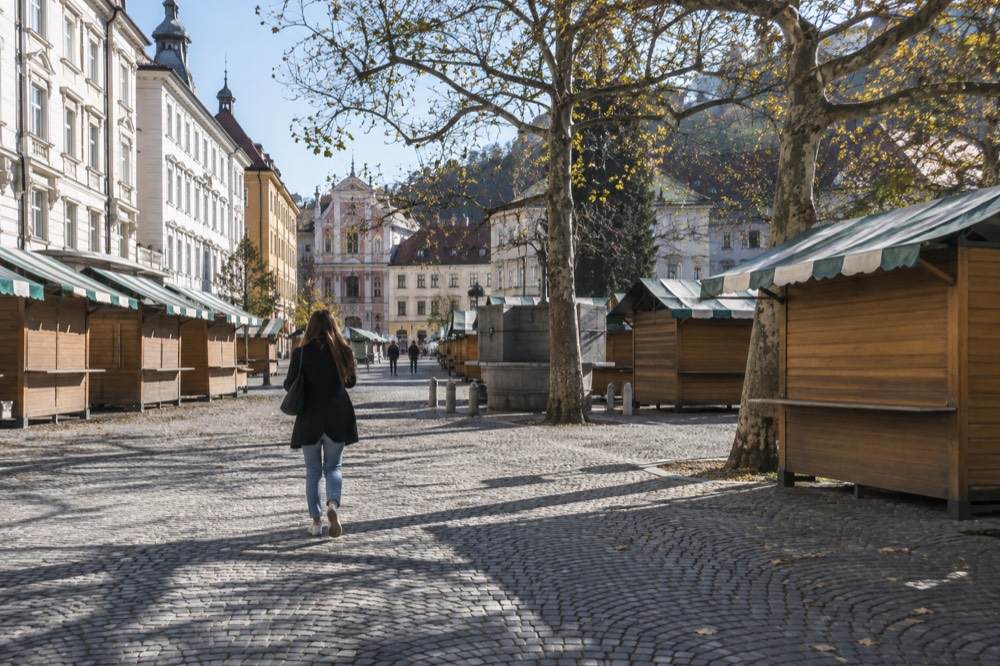
The Sunday pattern is European rather than Slovenian-specific, but Ljubljana's version is compact enough to plan around precisely. Between April and November the outdoor market at Pogačarjev and Vodnikov trg opens on a limited Sunday basis, which is genuinely useful for a weekend visitor, but the covered halls, where the pantry souvenirs live, do not, so Saturday 07:00 to 14:00 is the last reliable window for cheese and oil. Miss it and the food gifts have to come from a specialist shop in the centre instead. The wider set of guides lives on Ljubljana Travel Guide.
The attractions fill the gap. Ljubljana Castle and the funicular operate every day of the year, with the funicular running 09:00-19:00 from October through April and 09:00-22:00 from May through September, and last tickets sold an hour before closing. The riverside walks, the bridges and the whole pedestrian centre are, by definition, always open. If your two days in the city span a weekend, our weekend in Ljubljana guide sequences exactly this problem.
The other Sunday-specific fact worth knowing cuts the other way: the first Sunday of every month is free admission day at the national museums and galleries. On those Sundays the museum shops, which are the best book-and-print shopping in the city, are open and the buildings are free to enter, which makes a first Sunday the single best day on the calendar for museum-shop browsing. It is confirmed independently by the National Museum of Slovenia, the National Gallery, MSUM and the Slovenian Ethnographic Museum, each publishing it in their own words.
Which Museum Shops Are Worth Browsing?
The museum shops of Ljubljana are the city's best source of design-led souvenirs, books and prints, concentrated in the institutions around the centre and Metelkova, almost all closed on Mondays, open Tuesday to Sunday 10:00-18:00 with Thursday evenings to 20:00 at several of them, and free to enter on the first Sunday of each month even though the shops themselves charge nothing to walk into regardless.
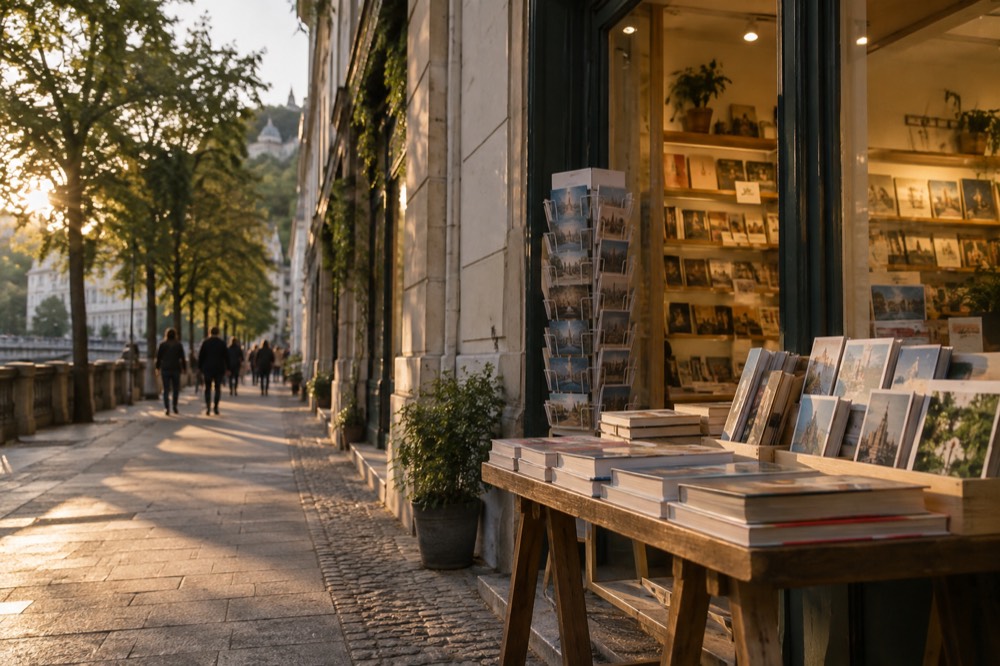
The pattern across the institutions is strikingly uniform, which makes it easy to plan. Nearly everything closes on Monday; nearly everything opens 10:00 to 18:00 the rest of the week; the National Gallery, the Slovenian Ethnographic Museum and the Natural History Museum extend to 20:00 on Thursdays. The Museum of Illusions runs daily 09:00-21:00, the exception that proves the rule, and it is a private attraction rather than a state institution.
| Institution | Closed | Hours | Adult entry |
|---|---|---|---|
| National Gallery | Monday | Tue-Sun 10:00-18:00, Thu to 20:00 | 10 EUR permanent, 6 EUR temporary, 14 EUR combined |
| Museum of Modern Art (Moderna galerija) | Monday | Tue-Sun 10:00-18:00 | 7 EUR |
| MSUM Metelkova | Monday | Tue-Sun 10:00-18:00 | 7 EUR, 10.50 EUR combined with Moderna galerija |
| City Museum of Ljubljana | Monday | Tue-Sun 10:00-18:00 | 10 EUR |
| Slovenian Ethnographic Museum | Monday | Tue-Sun 10:00-18:00, Thu to 20:00 | 8 EUR |
| Natural History Museum | none | Daily 10:00-18:00, Thu to 20:00 | 6.50 EUR |
| Plečnik House | Monday | Tue-Sun 10:00-18:00, guided tours on the hour | 12 EUR including guide |
| Museum of Illusions | none | Daily 09:00-21:00 | 16 EUR |
For shopping purposes the two that matter most are the Ethnographic Museum, whose shop carries the craft-adjacent objects and folk-design pieces the centre's souvenir streets do not, and the National Gallery, whose book selection is the strongest in the city for art and architecture titles. The Metelkova cluster has its own draw: MSUM sits inside the former barracks quarter, and the Metelkova autonomous cultural centre around it, free to enter with clubs setting their own covers, is the street-art end of the city's creative output, a place where the aesthetic you were trying to buy in a print is on the walls for nothing.
The Plečnik House shop deserves a special note because the house itself is guided-entry only with tours departing on the hour. You cannot wander in for a quick shop visit the way you can at the others; you take a tour, and the tour is worth taking. The castle funicular and the castle's own shop, meanwhile, give you the one museum-adjacent retail option that never closes on a Monday, since the castle is open 365 days a year.
How Does the Weather Affect Shopping in Ljubljana?
The weather matters more to shopping in Ljubljana than in most cities because the two best retail experiences, the open-air Central Market and the Open Kitchen street-food market, are weather-dependent, and the city's own climate record shows why: it averages 147 mm of rain in each of September and October, more than July's 115 mm, and 12.4 days of fog in each of those months on the 1971-2000 normals, so the shoulder season everyone assumes is dry is actually the joint wettest and foggiest.
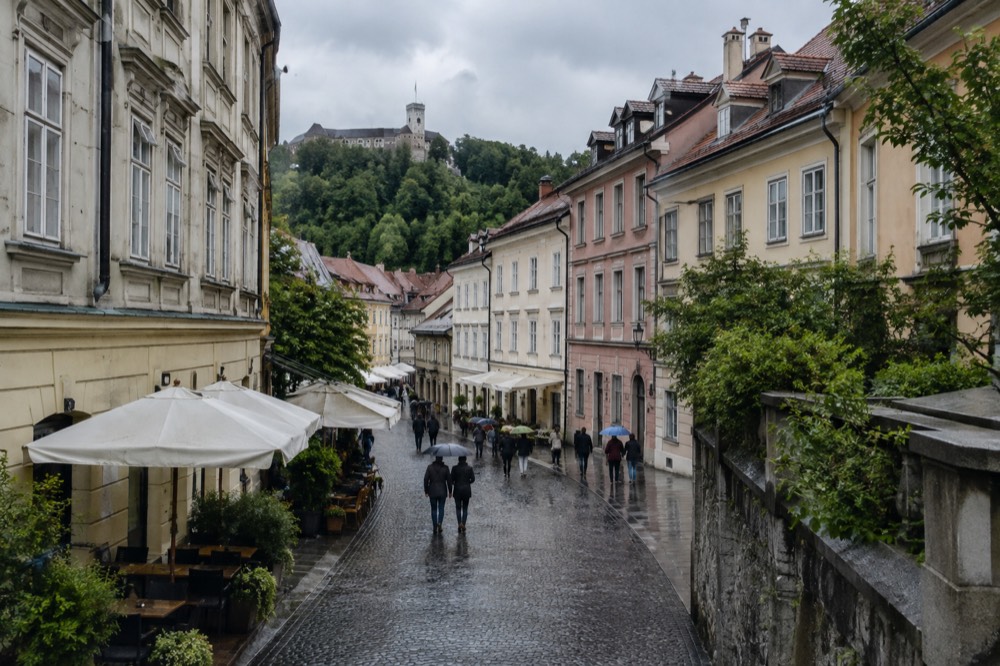
This is the fact that the first page of search results about Ljubljana does not tell you, and it reshapes a shopping itinerary. The basin the city sits in traps cold air under warmer air in the colder half of the year, and the fog statistics follow: 91.2 days of fog a year on the 1971-2000 series, with September, October and December clustered at the top and October averaging a single clear day a year on the 1981-2010 sunshine tables. The ARSO normals record 56 hours of December sunshine for the city against 120 hours at Kredarica at 2,514 m on Triglav, which is why the locals' answer to a grey Sunday is to go up rather than to stay in the basin.
For a shopper, that translates into three practical rules. First, do the outdoor market early in your stay, not on the last morning, because a wet or fogged-out market day can cost you the food gifts entirely and the covered halls close at 14:00 on Saturday. Second, treat the Open Kitchen Friday as conditional: the official description is "every sunny Friday" and it is meant literally, so check the forecast rather than the calendar. Third, hold the museum shops and the covered halls in reserve as the fog-day plan, since they are the parts of the retail city that do not care about the sky. Our rainy day in Ljubljana guide is built on exactly this.
There is one retail category that the fog cannot touch, and it is the strangest useful fact in the region: the caves. Postojna Cave holds about 10 C year round, the Škocjan Caves about 12 C, whatever the month, which is why the caves are the standing answer to both a heatwave and a washout. Their gift shops, unlike anything in the city, are open every day including holidays and in bad weather, and the Postojna site states it explicitly.
Can You Combine Shopping with a Day Trip from Ljubljana?
Yes, and it is the natural shape of a Ljubljana visit: the shopping centre is compact enough that a morning covers the market and the museum shops, leaving the afternoon or the whole next day for the country's two headline retail-adjacent draws, the Lake Bled day trip and the karst caves, both bookable as organised tours from the city and both Schengen-internal travel with no border checks and no currency to change.
The logic follows from the visitor numbers. With an average stay of about 2.04 nights, most people in Ljubljana are pairing one day in the city with one day out, and the city's compactness makes the shopping genuinely a half-day activity. Bled carries more search demand than the city itself, so for many visitors the trip out is the main event and the market morning is the bonus. Our day trips from Ljubljana guide ranks the full field.
For shopping-flavoured day trips, the strongest are the ones that end somewhere with something to carry home. Piran on the coast brings salt-pan salt and coastal wine back on the same coach; the Vipava Valley wine tours are effectively a shopping trip with a driver, winery-hopping direct from Ljubljana and returning with bottles that beat anything you can buy in a city centre at the same price. The Piran guide and the wine listings on this site cover both.
| Day trip | What you bring back | Duration as a tour | Weather dependence |
|---|---|---|---|
| Lake Bled | Cream cake eaten on the spot, local honey and wine | About 5 to 6 hours | Low; the lake is a rain-tolerant landscape |
| Postojna Cave and Predjama | Cave-shop souvenirs, karst wine and prosciutto from the region | About 5h 30m to 6 hours | None; the cave holds about 10 C in any weather |
| Škocjan Caves and Piran | Salt, olive oil, coastal wine | About 9h 30m to 10h 30m | Low; the cave is all-weather, Piran is coastal |
| Vipava Valley | The wine you tasted, bought at the cellar door | About 5 hours | Low; cellar visits are indoors |
| Soča Valley and Kranjska Gora | Little; it is a landscape day | About 10 hours | Moderate; valley fog and rain |
The cave-and-castle trip is the one most first-time visitors book out of the city, and it doubles as the best bad-weather day trip in the country, for the temperature reason above. Predjama Castle is open year round and the two pair naturally, and the versions that run from Ljubljana handle the transfer and the ticket logistics in one purchase.
Between the cave and the lake there is also the small-group Bled option, which trades some flexibility for intimacy, taking in the castle and the island in about five and a half hours. Whichever you pick, the pattern holds: shop in the morning, because the market will not wait, and leave the afternoon to the country.
Common Questions About Shopping in Ljubljana
What are the main shopping streets in Ljubljana?
The shopping happens across the pedestrianised historic centre, roughly 20 hectares closed to general traffic in stages since 2007, running from Prešernov trg through the Old Town streets to the Central Market on Vodnikov and Pogačarjev trg. There is no separate out-of-centre retail district visitors need; it is all walkable.
What time does the Central Market close?
The outdoor stalls run roughly Monday to Saturday 06:00-18:00 in summer and 06:00-16:00 in winter, with limited Sunday opening April to November. The covered halls open Monday to Friday 07:00-16:00 and Saturday 07:00-14:00.
Is shopping in Ljubljana expensive?
Everyday costs are moderate and priced in euro. A zone 1 bus ride is 1.50 EUR, museum entries mostly run 6.50-12 EUR, and the food gifts the market is best for are modestly priced. The Ljubljana Card at 41 EUR for 24 hours pays for itself if you combine the castle, the river cruise and one museum inside the window.
Can you shop on Sundays in Ljubljana?
Limited. The outdoor market has some Sunday opening April to November, most private shops in the centre close or open briefly, and the covered market halls are shut. The castle, funicular and pedestrian centre run every day, and the first Sunday of each month is free admission at the national museums, whose shops are open that day.
What should you buy as a souvenir from Ljubljana?
Edible goods: Slovenian honey, pumpkin seed oil, wine and herbal spirits, and market-bought cheese and cured meats, bought mainly at the Central Market halls or specialist food shops in the centre. For non-food souvenirs the museum shops carry the best books, prints and design pieces.
Do shops in Ljubljana take cards?
Card acceptance in the centre is normal, and city buses accept contactless bank cards and phone wallets. The one place cash never works is on board a bus: no cash is accepted at all, so you need an Urbana card or a contactless payment method.